Need help?
Do you have a question about the ABB Turbocharger A130-M and is the answer not in the manual?
Explains how the turbocharger is fitted correctly and safely.
Identifies engineers and mechanics responsible for fitting.
Explains symbols used in the document for clarity.
Defines warning, caution, and note symbols and their meanings.
Explains mandatory signs and pictograms for safety and procedures.
Overview of safety, CE conformity, residual risks, and operating company responsibilities.
Safety procedures and warnings for lifting turbocharger components.
General safety measures, risk of falling, and specific hazards.
Details mechanical hazards and risks from operating materials.
Provides weights for different turbocharger models and transport guidelines.
Instructions for correctly inserting gaskets to prevent oil leaks.
Details on fitting threaded rods onto the bracket, including dimensions.
Steps for positioning and aligning the turbocharger on its mounting bracket.
Procedures and specifications for fastening using standard nuts.
Steps to prepare for tightening clamping nuts, including CAUTIONS.
Detailed procedure for tightening clamping nuts.
Steps for tightening pressure screws in a specific sequence and torque.
Instructions for connecting cables, gas, water, and air lines.
Steps for attaching the optional support bracket to the engine.
Guidelines for storing turbochargers for up to 6 months.
Procedures and warnings for long-term storage and VCI handling.
Details on long-term storage preparation and unpacking procedures.
Guides users to the Operation Manual for commissioning and maintenance.
Instructions on locating and downloading the Operation Manual online.
Provides contact phone, fax, email, and website for ABB Turbocharging.
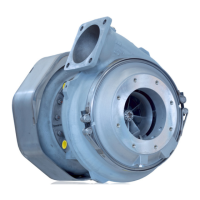
The document describes the ABB A100-M radial turbocharger, an essential component designed to enhance engine power and fuel efficiency. These assembly instructions are specifically tailored for the A100-M series, including models A130-M, A135-M, A140-M, and A145-M. The primary function of the turbocharger is to increase the power output of an engine by forcing more air into the combustion chamber, leading to more complete combustion and improved performance.
The ABB A100-M radial turbocharger is designed to be correctly fitted to an engine, ensuring optimal performance and safety. It operates by utilizing exhaust gases to drive a turbine, which in turn powers a compressor. This compressor draws in ambient air, compresses it, and then delivers it to the engine's intake manifold. This process, known as forced induction, allows the engine to burn more fuel and air in each combustion cycle, resulting in increased power and torque without significantly increasing engine displacement. The document highlights that the A100-M turbocharger contributes to "More power, less fuel," underscoring its efficiency benefits. The turbocharger can feature either an oil-cooled or water-cooled bearing casing, depending on the specific variant, to manage operating temperatures effectively. The assembly process involves careful insertion of gaskets to prevent oil leaks, fitting threaded rods for secure mounting, and precise positioning on the engine bracket.
The assembly instructions are intended for engineers and mechanics responsible for the installation of the turbocharger on the engine, requiring basic mechanical training. Key usage features revolve around the correct and safe installation of the device. The document emphasizes the importance of using new gaskets and inserting them carefully to ensure proper sealing for oil supply and drain connections. Threaded rods, which are not included in the ABB scope of delivery, must be lightly oiled and screwed into the bracket with the aid of locknuts. The turbocharger is then placed on the bracket, aligning with positioning pins to prevent incorrect fitting, especially for water-cooled bearing casings. Fastening can be done with either standard nuts or clamping nuts, with specific tightening torques and procedures provided for each variant. For clamping nuts, pressure screws are equipped with a permanent sliding layer and must not be cleaned or lubricated to ensure the necessary tension force is reached. The installation also involves connecting the speed sensor cable, and all gas, water, and air lines according to the engine builder's instructions. For versions with water-cooled bearing casings, water pipes must be fitted, and for compressor wheel cooling, the cooling air line must be connected after removing a screw plug. An optional support can be attached to the engine support or a connecting piece.
The document provides detailed guidelines for the storage and long-term maintenance of new turbochargers and spare parts, crucial for preserving their condition and functionality. New turbochargers and spare parts can be stored in sealed packaging with a Volatile Corrosion Inhibitor (VCI) label for up to 6 months from the date of delivery without additional mothballing measures. Storage must be in dry rooms with relative humidity between 40% and 70%, free from condensation. For storage exceeding 6 months, specific mothballing measures are required every 6 months: opening the package, removing and replacing the VCI corrosion protection emitter with a new, identical one (available from www.branopac.com), disposing of the old emitter environmentally, and resealing the package securely.
For prolonged storage, turbochargers can be specially prepared by ABB Turbocharging upon request, and the package will include a hygrometer. Every 6 months, the hygrometer in the sight-glass must be checked through an opening in the wooden crate. If the display field at the 70% level has changed color, indicating exceeded maximum permissible humidity, the turbocharger must be inspected and repacked by an ABB Turbocharging Service Station. The package itself should also be inspected for damage, and if found, the turbocharger requires inspection and repacking by a service station. After every 3 years, an ABB Turbocharging Service Station must perform a comprehensive inspection of components, replace the desiccant agent, and repackage the components. If the hygrometer's 70% display field has not changed color and the package is undamaged, the turbocharger can be put into operation without prior testing by an ABB Turbocharging Service Station. When unpacking turbochargers, the corrosion protection effect ends, and it's advised that the surroundings and package contents have the same temperature to prevent condensation. The Operation Manual, which contains further information on commissioning, operation, maintenance, and ordering spare parts, is available online using the turbocharger's serial number found on the rating plate.
 General
| Model | A130-M |
|---|---|
| Manufacturer | ABB |
| Category | Turbocharger |
| Engine power range | Up to 3000 kW |
| Application | Marine and Power Generation |
| Type | Industrial |

 To Next Page