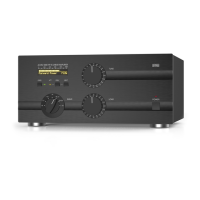
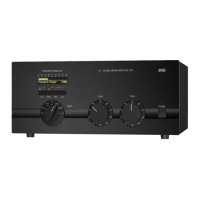
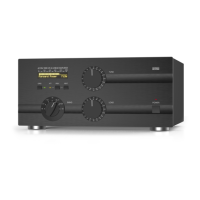
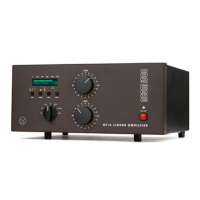
d) Tuning hint. A benefit of TRI is that the knob positions are virtually independent. The plate-load
resistance decreases to the right and increases to the left of the TRI center. A centered tuning indication
corresponds to the proper LOAD capacitor tuning, which presents an optimum load resistance to the
If the LOAD knob is turned to the left with a centered TRI, there will be more gain, but less linearity.
When available drive power is insufficient or when less output but better efficiency are needed, e.g.,
for RTTY and SSTV, this may be desirable. Tuning to the right of the center would lead to the opposite
result, i.e., less gain and more power attainable. Of course, this requires more drive power, more plate
current, and more plate heat, which shortens tube’s-expected life. Off -center tuning may also be used to
compensate for line (mains) voltage variations in order to maintain tube efficiency. In that case, tune to
the left when line (mains) voltage is high, or tune to the right if it is low. However, where there is more
than a 10% difference from the nominal line (mains) voltage, the voltage selector inside the amplifier
should be changed. See Section 2-2 (Line Voltage Selection).
4-6 The Auto-Protection System
When any abnormal amplifier condition is detected by the auto-protection microprocessor, the risk will
be evaluated automatically and either of two levels of protection will be applied:
a) The first degree of protection consists of an illuminated LED warning. These include the yellow LED
warnings discussed earlier, i.e., “G1” (grid 1), “G2,” (grid 2), and “IP” (plate). Operation may be continued
but the amplifier is likely to proceed to the second degree of protection, the trip.
b) The second degree of protection is a trip to the standby mode. The red “F” (fault) LED illuminates
and the amplifier automatically goes to the standby mode for several seconds. Also, the green
LED goes off. The amplifier will indicate the reason for the protection trip:
- if one of the yellow (G1, G2, IP) warning LEDs is illuminated along with the “F” LED, a current limit
has been exceeded; drive power must be reduced or retuning is necessary;
- if the last red LED of the reflected-power bar-graph is illuminated together with the “F” LED, the
reflected-power limit has been exceeded; the drive must be reduced or the antenna VSWR must be
- if all three LEDs of the TRI are flashing simultaneously together with the “F” LED, the tuning is not
adjusted correctly; most likely the antenna impedance has changed and retuning is required.
Fault information normally remains on the display for several seconds while the amplifier is in the standby
mode. The auto-operate function will attempt to return the amplifier to the operate mode automatically.
If the protection trips repeatedly, the user must attend to the cause of the trip, which is typically too
much drive or antenna mismatch.
If all LEDs in the bar-graph window are flashing simultaneously, you must immediately
switch off the amplifier to avoid damage.


 To Next Page