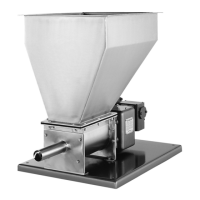
As an option, all of Acrison’s various model volumetric feeders are available with precision SCR/DC
variable speed drives employing tachometer feedback for precise speed control and regulation. However,
when Acrison volumetric feeders equipped with variable speed DC drives are utilized as the metering
mechanism of an Acrison weigh feeder, the weigh feeder control scheme includes tachometer feedback
as a standard feature.
Two different type digital tachometers are furnished by Acrison
…
an Optical Tachometer (45) and a
Magnetic (Pulse) Tachometer (110). The Optical Tachometer (45) couples directly to the high speed shaft
extension of the Gear-reducer (2), as shown in Figure 6. The Magnetic Tachometer (110) installs
between the Gear-reducer (2) and its drive Motor (1), as shown in Figure 7.
Optical Tachometer
Please refer to Figure 6.
4.9.1
When an Acrison volumetric feeder is equipped with a variable speed DC drive including a digital
Tachometer (45), a specially designed Gear-reducer (2), equipped with a high speed extension
shaft, is utilized to drive the tachometer. This high speed shaft is basically an extension of the
motor input shaft of the gear-reducer that extends out of the Gear-reducer (2), directly opposite
the DC motor, to drive the tachometer at the same speed as the motor. The appropriate
tachometer housing, dust-tight, water-tight or explosion-proof, attached to the Gear-reducer (2),
encloses the high speed extension shaft and the tachometer to which the gear-reducer’s high
speed shaft couples.
NOTE:
Due to the very small gauge (thickness) of digital tachometer wires, all connections to
the tachometer must be soldered to ensure proper operation.
4.9.2 Figure 6, Assembly “A”
illustrates Acrison’s standard tachometer mounting arrangement in a
dust-tight or water-tight enclosure. A stainless steel Spring Coupling (47) has been selected to
connect the Tachometer (45) to the High Speed Extension Shaft (48) of Gear-reducer (2) because
of the negligible amount of radial force such a coupling applies to the shaft of the tachometer, plus
the fact that these particular tachometers only require an extremely small amount of torque to
rotate. The Spring Coupling (47) slips over the flat surfaces machined onto both the High Speed
Extension Shaft (48) of Gear-reducer (2) and the tachometer shaft. Tachometer housings are
normally manufactured of aluminum, and the standard assembly is dust-tight.
To remove the Tachometer (45), first remove the Cover (44) of the Tachometer Housing (43).
[Please note that dust-tight and water-tight tachometer housing covers are bolted-on as shown in
the illustration, Assembly “A.” An Explosion-Proof Tachometer Housing (54), as illustrated in
Assembly “B,” includes a threaded cover.] Once the Tachometer Housing Cover (44) has been
removed, remove the Tachometer Mounting Plate (46) onto which the Tachometer (45) attaches.
The Spring Coupling (47) will simply slide off either the tachometer shaft or the High Speed
Extension Shaft (48) of Gear-reducer (2). The Tachometer (45) is secured onto its Mounting Plate
(46) with several small screws.
To reassemble, reverse the preceding procedure.
During reassembly, be certain to properly
align the flats on both ends of the Spring Coupling (47) onto the flats of each shaft to which it
attaches. Tachometer wiring information is included within the instruction manual for the specific
model SCR/DC controller being utilized.
4.9.3 Figure 6, Assembly “B”
illustrates an explosion-proof tachometer mounting arrangement. A
stainless steel Spring Coupling (47) is used to connect the High Speed Extension Shaft (48) of
Gear-reducer (2) to the Tachometer (45) through an intermediary Adapter Shaft Assembly (49). A
spring coupling has been selected for use because of the negligible amount of radial force such a
coupling applies to the shaft of the Tachometer (45), plus the fact that these particular
tachometers only require an extremely small amount of torque to rotate. The Spring Coupling (47)
slips over the flat surfaces machined onto both the High Speed Adapter Shaft (53) and the
18



 To Next Page