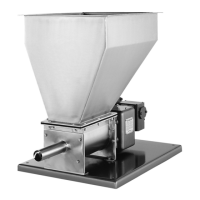
4.10 Feeders with Quick-Clamp Construction
Model 105 Series Volumetric Feeders which include Quick-Clamp Construction are designed for the rapid
removal and cleaning of all major components without the need for tools. Disassembly and reassembly is
basic and obvious in the utilization of quick-clamps and knurled knobs and therefore, specific instructions
relating to disassembly/reassembly (of the major components) are not provided. All other
design/functional parameters of the equipment, however, are identical. Sanitary feeders include
Quick-Clamp Construction as a standard feature.
5.0 SAFETY INTERLOCKS
Certain feeders may include a safety interlock (or interlocks).
If a single interlock to prohibit mechanical operation is provided, the interlock may be a magnetic clutch
installed between the motor and gear-reducer that powers the feeder’s mechanism. By removing power to
the clutch, accomplished by a lockable switch, the operating mechanism of the feeder will not function,
even if the motor was somehow energized. Please refer to Figure 5.
If a number of individual interlocks are provided, each applicable component of the feeder (typically those
which can be opened and/or removed via quick-clamps or threaded knobs) and which, when opened or
removed exposes the operator to potential danger, includes an interlock switch, any of which disconnects
power to the feeder’s motor driven mechanism. Various types of interlocks are available, the selection of
which is usually determined by application parameters or user preference.
6.0 MAINTENANCE—General
²
WARNING:
Disconnect the feeder from all power sources prior to performing
any maintenance whatsoever.
Acrison’s Model 105 Series of Volumetric Feeders have been designed to eliminate as much
maintenance as possible; however, the following normal preventative procedures should be observed:
6.1 Bearings
All bearings furnished with grease fittings are factory lubricated but should be periodically inspected and
greased to maintain a slight leakage at the seals. The suggested lubrication schedule is once every six
months when operating twenty-four hours per day. The grease should be of high quality and medium
consistency. Permanently lubricated bearings do not require any lubrication and are designed for a
minimum of five years of operation under normal operating conditions.
6.2 Gearbox (3)
Gear lubrication for the Gearboxes (3) of Model 105 Feeders should be checked at least once every six
months when operating continuously, or at intervals found to be appropriate (based on equipment usage)
to ensure that an adequate coating of grease exists on the gears at all times. Manual lubrication is
accomplished by applying a heavy-duty gear grease (such as Keystone Moly 29 or equivalent) to the
gears with a brush, with volume and frequency determined by periodic inspection. It is important to
maintain adequate grease on the gears to avoid undue wear.
20



 To Next Page