100
Tip:
When laying the boundary wire
around the flower beds, it is important
to remember how flowers and plants
change throughout the seasons, so that
at any time of year there is space for the
robotic mower to pass the bed without
damaging the plants (some plants/flow-
ers may overhang the lawn).
Also be aware that using the boundary
wire around many flower beds in the
middle of the lawn may mean that you
don’t have enough cabling to reach
all the way around. Check this when
sketching the garden. Extra boundary
wire can be purchased.
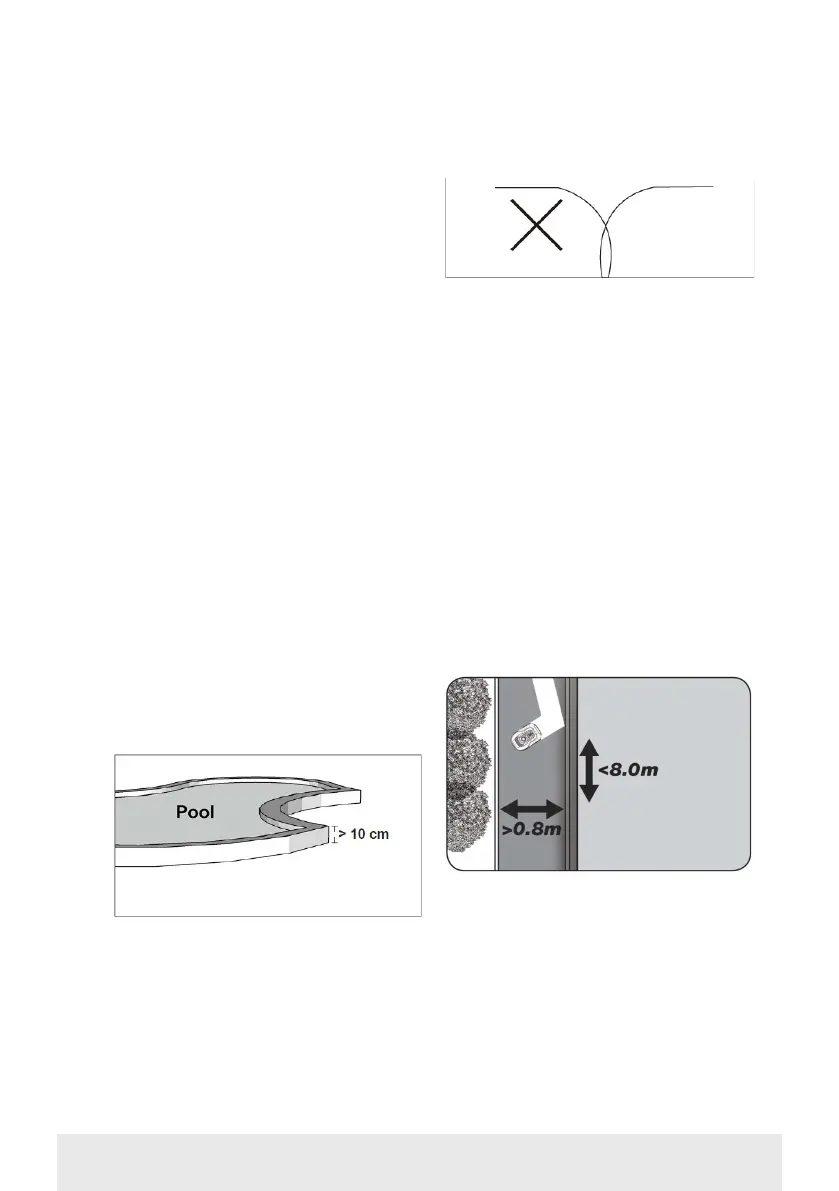
Garden ponds and swimming pools.
Naturally, the robotic mower cannot be
submerged in water. If the garden pond
or swimming pool does not have a high
edge as shown in the picture (at least 10
cm), it must be isolated by the boundary
wire or alternatively, a fence must be
erected around the pool.
If boundary wire is chosen to isolate the
pool, it is important that the distance to
the water's edge is increased from the
normal >20 cm to 1 metre to prevent
the robot from slipping over the edge in
wet weather.
Note
Do not lay the boundary wire in parallel
over an ordinary power cable. The
electric field in the power cable can
interfere with the signal in the bound-
ary wire! When isolating obstacles with
the boundary wire, it is important that
the cable does not cross itself, as this
will prevent the robotic mower from
following the correct direction.
Corridor
If the mowing area has a narrow corri-
dor, there are certain minimum targets
that must be met for the robotic mower
to run optimally. If the width is only
0.8-1 m, the maximum length should be
8 m. In general, the corridor should not
be narrower than 0.8 m at any point.
Driving in narrow corridors uses more
power as the robot has to turn many
times.
If the corridor is narrower than 0.8
metres, the robot cannot manoeuvre
around it properly and the area must be
removed from the cutting area using
the boundary wire.
REMEMBER: The boundary wire must
NOT cross itself at any time.
Now that you've laid the boundary wire,
carefully observed all spacing measure-
ments and you're happy with the way
the wire is laid in your garden, it's time
to fix the pegs. Take your hammer and
hammer the plastic pegs firmly into the
ground. Make sure you hold the cable
tightly when fixing the pegs so that the



 To Next Page