98
Stones
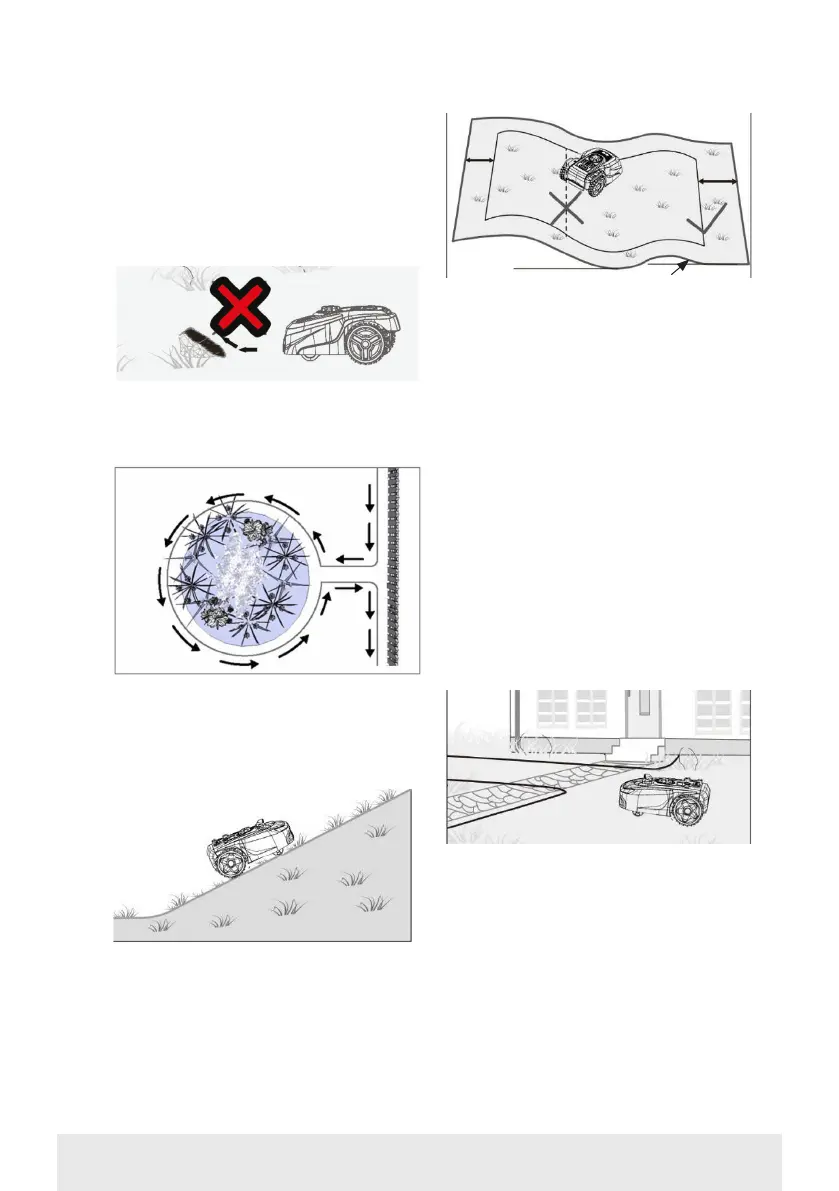
If there are stones in the robot's cutting
area, it is important to assess whether
the edge of the stone is higher or lower
than 100 mm, as well as whether the
stone needs to be protected or not. This
is to avoid damaging the robot.
When isolating individual objects, it is
important to follow the direction from
which you started.
Slopes
The robot lawnmower can drive up and
down slopes with a maximum gradient
of 20° (or 36%).
36% (20
o
)
If there is a direct descent towards the
boundary wire, the slope must not
exceed 10° gradient to prevent the robot
from driving over the wire if there is
low friction in the grass.
30 cm
40 cm
17% - 40%
< 10% incline
If the robotic mower drives down
towards the boundary wire from an
incline greater than 10°, there must be a
minimum of 2 metres from the edge of
the slope to the boundary wire.
Paths, driveways and paving
If there is a walkway or driving area in
the robot's cutting area that is at a dif-
ferent level from the lawn, you should
try to prevent the robot from driving
over this area in an attempt to get to
the grass on the other side. Instead,
boundary wire should be laid at least 20
cm from the walkway.
If the lawn and walkway/driveway are
at the same height, you can let the robot
drive over the area using the boundary
wire.
Cutting along paving
If the paved area is flat and level with
the lawn, you can let the robot drive out
a little onto the walkway with one wheel
so that it can cut the area over the edge
of the lawn. Here, you should lay the
boundary wire with 8 cm distance to
the edge.


 To Next Page