Need help?
Do you have a question about the ADLINK Technology SMARC LEC-MTK-I1200 and is the answer not in the manual?
Provides legal information about ADLINK products and intellectual property rights.
Details ADLINK's commitment to environmental preservation and compliance with RoHS and WEEE directives.
Warns about chemical exposure from the product and links to P65Warnings.ca.gov for more information.
Lists product names used for identification purposes only.
Essential guidelines for safe handling, installation, and operation of the equipment.
Defines symbols used to convey important information, warnings, and cautions.
Provides contact details for ADLINK's global offices for customer support and inquiries.
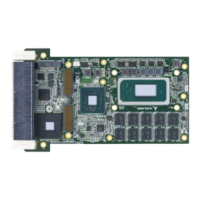
Introduces the SMARC module based on MediaTek Genio 1200, highlighting its AI capabilities and target applications.
Describes the SMARC ("Smart Mobility ARChitecture") standard, its features, sizes, and modular approach.
Details the SoC, AI Accelerator, Memory, Cache, and Security features of the module.
Covers GPU core, VPU core features, and graphics acceleration capabilities.
Lists supported display interfaces including MIPI DSI, eDP, and HDMI.
Details the MIPI CSI camera input support.
Mentions support for on-carrier I2S codec.
Describes the primary and secondary LAN interfaces.
Notes support for Wi-Fi/Bluetooth via M.2 1216 footprint.
Lists supported expansion buses like PCIe, USB, and UART.
Details CAN bus, SPI, I2S, I2C, and GPIO interfaces.
Covers SDIO and UFS storage capabilities.
Describes the debug header (DB30) and fan control features.
Specifies the power input voltage.
Details operating temperature, humidity, EMI, and shock/vibration resistance.
Provides MTBF figures for the module under different conditions.
Lists all signal pins on the MXM 3 connector, indicating supported and unsupported signals.
Explains the meaning of terms used in signal description tables, including abbreviations and signal types.
Details signal functions organized by interface type, such as display and camera.
Details HDMI port signals and their functions for display output.
Details DP port signals and their functions for display output.
Describes MIPI CSI camera interfaces, including CSIO (2 lanes) and CSI1 (4 lanes).
Details the I2S signals for audio input and output, including synchronization and clock signals.
Lists all USB ports, their types (USB 2.0, 3.1, OTG), and associated signals.
Details the Peripheral Component Interconnect Express (PCIe) interfaces and their configurations.
Describes the Gigabit Ethernet (GBE) LAN ports, including primary and secondary interfaces.
Explains the Secure Digital Input/Output (SDIO) interface and its usage.
Details the Serial Peripheral Interface (SPI) modes and signals.
Lists General Purpose Input/Output (GPIO) pins and their functions.
Covers CAN bus signals and miscellaneous interface functions.
Details signals related to power supply, battery, sleep states, and system control.
Explains the boot selection pins and their influence on the module's boot process.
Lists power input voltage (VDD_IN) and ground (GND) pins, and RTC backup power.
Indicates the latest release of the Yocto Project supported by the module.
Specifies the supported Android version (Android 13).
Highlights support for Arm NN and TFlite models for AI processing.
Provides detailed physical dimensions and mounting hole information for the module.
Describes the heatspreader solution for thermal management, including its specifications and operating range.
Details the heatsink solution for thermal management, including its specifications and operating range.
 General
| Form Factor | SMARC |
|---|---|
| GPU | ARM Mali-G57 MC5 |
| Memory | Up to 8GB LPDDR4X |
| Storage | eMMC 5.1 up to 64GB |
| Connectivity | Wi-Fi 6, Bluetooth 5.2 |
| Processor | MediaTek Genio 1200 |
| CPU Architecture | ARM Cortex-A78/A55 |
| Ethernet | 1x Gigabit Ethernet |
| Operating Temperature | 0°C to 60°C |
| Power Input | 5V DC |
| I/O Interfaces | 2x USB 3.2, 2x UART, 2x I2C, 1x SPI, 4x MIPI-CSI |
| Operating System | Linux, Android |


 To Next Page