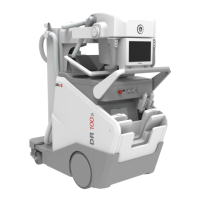
DX-D 100 Mobile X-ray Unit
User Manual
A-2
Appendix A
Positioning the pediatric patient: Pediatric patients are not as likely as adults
to understand the need to remain still during the procedure. Therefore, it makes
sense to provide aids to maintaining stable positioning. It is strongly
recommended the use of immobilizing devices such as bean bags and
restraint systems (foam wedges, adhesive tapes, etc.) to avoid the need of
repeating exposures due to the movement of the pediatric patients. Whenever
possible use techniques based on the lowest exposure times.
Shielding: We recommend you provide extra shielding of radiosensitive
organs or tissues such as eyes, gonads and thyroid glands. Applying a
correct collimation will help to protect the patient against excessive radiation as
well. Please review the following scientific literature regarding pediatric
radiosensitivity: GROSSMAN, Herman. “Radiation Protection in Diagnostic
Radiography of Children”. Pediatric Radiology, Vol. 51, (No. 1): 141--144,
January, 1973: http://pediatrics.aappublications.org/cgi/reprint/51/1/141.
Technique factors: You should take steps to reduce technique factors to the
lowest possible levels consistent with good image acquisition.
For example if your adult abdomen settings are: 70--85 kVp, 200--400 mA,
15--80 mAs, consider starting at 65--75 kVp, 100--160 mA, 2.5--10 mAs for a
pediatric patient. Whenever possible use high kVp techniques and large SID
(Source Image Distance).
Summary:
Image only when there is a clear medical benefit.
Image only the indicated area.
Use the lowest amount of radiation for adequate imaging based on size
of the child (reducing tube output -- kVp and mAs).
Try to use always short exposure times, large SID values and
immobilizing devices.
Avoid multiple scans and use alternative diagnostic studies (such as
ultrasound or MRI) when possible.



 To Next Page