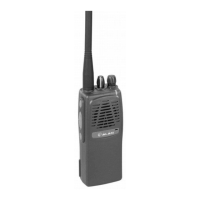
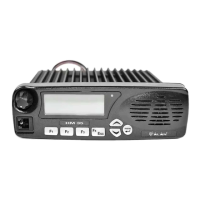
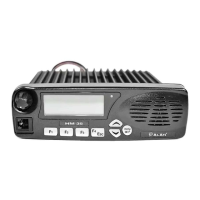
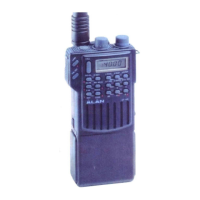
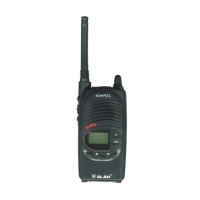
HP105/HP405 User manual
Page. 11
Basic Operations
This section describes how the standard operations work. Standard operation can be changed by
programming, moreover the functions the radio includes can be modified via an IBM compatible PC. For
this reason the way your radio operates may be upgraded and may slightly differ from what is described
here.
!
IMPORTANT: Due to the full programmability of the radio, certain commands could be
unavailable. In case of doubts please contact your dealer/radio network administrator for further
details.
Switching the radio ON/OFF
To switch the radio on:
1) Rotate the PWR/VOL knob clockwise until the radio is switched on: the CPU will start an autotest
showing in sequence:
• LED will light GREEN, then RED and finally OFF.
• A beep confirms that the autotest is passed
!
The self-test goes very fast, therefore the LED could not be seen.
To switch the radio off just rotate the PWR/VOL knob anticlockwise.
Adjusting volume
The PWR/VOL knob is used to adjust the RX volume: just turn it clockwise to increase or anticlockwise to
reduce it.
Channel selection
If your radio has been programmed with more than one channel you can easily change it. To select a
channel, turn the channel selector knob clockwise or anticlockwise until the channel indicator on the knob
matches the wished channel.
Reception
Your radio could be previously programmed to work, channel by channel, in “Open traffic” or “GROUP
MODE (CTCSS/DCS)”. Please have a look to each description and ask your radio network manager or
dealer which mode your radio channels work.
• OPEN TRAFFIC: in this case you will hear any communication which will be transmitted on the
selected channel. When the right carrier is received your squelch will unmute, you will see the status
LED glowing green and you will hear the message.
• GROUP MODE:
• CTCSS/DCS (Continuous Tone Code Squelch System - Digital Coded Squelch): they are systems
which use particular TX signalling (a continuous sub audio tone for CTCSS or a digital code for
DCS) as an access “key” to work a repeater (encoder) or to unlock the party’s signalling sensitive
squelch. This last condition allows to share more radio networks in the same frequency. In this
case you will receive only messages coming from parties sending a proper TX signalling. During
CTCSS/DCS operation the radio may be set-up so that the appropriate CTCSS/DCS decoder



 To Next Page