RFID TAG READER CHAPTER 3
ALR-H450 USER GUIDE
DOC. CONTROL #8102146-000 REV A
Tag Access Utility
The Tag Access utility allows you to read from and write to specific portions of a tag’s memory. The
utility is divided up into two separate tabs: the Basic tab and the Advanced tab. The Basic tab gives
a quick overview of the tag’s memory layout, and gives you basic ability to write new data to the tag.
The Advanced tab gives full access (bank, start pointer, and length) over the low-level writing and
reading operations, as well as controls for locking and unlocking specific portions of tag memory.
EPC Gen2 tag memory is divided up into four distinct banks: Reserved, EPC, TID, and User. The
Reserved bank contains the tag’s Access password and Kill password (each two words long),
though all tags may not support both passwords. The EPC bank contains the tag’s “id” – its
Electronic Product Code (or “EPC”) – along with some other information related to the EPC. The
TID bank is read-only, and contains information about the tag’s manufacturer, model, and basic
capabilities. Alien Higgs tags contain bits in the TID bank that are guaranteed to be unique from one
tag to the next. The User bank may not be present in all tag types, and when present, each tag
provides different amounts of available user memory.
Basic Access Tab
The Basic Access tab has text fields for each of the separate fields of tag memory. Clicking the
Read button (or pulling the pistol-grip trigger) causes the reader to try and read all of the data for
each of the fields, from whatever tag is in the field. The separate fields fill in, one-by-one, as the
data is read. Since there is no definitive way of knowing how much User memory a tag has, the
reader simply reads the User data two words (32 bits) at a time, until a failure occurs.
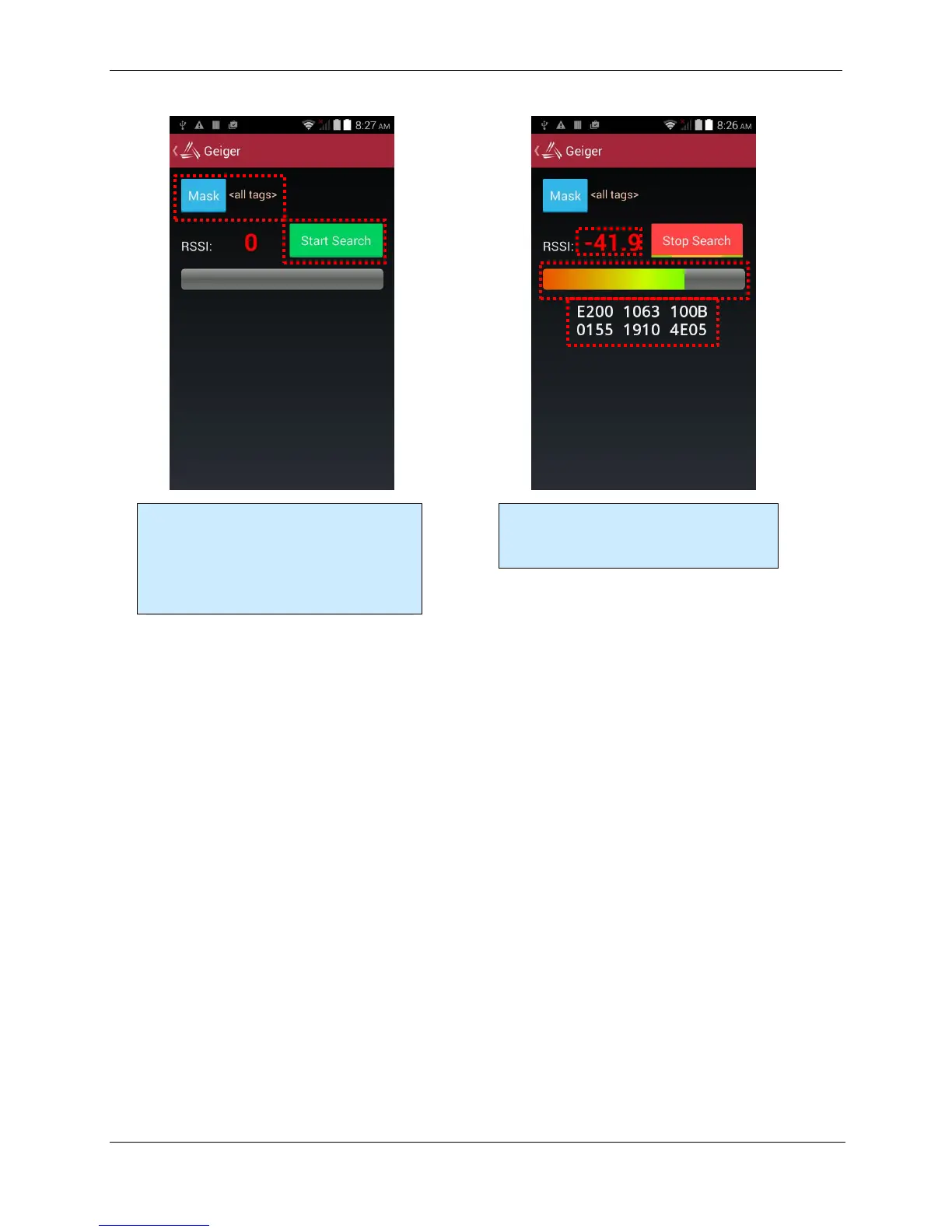
The Geiger will show the tag’s signal strength.
Use the Start Search button (or pistol-grip
trigger) to start the search.
Use the Mask button to refine your search to
specific tags.
When a tag is read, its EPC is displayed on the
screen, along with graphical and numeric
readouts of the tag’s return signal strength.



 To Next Page