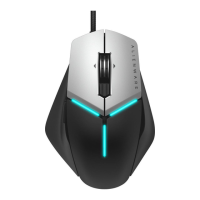
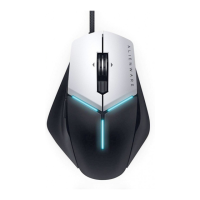
The Alienware Advanced Gaming Mouse AW558 is a wired gaming mouse designed for use with Microsoft Windows 10 and above. It offers a range of customizable features to enhance the gaming experience, including adjustable DPI settings, programmable buttons, and customizable lighting effects, all managed through the Alienware Control Center software.
Function Description
The Alienware AW558 mouse serves as a primary input device for gaming and general computer use. Its core function is to translate physical movements and button presses into digital signals that control the cursor and execute commands within a computer system. The mouse is equipped with a USB plug for direct connection to a computer's USB port, ensuring a stable and responsive connection crucial for gaming.
Key functional components include:
- Left and Right Buttons: Standard mouse buttons for primary and secondary clicks.
- Middle/Scroll Button: Functions as a scroll wheel for navigation and can also be pressed as a third button.
- Wheel Left/Right Tilt: Provides additional horizontal scrolling or programmable functions.
- DPI Left/Right Buttons: Dedicated buttons for on-the-fly adjustment of the mouse's tracking resolution (Dots Per Inch). Pushing the left side decreases DPI, while pushing the right side increases it. This allows users to quickly adapt mouse sensitivity to different in-game scenarios without interrupting gameplay.
- Forward and Backward Buttons: Typically used for navigation in web browsers or file explorers, but are also programmable for custom macros in gaming.
The mouse's adjustable DPI feature is a significant aspect of its gaming functionality. It allows users to set up to three different tracking resolutions, with default settings often including 800, 1600, and 3200 DPI. The LED color on the mouse changes to indicate the current DPI stage, providing visual feedback to the user. This on-the-fly DPI adjustment is crucial for gamers who need to switch between precise aiming (lower DPI) and rapid movements (higher DPI) during gameplay.
Usage Features
The Alienware AW558 is designed with several features to optimize its use for gaming and provide a personalized experience:
- Plug-and-Play Setup: The initial setup involves simply removing a protective sheet from the footpad and inserting the USB plug into a computer's USB port. The computer will then power on the mouse.
- Alienware Control Center Software: This proprietary software is central to unlocking the full potential of the AW558. It allows users to customize various aspects of the mouse, including button assignments, lighting effects, and macro configurations. The software can be downloaded from the Dell support website.
- Customizable Buttons: Users can remap the mouse buttons to perform specific functions or execute complex macros. This is particularly useful in games where quick access to multiple commands is advantageous.
- Configurable Lighting: The "Lighting" tab in the Control Center allows users to customize the mouse's LED lighting. Options include:
- Static Lighting: Users can select a single color from a color wheel or choose from predefined color presets. The intensity of the static light can also be adjusted.
- Animated Lighting: The mouse supports animated lighting effects. Users can select from various animation presets and adjust the animation speed using a tempo slider. For animated lighting, options like "One color," "Two color," or "Rainbow" effects are available. When "Two color" is selected, users can pick two distinct colors from a color bar. The intensity of animated lighting can also be adjusted.
- Color Presets: Users can create and save their own color presets by dragging a selected color from the color wheel to the presets area.
- Macro Configuration: The "Macros" tab enables users to record, save, and assign sequences of keystrokes and mouse clicks to the mouse's programmable buttons. This feature is invaluable for executing complex actions with a single click in games or productivity applications.
- Creating Macros: Users can add new macros, record keystrokes and mouse clicks, and then name and save these macros.
- Assigning Macros: Saved macros can be dragged and dropped onto the image of the macro keys displayed in the Control Center to assign them to specific buttons.
- Import/Export Macros: The software allows users to import previously saved macros or export existing macros for backup or sharing.
- Key Mapping: This feature, specifically for gaming mice, allows users to switch primary and secondary button functions and assign specific functions or game commands to various mouse keys. Users can drag and drop selected gestures onto the image of the mouse keys to customize their layout.
- Settings Customization: The "Settings" tab provides advanced customization options:
- Polling Rate Delay: Users can adjust the polling rate, which determines how often the mouse reports its position to the computer, impacting responsiveness.
- Mouse Acceleration: This option allows users to enable or disable mouse acceleration, which can affect cursor speed based on mouse movement speed.
- Tilt Slider: Adjusts the speed related to the wheel tilt function.
- Double Click Slider: Adjusts the speed at which double-clicks are registered.
- Scroll Slider: Adjusts the scrolling speed of the mouse wheel.
- DPI Settings: Provides a dedicated section to fine-tune DPI values beyond the on-the-fly buttons, allowing for precise control over sensitivity. Users can drag a slider to increase or decrease the DPI value.
- Visual Feedback: The mouse provides visual cues, such as changing LED colors, to indicate different DPI settings, helping users quickly identify their current sensitivity level.
Maintenance Features
While the manual does not explicitly detail extensive maintenance features, it provides guidance on troubleshooting common issues that can be considered part of routine care and problem resolution:
- Connectivity Checks: For issues like the mouse not functioning or lighting being off, the primary maintenance steps involve unplugging and re-plugging the mouse into the current USB port, trying a different USB port, or restarting the system. This ensures a proper connection and resets any temporary software glitches.
- Cleanliness: If cursor issues arise (e.g., slow movement or erratic behavior), a key recommendation is to "make sure the optical opening at the bottom of the mouse is clean." This highlights the importance of keeping the sensor free from dust and debris to maintain accurate tracking.
- Surface Optimization: For cursor tracking problems, the manual suggests ensuring "the surface you are using has enough of a pattern in it that the mouse can tell when it has been moved (a mouse pad is best, since the mouse judges movement by reflections, a uniform surface is harder for the mouse to tell when it has been moved)." This implies that using an appropriate mouse pad or surface is a form of preventative maintenance for optimal performance.
- Software Management: Ensuring the Alienware Control Center software is correctly installed and that the desired configurations are saved is crucial for the mouse to operate as intended, especially when custom settings or macros are involved. This is a software-based maintenance aspect.
- Button Functionality: If mouse button issues occur, checking for physical obstructions preventing button movement is recommended, along with the standard connectivity troubleshooting steps.
- System Restart: A general troubleshooting step for various issues is to save data, close programs, and restart the computer, which can resolve many software-related conflicts affecting mouse performance.
In summary, the Alienware Advanced Gaming Mouse AW558 is a highly customizable wired gaming mouse that prioritizes user control over performance parameters and aesthetic preferences through its dedicated software. Its maintenance primarily involves ensuring clean physical components, stable connectivity, and correct software configuration.

 Need help?
 General
 Weight and Dimensions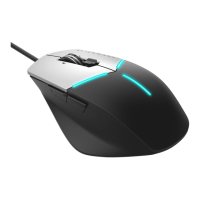

 To Next Page