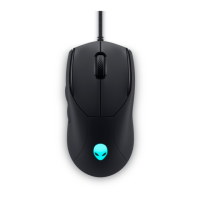
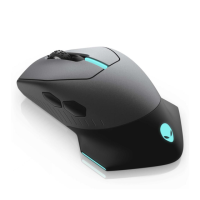
The Alienware Tri-Mode Wireless Gaming Mouse AW720M is a versatile peripheral designed for gamers, offering flexible connectivity options and customizable features to enhance the gaming experience. This user guide provides comprehensive information on setting up, using, and maintaining the mouse, along with troubleshooting tips and statutory information.
Function Description:
The Alienware AW720M is a tri-mode wireless gaming mouse, meaning it supports three different connection modes: wired, 2.4GHz wireless, and Bluetooth 5.1 Low Energy (BLE). This allows users to choose the most suitable connection for their setup and preferences. The mouse is equipped with a rechargeable battery and features a magnetic snap charging function for fast and convenient power replenishment. It also includes an adjustable Dots Per Inch (DPI) setting, allowing users to instantly change the mouse tracking resolution to suit different gaming scenarios or tasks. The mouse integrates with the Alienware Command Center (AWCC) application, which provides a single interface for customizing and enhancing the gaming experience through various settings and features.
Important Technical Specifications:
- Model Number: AW720M
- Connection Type: Tri-mode Wireless (2.4GHz, Bluetooth 5.1, and wired)
- Operating Voltage: 5 V
- Battery Type: Polymer Li-ion Rechargeable Battery, 500 mAh
- Battery Life (with LED off):
- RF mode: 140 hours
- BLE mode: 420 hours
- RF Transmission: Supports 2.4GHz and BT5.1 LE
- Operation Distance: Up to 10 meters
- Weight: Under 90 g (Under 0.1984 lb)
- Dimensions:
- Length: 125 +/- 0.5 mm (4.921 +/- 0.020 in.)
- Width: 62 +/- 0.5 mm (2.441 +/- 0.020 in.)
- Height: 37.5 +/- 0.5 mm (1.476 +/- 0.020 in.)
- Environmental Specifications:
- Operating Temperature: 0°C to 40°C (32°F to 104°F)
- Storage Temperature: -40°C to 65°C (-40°F to 149°F)
- Storage Humidity: 95% maximum relative humidity; non-condensing
- System Requirements (with Alienware support feature):
- Windows 10 RS3 and above, 32/64 bit
- Windows 11
- System Requirements (without Alienware support feature):
- Windows 7, 32/64 bit
- Windows 8, 32/64 bit
- Windows 8.1, 32/64 bit
- OS X
Usage Features:
The AW720M offers a range of features designed for optimal gaming performance and user convenience:
- Tri-Mode Connectivity: Seamlessly switch between wired, 2.4GHz wireless (via USB dongle), and Bluetooth 5.1 modes. The 2.4GHz mode provides a stable and low-latency connection ideal for gaming, while Bluetooth offers broader compatibility with various devices. Wired mode ensures continuous power and a direct connection.
- Magnetic Snap Charging Function: The mouse supports fast charging (5V=900mA) through a magnetic snap head, making it easy to connect the USB-C magnetic dongle for charging.
- Adjustable DPI: A dedicated DPI adjustment button allows for on-the-fly changes to mouse tracking resolution. The mouse offers five default DPI settings indicated by different LED colors:
- 800 DPI: Blue
- 1200 DPI: Green (default)
- 1600 DPI: Yellow
- 2400 DPI: Purple
- 3200 DPI: Red
These settings can be customized further using the Alienware Command Center (AWCC) application.
- Alienware Command Center (AWCC) Integration: AWCC is a central hub for customizing the mouse. Through the FX menu, users can:
- View device connection type (BLE, 2.4GHz, wired).
- Monitor battery level and charging status.
- Change lighting color and animation via the Lighting tab.
- Assign program shortcuts to programmable buttons using the Macros tab.
The Settings tab in AWCC allows for:
- Adjusting power saving modes.
- Modifying mouse button click and scroll bar responses.
- Swapping mouse buttons.
- Customizing DPI levels in the DPI Settings tile.
- Selecting Lift-Off Distance (LOD) in the Calibration tile.
- Viewing and updating firmware in the Update tile.
- Resetting device settings to factory default.
- Swift Pair (Bluetooth): For Windows users, the mouse supports Swift Pair, enabling quick and easy pairing with Bluetooth-enabled computers by simply placing the mouse near the computer and confirming the connection.
- Battery Indicator Colors: The mouse provides clear visual cues for battery status:
- Low power: Amber pulsing.
- Charging: Morphing between amber and green for 12 seconds, then reverts to user default lighting.
- Fully charged: Blinks green for 2 seconds, then stays static green for 10 seconds, then reverts to user default lighting.
- Included Accessories: The mouse comes with essential accessories for versatile use, including a USB charging cable, a USB wireless dongle, a dongle extender, a USB-C magnetic dongle for charging, a clip, and documentation.
Maintenance Features:
- Firmware Updates: The mouse and its USB wireless dongle can be updated to the latest firmware versions to ensure optimal performance and access to new features. Firmware updates can be performed automatically through the Alienware Command Center (AWCC) or manually by downloading update tools from the Dell Support website.
- Troubleshooting Guide: The manual includes a comprehensive troubleshooting section to address common issues such as the mouse not functioning, lights not turning on, cursor issues, mouse button problems, slow-moving cursor, cursor lagging, and lift-off distance (LOD) surface calibration issues. This guide provides step-by-step solutions, including checking battery power, reconnecting cables/dongles, ensuring sensor cleanliness, and adjusting software settings.
- Battery Management: To improve battery life, users are advised to turn off the power switch when the mouse is not in use. The mouse has a rechargeable battery, and it is recommended to fully charge it before first use for best results.
- Cleaning: For cursor issues, ensuring that the sensor is not obstructed or dirty is a recommended solution, implying that periodic cleaning of the sensor area is beneficial for maintaining tracking accuracy.
- Surface Calibration: For LOD surface calibration issues, using a dark-colored fabric mouse pad is suggested to improve calibration, indicating that the mouse's performance can be optimized by selecting appropriate surfaces.

 Need help?

 To Next Page
 General