2
INSTALLATION
WHERE AND HOW TO MOUNT YOUR RADIO
1.
a) You should choose the most appropriate setting from a simple and
practical point of view.
b) Your radio should not interfere with the driver or the passengers.
c) Remember to provide different wires for passing and protection.
(e.g.: power, antenna, accessory cabling) so that they do not in any
way interfere with the driving of vehicles.
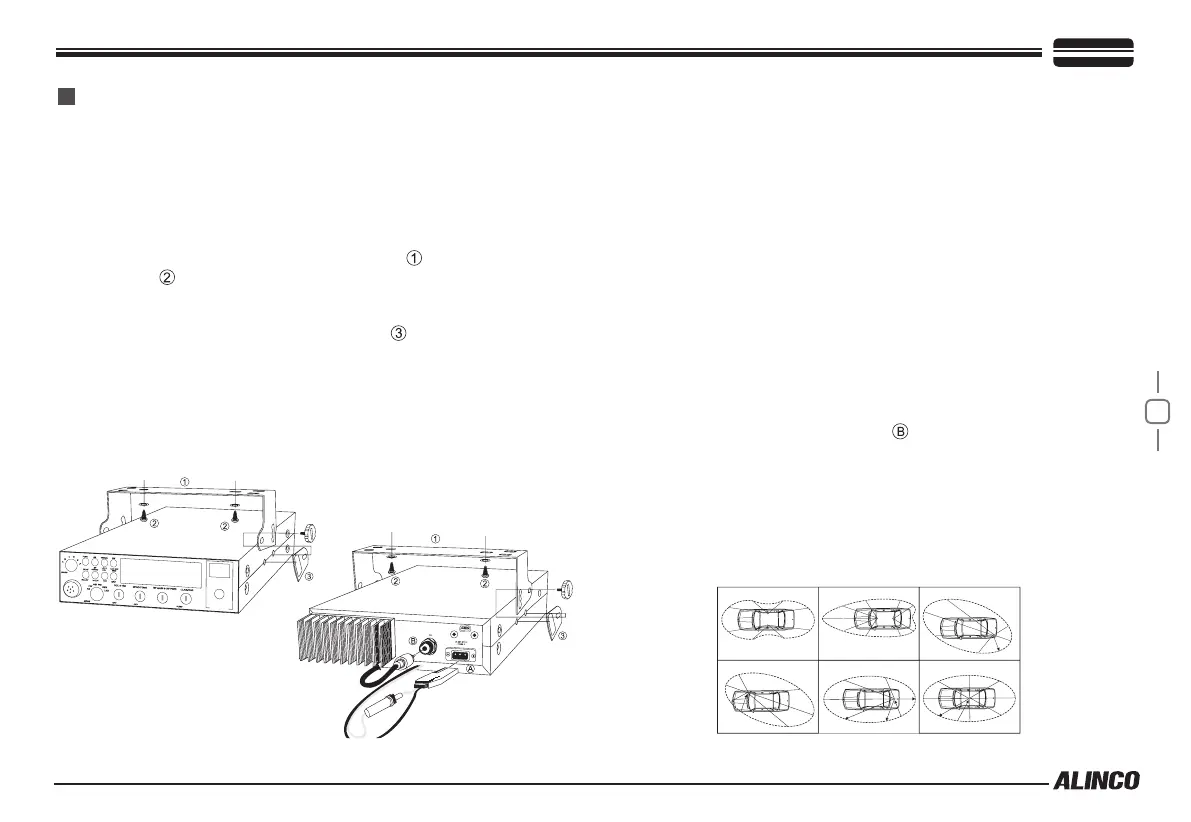
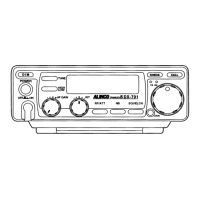
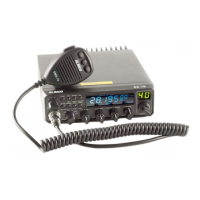
d) To install your equipment, use the cradle and the self-tapping
screws provided (drilling diameter 5 mm). Take care not to
damage the vehicle’s electrical system while drilling the dash
board.
e) Do not forget to insert the rubber joints between the radio and
its support as these have a shock-absorbing effect which permits
gentle orientation and tightening of the set.
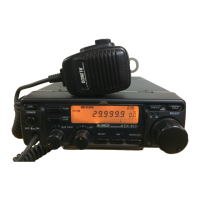
f) Choose where to
place the microphone support and remember that
the microphone cord must stretch to the driver without interfering
with the controls of the vehicle.
ANTENNA INSTALLATION
2.
a) Choosing your antenna:
For radios, the longer the antenna, the better its results. Your
dealer will help you with your choice of antenna.
b) Mobile antenna:
-Must be fixed to the vehicle where there is a maximum of metallic
surface (ground plane), away from windscreen mountings.
-There are two types of antenna: Pre-Regulated Antenna which
should be used on a good ground plane (e.g. car roof or lid of the
boot), and Adjustable Antenna which offer a much larger frequency
range and can be used on a smaller ground plane.
For an antenna which must be fixed by drilling, you will need a
good contact between the antenna and the ground plane. To obtain
this, you should lightly scratch the surface where the screw and
tightening star are to be placed.
-Be
careful not to pinch or flatten the coaxial cable (as this runs the
risk of break down and/or short circuiting).
-Connect the antenna to location .
c) Fixed antenna:
A fixed antenna should be installed in a space as clear as possible.
If it is fixed to a mast, it will perhaps be necessary to stay it,
according to the laws in force (you should seek professional
advice).
LO
CK
C
O
L
CHNNEL
Caution:
Use only the provided screws
otherwise you risk damaging
the circuit board, components
or fall-off of the unit.


 To Next Page