35
SMOKED FISH (Salmon, rockfish and flatfish (sole, cod, flounder) and other fish)
Caution: Safe processing times for other smoked seafood have not been determined. Those products
should be frozen. Smoking of fish should be done by tested methods. Lightly smoked fish is
recommended for canning. However, because it has not yet been cooked, do not taste lightly smoked
fish before canning.
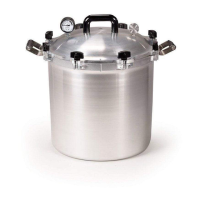
Follow these recommended canning instructions carefully. Use a 16 quart or larger pressure canner for
this procedure; do not use smaller pressure canners. Safe processing times haven’t been determined.
Do not use quart jars or tin cans. Half-pints could be safely processed for the same length of time as
pints, but the quality of the product may be less acceptable.
Procedure: If smoked fish has been frozen, thaw in the refrigerator until no ice crystals remain before
canning. If not done prior to smoking, cut fish into pieces that will fit vertically into pint canning jars, leaving
1-inch headspace. Measure 4 quarts (16 cups) of cool tap water and pour into the pressure canner. (Note:
The water level probably will reach the screw bands of pints jars.) Do not decrease the amount of water or
heat the water before processing begins. Pack smoked fish vertically into hot jars, leaving 1- inch
headspace between the pieces and the top of the jar. The fish may be packed either loosely or tightly. Clean
jar rims with a clean, damp paper towel. Do not add liquid to the jars. Adjust lids and process.
Process time for Smoked Fish Weight Setting at Altitudes of
Jar Size Process Time 0-1,000 ft Above 1,000 ft
Pints 110 min 10 lb 15 lb
TUNA
Tuna may be canned either precooked or raw. Precooking removes most of the strong-flavored oils. The
strong flavor of dark tuna flesh affects the delicate flavor of white flesh. Many people prefer not to can dark
flesh. It may be used as pet food.
Note: Glass-like crystals of magnesium ammonium phosphate sometimes form in canned tuna. There is no
way for the home canner to prevent these crystals from forming, but they usually dissolve when heated and
are safe to eat.
Procedure: Keep tuna on ice until ready to can. Remove viscera and wash fish well in cold water. Allow
blood to drain from stomach cavity. Place fish belly down on a rack or metal tray in the bottom of a large
baking pan. Cut tuna in half crosswise, if necessary. Precook fish by baking at 250°F for 2
1
⁄
2
to 4 hours
(depending on size) or at 350°F for 1 hour. The fish may also be cooked in a steamer for 2 to 4 hours. If a
thermometer is used, cook to a 165° to 175°F internal temperature. Refrigerate cooked fish overnight to firm
the meat. Peel off the skin with a knife, removing blood vessels and any discolored flesh. Cut meat away
from bones; cut out and discard all bones, fin bases, and dark flesh. Quarter. Cut quarters crosswise into
lengths suitable for half-pint or pint jars. Fill into hot jars, pressing down gently to make a solid pack. Tuna
may be packed in water or oil, whichever is preferred. Add water or oil to jars, leaving 1-inch headspace.
Add
1
⁄
2
teaspoon of salt per half-pint or 1 teaspoon of salt per pint, if desired. Adjust lids and process.
Process time for Tuna Weight Setting at Altitudes of
Jar Size Process Time 0-1,000 ft Above 1,000 ft
Half-pints or Pints 100 min 10 lb 15 lb



 To Next Page