CARING FOR YOUR COOKER/CANNER
READ BEFORE USING PRESSURE COOKER/CANNER
For your own safety and to avoid damaging the cooker/canner, please read these instructions carefully
before using.
Metal-to-Metal Seal
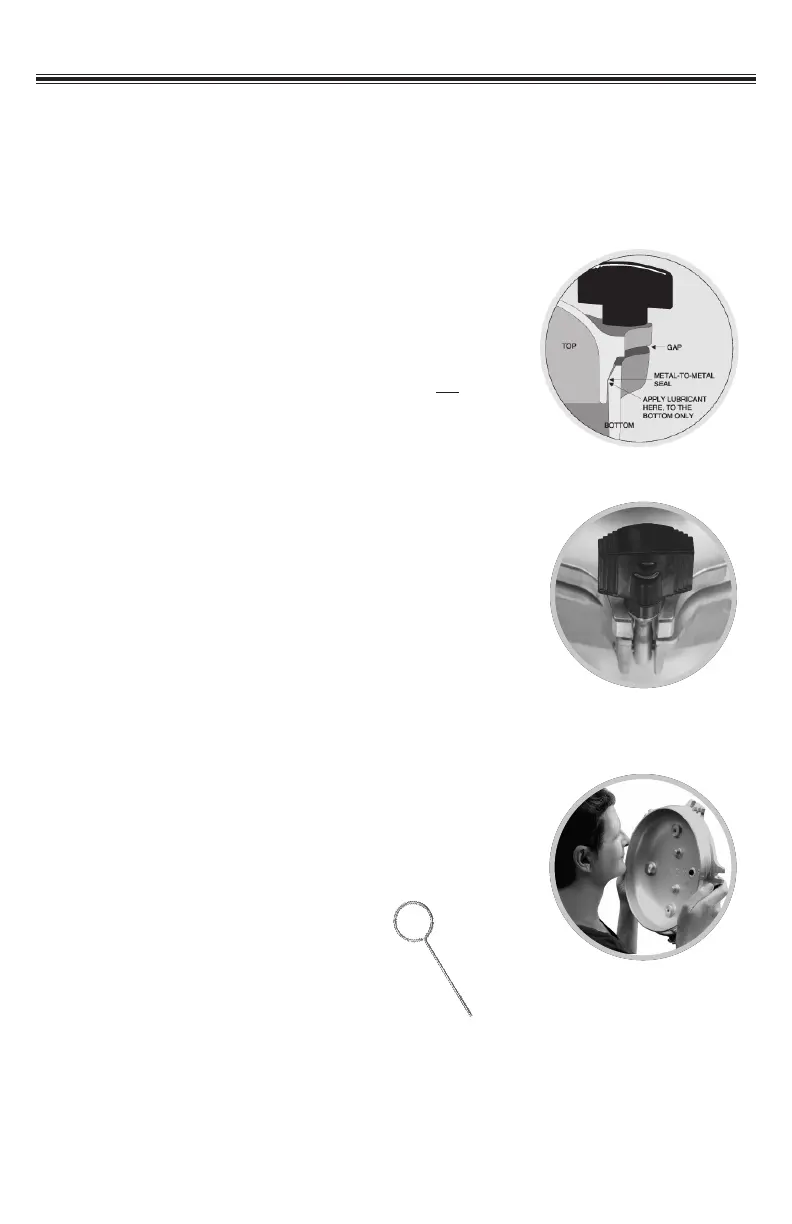
Before using your cooker/canner, you must lubricate the metal-to-metal seal area with olive oil. If olive oil is
not available, you may use Vaseline. We do not recommend using cooking oil because
there are so many different grades that some simply gum-up and do not work
very well. Apply a thin film of lubricant to the edge inside the cooker where
the inside wall begins to bevel out see Diagram D below. Use just enough
lubricant to wet the edge, but not enough to actually see it.
It is also important to periodically wipe off the metal-to-metal seal with a
clean towel to remove any build-up of foreign material trapped in the
lubricant. You may use a red 3M brand Scotch Brite pad, the red
color only.
You can also use an SOS scrubbing pad. With pad, clean bottom seal using
a horizontal motion around the circumference to remove any build-up of
hardened lubricant. Do not use a vertical or small circular motion and avoid hard
scrubbing of the metal-to-metal seal to prevent damage. After this is complete, wash
the seal with hot soapy water, rinse, dry, and lubricate the metal-to-metal seal.
Wing Nut/Clamp Bolt
From time to time, place a small amount of lubricant on the threads of the
phenolic wing nut. You can unscrew the wing nut and put the lubricant inside
the threaded opening or on the clamp bolt and screw the wing nut back on.
Vaseline or olive oil works well in this instance. Also lubricate the metal
surface at the base of the wing nut where the bottom of the wing nut comes
in contact with the aluminum surface of the pressure cooker lid (see Diagram
E below). Wipe away excess lubricant. This will help the wing nuts turn more
easily and hold the cover securely to the cooker/canner, preventing steam leaks.
Keep Safety Openings Clear
It is important to inspect the openings of the vent pipe, and the pressure dial gauge regularly to make sure
steam can pass through them.
Before each use, hold the cover up to the light and look through the vent pipe (see
Diagram F). If the vent pipe is blocked, excess pressure cannot be released
through it. Pressure may then build to unsafe levels. Pressure will continue
to build until the overpressure plug is forced out of its cover opening.
Therefore, if it is blocked or partially blocked, clean the vent pipe by inserting
the #75 cleaning rod, a piece of wire, or a pipe cleaner
in the vent pipe and run it gently in and out to be
sure the opening is clear and unobstructed. Rinse
with hot water.
10
Diagram D
#75 cleaning rod
Diagram E
Diagram F



 To Next Page