Ampcontrol Pty Ltd – ABN 28 000 915 542
OCS USER MANUAL
MAG-182 Version 5 – FEB/2020
Uncontrolled Copy - Refer to Ampcontrol Website for Latest Version
APPROVED FOR EXTERNAL DISTRIBUTION
– PROPERTY OF AMPCONTROL PTY LTD
– NOT TO BE REPRODUCED IN PART
The three phase currents are compared and the highest current is used to determine the trip time. If the
current exceeds the selected full load current, an overcurrent trip accumulator (TAC) increases at a rate
determined by the above function. If the over-current condition persists so that the trip accumulator
reaches 100% then a trip occurs. If viewed during start up the trip accumulator can help determine if the
over-current settings are correct.
The Overcurrent curves provided are as follows:
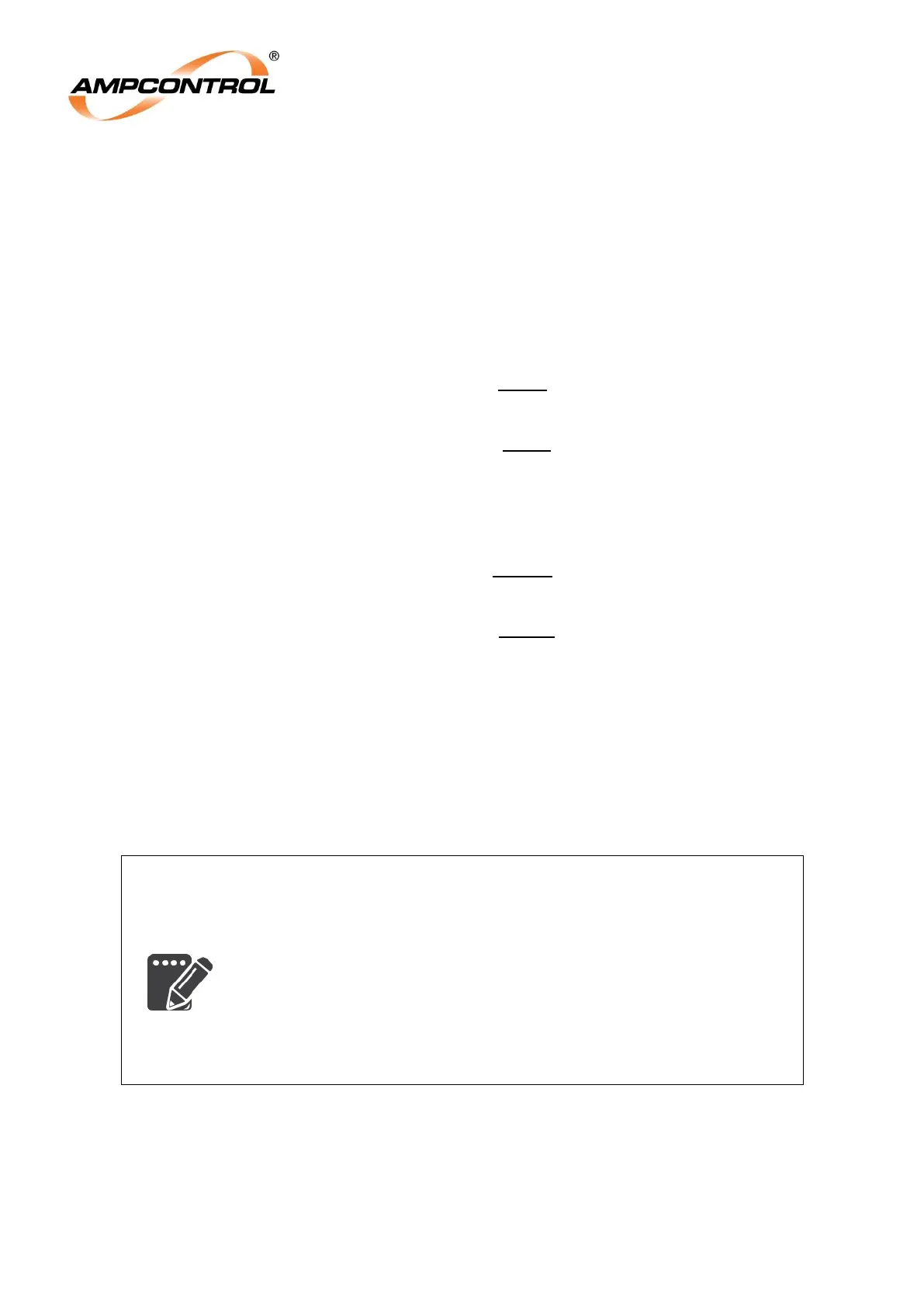
1. Very Inverse as per IEC 60255-151 B Curve. The trip time and reset time in seconds for
current
I
follows the characteristic defined by :
2. Extremely Inverse as per IEC 60255-151 C Curve. The trip time and reset time in
seconds for current
I
follows the characteristic defined by :
Where:
t(I) = the idealised trip time,
I = the input current ratio relative to the full load current set point – ie per unit current,
TMS = the Over Current Time Multiplier Setting,
t
R
(I) = the idealised reset time.
1. The per unit current is clipped to a maximum of 1250%. Therefore
the trip time for input currents above this level will not decrease any
further i.e. the trip characteristic ‘flat lines’ beyond 1250% of the
selected full load current.
2. Independent of the selected curve and TMS setting, the minimum
trip times for the Over Current functions are nominally 100ms.
3. The trip times calculated from the above formulae are idealised.
The trip calculations are executed every 20ms, so there is an
additional delay and uncertainty of 25ms +/-15ms.
See Overcurrent Curves, drawing OCSB001in APPENDIX B: DRAWINGS.
When the Protection Element is not in the ‘running’ state and the thermal accumulator is not below the
selected start block level, a start block (trip) will occur. This will automatically clear once the thermal
accumulator drops to, or is below the selected level. Note however that generally this will happen quickly
when the inverse overcurrent modes are selected.



 To Next Page