Appendix A
Windowing
Introduction
The FREQ/DIST menu (page 2-11) provides for setting the cable loss and relative propa-
gation velocity of the coaxial cable. The
Window key opens a menu of FFT windowing
types for the DTF calculation.
The theoretical requirement for inverse FFT is for the data to extend from zero frequency to
infinity. Side lobes appear around a discontinuity due to the fact that the spectrum is cut off
at a finite frequency. Windowing reduces the side lobes by smoothing out the sharp transi-
tions at the beginning and at the end of the frequency sweep. As the side lobes are reduced
the main lobe widens thereby reducing the resolution.
In situations where there may be a small discontinuity close to a large one, side lobe reduc-
tion windowing should be used. When distance resolution is critical windowing can be re-
duced.
Examples
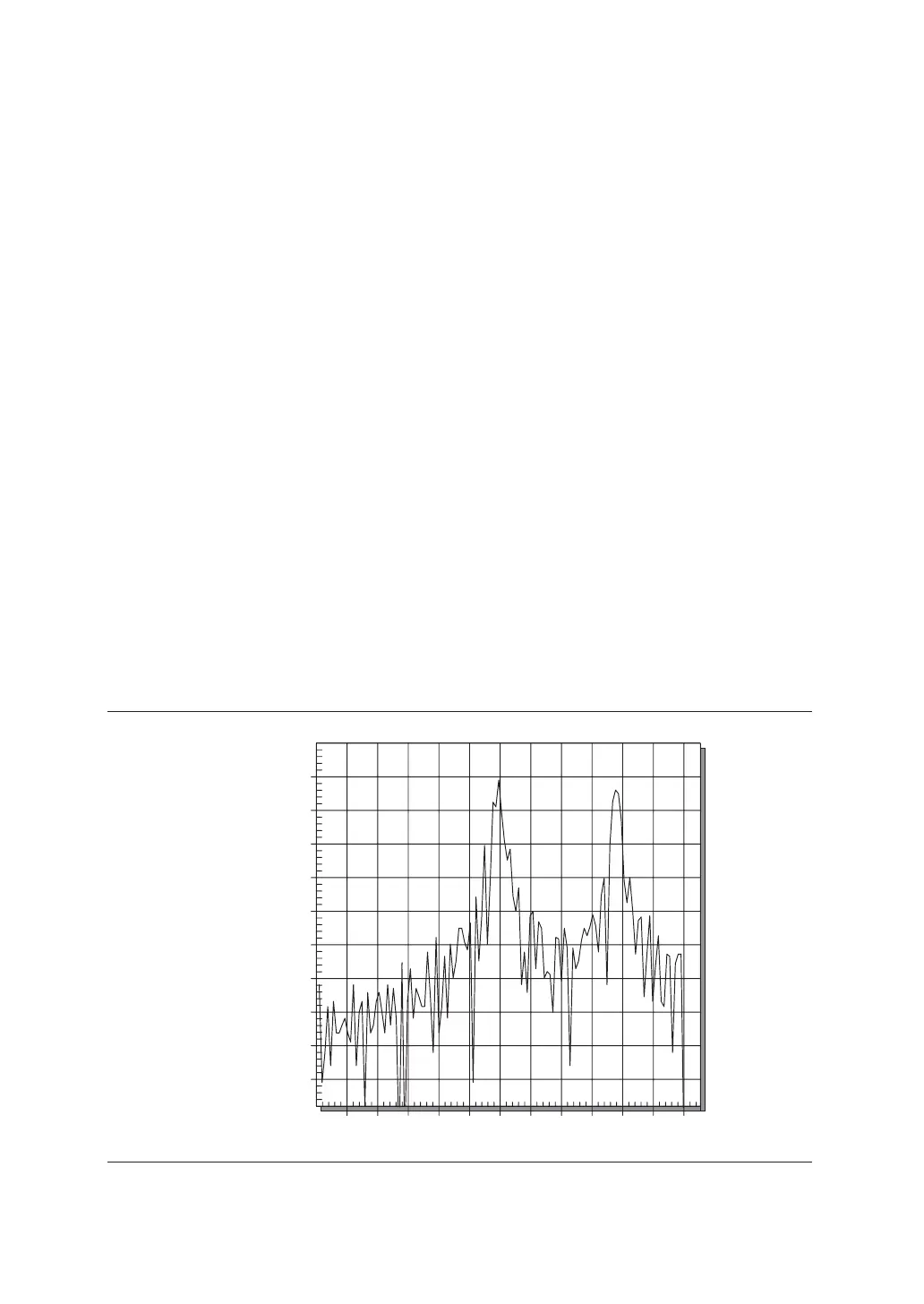
The types of windowing in order of increasing side lobe reduction are: rectangular, nominal
side lobe, low side lobe, and minimum side lobe. Figures A-1 thru A-4 show examples of
the types of windowing.
A-1
F e e t
5
1 0
1 5
2 0
2 5
3 0 3 5 4 0
4 5 5 0
5 5 6 0
- 5
- 1 0
- 1 5
- 2 0
- 2 5
- 3 0
- 3 5
- 4 0
- 4 5
- 5 0
R e t u r n L o s s ( d B )
D i s t a n c e T o F a u l t
Figure A-1. Rectangular Windowing Example









 To Next Page