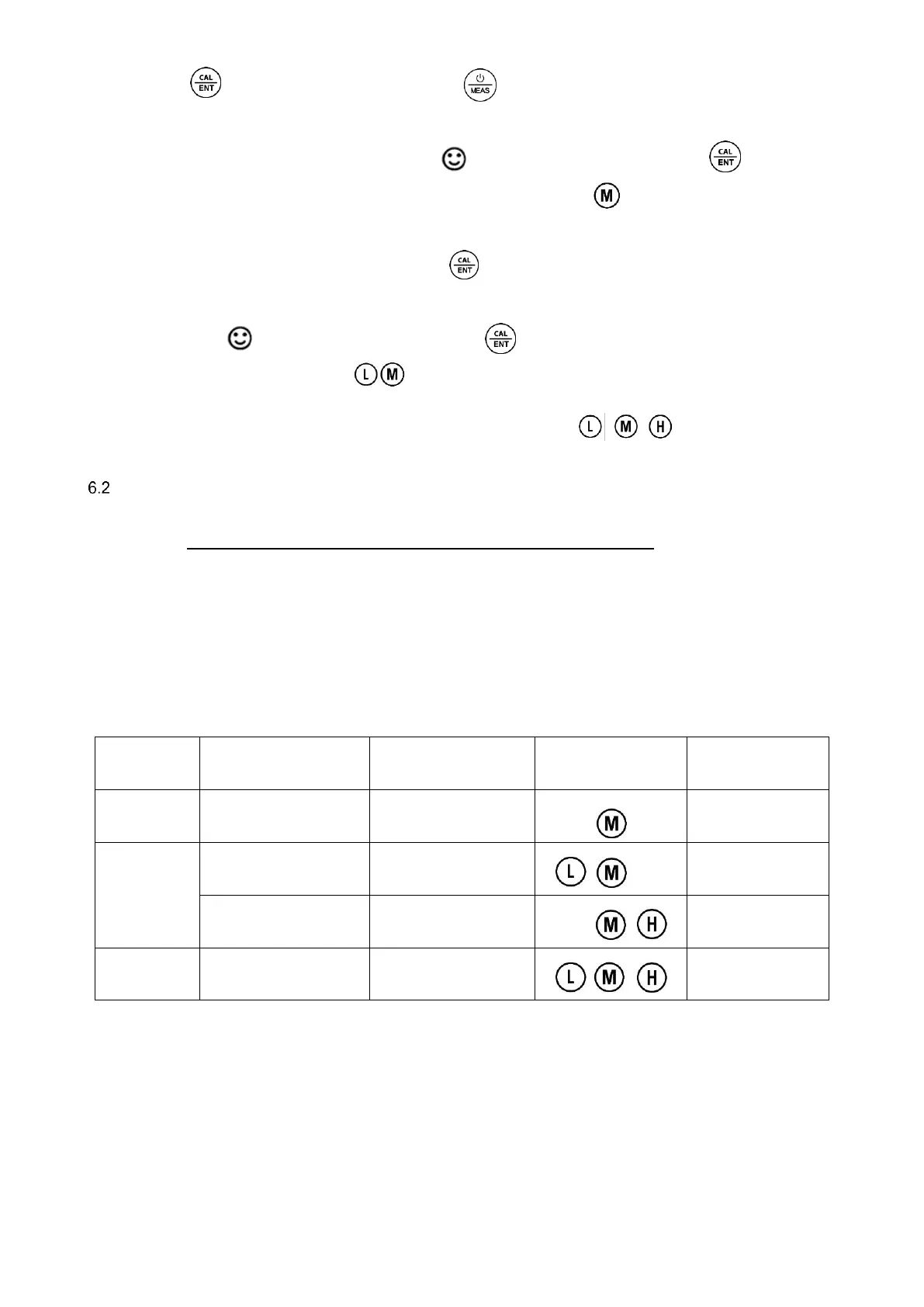
3) Long press to enter calibration mode; Short press to exit.
4) Place the probe in pH7.00 buffer solution, shake it for a few seconds, and allow it to stand still in the buffer solution
until a stable reading is reached. When stable icon stays on the LCD screen, short press to complete 1
st
point calibration and the tester returns to measurement mode. Indication Icon will appear at the bottom left of the
LCD screen.
5) Rinse the probe in distilled water and dry it. Long press to enter calibration mode to perform 2
nd
point of calibration.
6) Place the probe in pH 4.00 buffer solution, shake it for a few seconds, and allow it to stand still in the buffer solution.
When stable icon stays on the LCD screen, short press to complete 2-point calibration and the tester returns
to measurement mode. Indication icon will appear at the bottom left of the LCD screen.
7) If necessary, rinse the probe in distilled water and dry it, and place the probe in 10.01 buffer solution (sold
separately) to complete 3
rd
point of calibration according to the steps in 6), will appear at the bottom
left of the LCD.
Notes
1) Tester will automatically recognize pH buffer solution. Users can perform one-point, two-point, or three-point
calibration. For the 1
st
point calibration, only 7.00 pH/6.86 pH solution can be used. Then use other buffer
solutions to conduct 2nd or 3rd point calibration. Perform the 2
nd
point calibration (4.00 pH) immediately after the
1
st
point. Do NOT turn off the meter before you perform 2
nd
point calibration. If the meter is turned off after 1
st
point calibration, users will need to restart the calibration process with the 7.00 pH or 6.86 pH first and the 2
nd
point following after. Otherwise, Er1 will occur.
2) The tester will automatically recognize 5 kinds of pH buffer solutions in both USA and NIST series of standards.
Refer to the table below:
3) For pH Calibration buffer solutions, we recommend that users replace new buffer solution after 10 to 15 times
of use to keep the standard buffer’s accuracy. Do NOT pour the used calibration solutions back into the solution
bottles in case of contamination.
4) When calibrating strong basic solutions (pH>10), use 7.00 pH and 12.45 pH to calibrate; When measuring
strong acidic solutions (pH<4), 7.00 pH and 1.68 pH should be calibrated.
5) For the self-diagnosis information, please refer to the table below:



 To Next Page