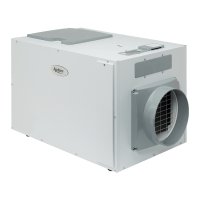
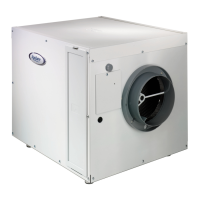
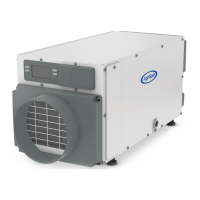
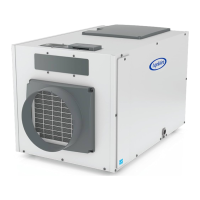
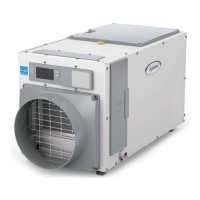
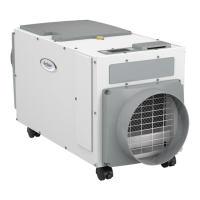
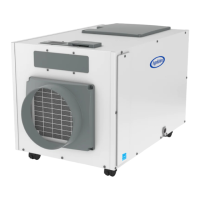
The Aprilaire Model 1830/1850/1870 Dehumidifier is designed to manage humidity levels in various residential settings, offering flexibility in installation and control. This quick start guide outlines different application scenarios, from single-zone whole-house dehumidification to more complex two-zone setups and integration with ventilation systems. The dehumidifier can be controlled either internally via its onboard interface or externally using compatible Aprilaire controls.
Function Description
The primary function of the Aprilaire dehumidifier is to remove excess moisture from the air, thereby improving indoor air quality and comfort, and preventing issues like mold growth and musty odors. It operates by drawing in humid air, passing it over a cooling coil to condense moisture, and then discharging drier air back into the space. The dehumidifier's blower can operate independently or in conjunction with an existing HVAC system blower, depending on the wiring and application.
Single Zone Dehumidification:
In a single-zone application, the dehumidifier targets a specific area, such as a whole house, basement, crawlspace, sealed attic, or storage area.
- Internal Control: When using internal control, the dehumidifier's onboard interface is used to set and monitor humidity levels. The dehumidifier samples the air periodically (typically once every hour) by turning on its blower. If the measured relative humidity (RH) is above the set point, the compressor activates to begin dehumidification. The unit continues to run until the RH drops 3% below the set point. This setup is suitable for whole-house or basement applications where the dehumidifier is ducted to the main return of the HVAC system or directly to a dedicated supply.
- External Control: For single-zone applications requiring remote control, an external Aprilaire control (e.g., Model 76, 8620, or 8910) can be used. This external control, installed in the space to be dehumidified, provides a dry contact output (normally open or normally closed) to signal the dehumidifier to operate. When the external control calls for dehumidification, the dehumidifier's blower and, if wired, the HVAC blower turn on, followed by the compressor after a brief delay. Operation ceases when the external control stops calling for dehumidification. This is particularly useful for crawlspaces, sealed attics, or basements where the dehumidifier itself might not be easily accessible.
Two Zone Dehumidification:
The dehumidifier can also be configured for two-zone operation, although this is generally not recommended in HVAC zoning applications. This setup allows for independent humidity control in two distinct areas, such as a whole house (primary zone) and a basement (secondary zone), or vice versa.
- Internal Control: In a two-zone setup with internal control, the dehumidifier's onboard interface sets the RH target for both zones. The dehumidifier first samples the air in the primary zone. If dehumidification is needed, it activates the dampers and its blower (and the HVAC blower if wired) to dehumidify the primary zone. If the primary zone does not require dehumidification, the dampers de-energize, and the dehumidifier proceeds to sample and dehumidify the secondary zone if needed. This sequential operation ensures that both zones are addressed based on the set humidity level.
- External Control in Primary Zone: This configuration uses an external control (e.g., Model 76 or 8910) for on-demand control of the primary zone, while the dehumidifier's internal control manages the secondary zone. A primary zone demand from the external control takes precedence over any existing secondary zone demand. When the primary zone calls for dehumidification, the dehumidifier energizes the dampers, turns on its blower and compressor, and can also activate the HVAC system blower if wired. After the primary zone demand is satisfied, or if there is no demand, the dehumidifier samples and dehumidifies the secondary zone based on its internal RH setting.
Ventilation Feature:
The dehumidifier can be integrated with a ventilation system to bring in fresh outdoor air. This feature utilizes a normally closed damper (e.g., Aprilaire Model 6506) and an optional outdoor temperature (ODT) sensor.
- Ventilation Operation: The dehumidifier can be set to ventilate for a specified number of minutes per hour. When the heating or cooling system runs, or when the dehumidifier itself turns on, the damper opens to draw in fresh outdoor air. If the HVAC system doesn't run for the set ventilation time, the dehumidifier will activate the HVAC fan at the end of the hour to ensure ventilation needs are met.
- Temperature Limits: The ODT sensor allows for setting temperature limits, preventing ventilation when outdoor air is too hot or too cold, which helps maintain indoor comfort and energy efficiency.
- Pre-Conditioning Ventilation Air: For enhanced performance, the dehumidifier can pre-condition the ventilation air by removing moisture before it enters the home. In this setup, the ventilation duct is connected to the dehumidifier's inlet. If the incoming outdoor air's RH is above the set point on the dehumidifier's internal control, the air will be dehumidified before being distributed. This requires the dehumidifier's internal control to be used for the primary zone.
Usage Features
The Aprilaire dehumidifier offers several features designed for user convenience and optimal performance:
- Flexible Installation: The dehumidifier can be installed in various configurations, including ducted to the main return of an HVAC system, ducted to a dedicated supply, or directly in the space to be dehumidified. This adaptability allows for integration into diverse home layouts and existing HVAC systems.
- Internal Control Interface: The onboard control provides a clear display and buttons for setting humidity levels and accessing installer setup menus. It indicates the current status, such as "OFF," "REMOTE DISABLED," "REMOTE ENABLED," "ZONE DISABLED," "ZONE ENABLED," "EXTERNAL DISABLED," "EXTERNAL ENABLED," and "DONE" during setup.
- Remote Control Capability: For installations where the dehumidifier is in a less accessible location (e.g., crawlspace), an external Aprilaire control can be used to manage settings from a more convenient living space. This remote control displays the RH of the dehumidified space and allows users to adjust the dew point setting (from 1 for less dry to 7 for more dry) and turn the unit on/off.
- Automatic Sampling: In internally controlled single-zone and two-zone applications, the dehumidifier automatically samples the air hourly to assess humidity levels, ensuring continuous and responsive dehumidification without constant manual intervention.
- Zoning Capability: The ability to manage two distinct zones allows for tailored humidity control in different areas of a home, addressing specific needs like a damp basement versus a drier living space.
- Ventilation Integration: The dehumidifier can be seamlessly integrated with a ventilation system, providing fresh air while simultaneously managing humidity. The option to pre-condition ventilation air further enhances comfort and air quality.
- Installer Set-Up Menu: A dedicated installer set-up menu, accessed by holding the "Mode" button for three seconds, allows for configuration of various operational parameters, including remote control enabling, zoning activation, and ventilation settings (timed or auto with temperature limits). This ensures the dehumidifier is optimized for the specific application.
- Status Indicators: The control board includes various terminals and indicators for wiring connections (e.g., thermostat, float switch, remote sensor, dampers) and troubleshooting.
Maintenance Features
While the manual primarily focuses on installation and operation, certain aspects imply maintenance considerations:
- Drainage System: The dehumidifier requires a drain pan and float switch (if required by local codes or installation type) to manage the condensed water. Regular inspection of the drainage system is crucial to prevent water leaks and ensure proper operation.
- Ductwork and Grilles: The installation involves duct fittings and grilles. Periodic inspection and cleaning of these components are recommended to maintain optimal airflow and prevent dust buildup, which could impede performance.
- Filter Maintenance (Implied): Although not explicitly detailed in this quick start guide, dehumidifiers typically have air filters that need to be cleaned or replaced regularly to maintain efficiency and air quality. This is a standard maintenance practice for such devices.
- Professional Installation: The guide emphasizes that installation should be performed by qualified heating and air conditioning professionals in accordance with the Installation Manual. This ensures correct setup and minimizes the likelihood of issues requiring extensive maintenance.
- Troubleshooting (Implied): The wiring diagrams and sequence of operation descriptions provide a basis for troubleshooting common operational issues, allowing professionals to diagnose problems efficiently. For instance, understanding when the compressor or blower should activate helps in identifying malfunctions.
- Component Accessibility: The design of the unit and its controls suggests that key components are accessible for service and maintenance by qualified technicians.

 Need help?
 General

 To Next Page