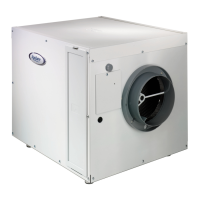
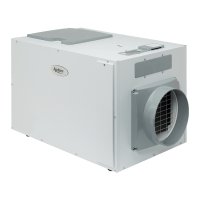
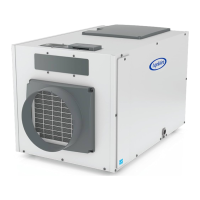
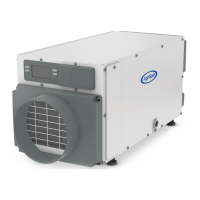
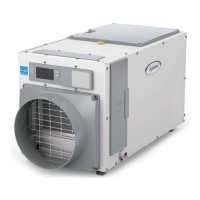
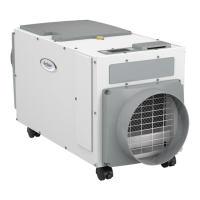
The Aprilaire Central Dehumidifier, models 1750A and 1770A, is an advanced system designed to manage and control humidity levels throughout an entire home, as well as in specific areas like crawlspaces and attics. Its primary function is to automatically and continuously monitor and adjust the true measure of moisture, or dew point, to a user-defined dryness set point. This set point can be configured directly on the unit or through an optional living space control, offering flexible management of indoor air quality.
A key usage feature of this dehumidifier is its built-in automatic air cycling capability. This function allows the unit to activate the HVAC fan, circulating air throughout the entire home to ensure proper balance and comfort. This is particularly useful for maintaining consistent humidity levels across different rooms and floors. The air cycling feature can be customized through dip switches and a cycle time dial, allowing users to set how often the HVAC fan should operate and for how long during each cycle period. For instance, users can choose cycle periods of 30 minutes, 1, 2, or 3 hours, and then specify the duration of HVAC fan operation within that period, ranging from 1 to 60 minutes. This granular control helps optimize energy consumption while ensuring effective air circulation.
Another significant usage feature is the patented built-in ventilation capability. This allows fresh air from outside to be introduced into the home. When outside air is brought in, the dehumidifier will automatically dehumidify it if necessary, based on the dew point and the dryness set point. This feature is designed to comply with ASHRAE 62.2 Standard for Ventilation, promoting healthier indoor environments by ensuring a supply of fresh, conditioned air. The ventilation function can be further enhanced with an optional ventilation damper and an outdoor temperature sensor. When these are installed, the system can intelligently restrict ventilation based on outdoor temperature conditions, preventing the introduction of excessively hot, cold, or humid air. For example, the damper will not open if the outdoor temperature is above 100°F or below 0°F, and it will only open with a heat call if the temperature is between 0°F and 20°F. This smart control ensures that ventilation is performed efficiently and only when beneficial for indoor comfort and air quality.
The Aprilaire Central Dehumidifier can be installed in various configurations to suit different home layouts and humidity control needs. In a central installation, the unit integrates with the existing HVAC system, pulling air from the return duct, dehumidifying it, and returning it to the supply duct. This setup provides whole-home humidity control. For localized installations, the dehumidifier can draw air specifically from a particular area, such as a basement or crawlspace, without necessarily being ducted to the main HVAC equipment. This is ideal for targeting specific problem areas with high humidity. A central/zoned (convertible) installation offers even greater flexibility, allowing the dehumidifier to prioritize humidity control in a specific zone while also switching to whole-home control when the HVAC equipment is operating. This mode utilizes motorized dampers to direct airflow as needed, ensuring optimal humidity management in both priority zones and the entire home.
Maintenance features are designed to ensure the longevity and efficient operation of the unit. The dehumidifier is equipped with a MERV 8 filter, which helps maintain air quality by capturing particulates. Access to the filter is straightforward, with a minimum clearance of 20 inches required in front of one of the filter access doors for easy removal and replacement. The unit also includes a drain trap that must be properly installed and primed with water prior to start-up to ensure effective condensate drainage. For installations in attics or areas prone to flooding, the dehumidifier should be placed in a secondary drain pan with a normally closed condensate overflow safety switch (float switch). This switch, when activated by rising water levels, disables the compressor to prevent water damage, while still allowing ventilation to continue. The manual provides detailed wiring instructions for the float switch, emphasizing its importance for leak protection.
Troubleshooting is facilitated by LED codes on the control board, which indicate the unit's status and potential issues. Green LEDs signal normal operations like compressor activity, sampling, and defrosting. Red LEDs, with various blink patterns, indicate specific problems such as RH sensor issues, temperature sensor faults, low refrigerant charge, or an open float switch. This diagnostic system helps installers and homeowners quickly identify and address operational problems. The manual also includes a comprehensive troubleshooting guide that links common symptoms, such as the dehumidifier blower running without airflow or the unit producing hot air, to possible causes and corrective actions. For instance, if the HVAC fan does not turn on in "TEST" mode, the guide directs users to check wiring, power supply, and sensor connections. If the dehumidifier is not adequately dehumidifying, it suggests checking airflow, static pressure, and compressor operation.
The design of the unit emphasizes ease of installation and service. It comes with two 8-inch round collars for duct connections, which are packaged with the drain trap inside the unit. The adjustable legs on the dehumidifier allow for proper accommodation of the drain trap. For hanging installations, the unit requires two unistruts to support the base, ensuring stability and proper clearance for filter access. The control board features clearly labeled terminals for various connections, including HVAC equipment, ventilation dampers, outdoor temperature sensors, and float switches, simplifying the wiring process. The system setup dip switches allow for easy configuration of operational modes, such as HVAC fan activation during dehumidification, whole-home versus convertible zoning, and automatic versus timed ventilation, providing a tailored solution for diverse humidity control requirements.



 To Next Page


 General