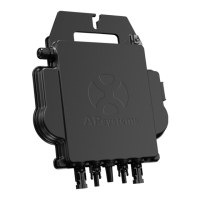
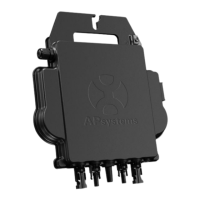
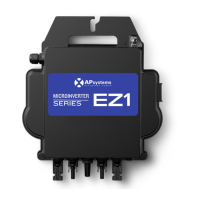
2.APsystems Microinverter System Introduction
2.2 The advantages of an APsystems system
This integrated system maximizes solar energy harvest, improves safety, increases system reliability, and simplifies
solar system design, installation, maintenance, and management.
APsystems Microinverters maximize PV energy production
Each PV module has an individual Maximum Peak Power Tracking (MPPT) control, which ensures that the maximum
power is produced to the utility grid regardless of the performance of the other PV modules in the array. When PV
modules in the array are affected by shade, dust, different orientation, or any situation in which one module
underperforms compared to the other ones, the APsystems Microinverter ensures top performance from the array
by maximizing the performance of each module individually within the array.
Safety with APsystems Microinverters
In a typical string inverter installation, PV modules are connected in series. The voltage adds-up to reach high
voltage value (from 600 Vdc up to 1000 Vdc) at the end of the PV string. This extreme high DC voltage brings a
risk of electrical shocks or electrical arcs which could cause fire.
When using an APsystems microinverter, PV modules are connected in parallel. Voltage at the back of each PV
module never exceeds PV modules Voc, which is lower than 60 Vdc for most of PV modules used with APsystems
microinverters. This low voltage is considered “safe to touch” by firemen department and will avoid risk of
electrical shock, electrical arcs and fire hazards.
More reliable than centralized or string inverters
The distributed APsystems Microinverter system ensures that no single point of failure exists across the PV system.
APsystems Microinverters are designed to operate at full power at ambient outdoor temperatures of up to 65 deg
C (or 149 F). The inverter case is designed for outdoor installation and complies with the IP67 environmental
enclosure rating.
Simple to install
APsystems Microinverters are compatible with most of 60 and 72 cell PV modules or 120 and 144 half-cut cells PV
modules. (In order to confirm compatibility of PV module with APsystems microinverter, feel free to check our
online “E-decider” module compatibility tool or contact your local APsystems Technical Support).
Installation requires a minimum number of accessories and microinverters offer a lot of versatility to the installer:
microinverters can indeed be installed on different roofs with different orientation or with modules having
different orientation.
In the same way, end-user can extend their system whenever they want with microinverters.
Smart system performance monitoring and analysis
The APsystems Energy Communication Unit (ECU) is installed by simply plugging it into any wall outlet and
providing an Ethernet or Wi-Fi connection to a broadband router or modem. After installing and setting the ECU
(see ECU Instruction Manual), the full network of APsystems Microinverters automatically reports to the APsystems
Energy Monitor and Analysis (EMA) web server.


 To Next Page