5
English
POSITIONING THE UNIT
Place your amplifier on a level, firm surface.
Avoid placing the unit in direct sunlight or near sources of heat or
damp.
Ensure adequate ventilation. Do not place the unit in an enclosed
space such as a bookcase or cabinet as both of these will impede air
flow through the ventilation slots.
CONNECTING TO LOUDSPEAKERS
You can connect one or two pairs of loudspeakers to your amplifier,
provided each pair is rated between 8–16Ω. If one or both pairs have
an impedance of less than 8Ω, the combined load on the amplifier falls
below 4Ω and could cause an overload. If so, the overload protection
circuit engages and the amplifier will not work.
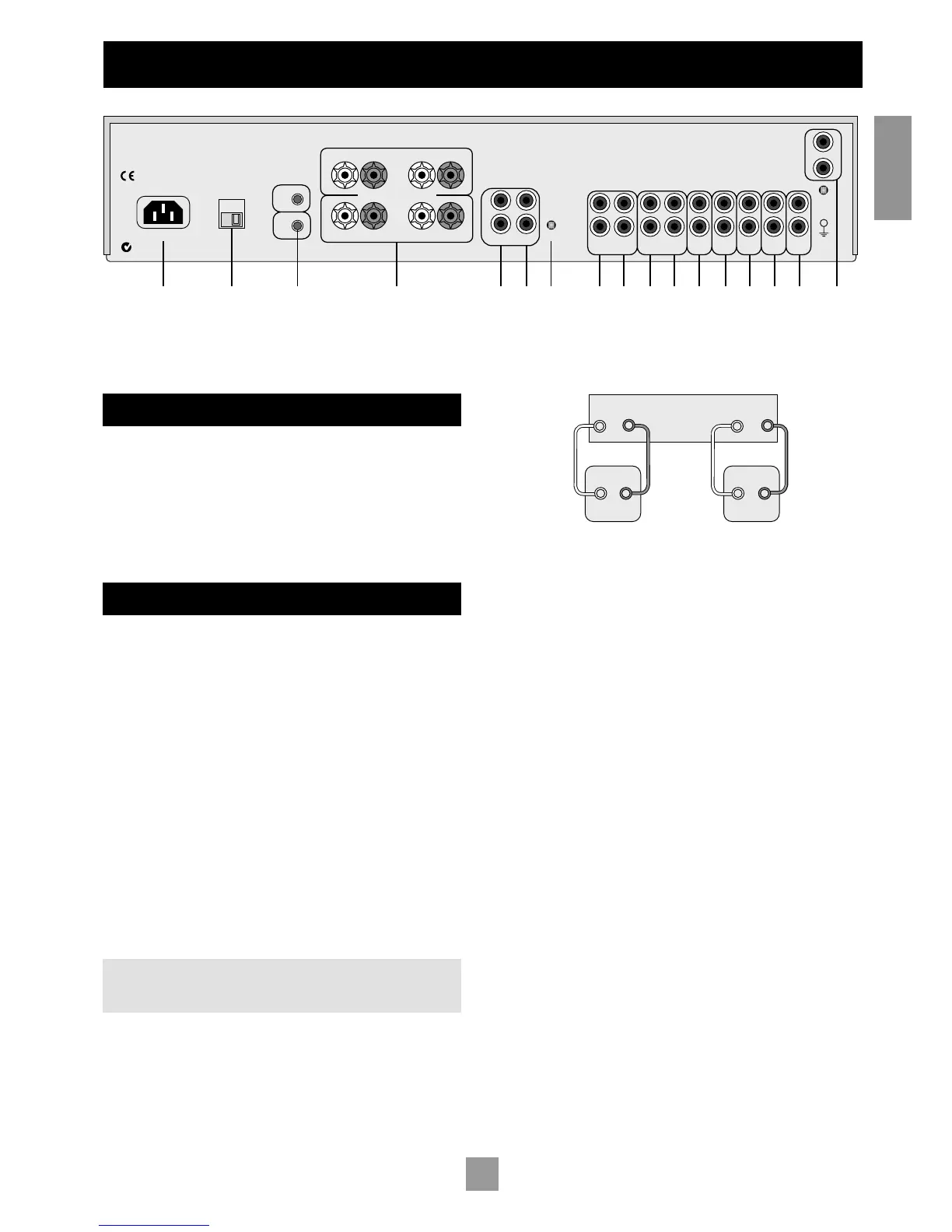
To connect one pair of loudspeakers, use the SP1 terminals.
SP1 and SP2 terminals
4
Both sets of loudspeaker terminals can be switched off by pressing the
MUTE button on the remote control. To switch SP1 and SP2 independently,
use the front panel switches (see page 7,
bk
) or the remote control
(see page 10).
Your amplifier is fitted with industry standard loudspeaker terminals.
The terminal accepts spade terminals or bare wires.
To connect a spade terminal or bare wire, unscrew the red (or black)
part of the loudspeaker terminal first. Insert the wire or spade terminal
and screw it back up.
Installation: A32 integrated amplier
Wiring your loudspeakers
CAUTION: Do not over tighten the loudspeaker terminals or use
a wrench, pliers, etc., as this could cause damage to the terminals
which will not be covered under warranty.
Connect the right speaker to the terminals on the back of your
amplifier marked R and the left speaker to the terminals marked L.
Connect your loudspeakers so that the red (positive/+) terminal on
each loudspeaker is connected to the red (positive/+) terminal on the
amplifier. Your loudspeaker cables may be marked to show polarity
(negative/– and positive/+), if not, then the positive terminal can usually
be identified by a ridge or coloured marking.
Now connect your loudspeakers’ black (negative/–) terminals to the
black (negative/–) terminals on the amplifier.
Ensure that no stray strands of inner wires are allowed to touch
another cable or the amplifier’s casing. This can cause a short circuit
and damage your amplifier!



 To Next Page