14
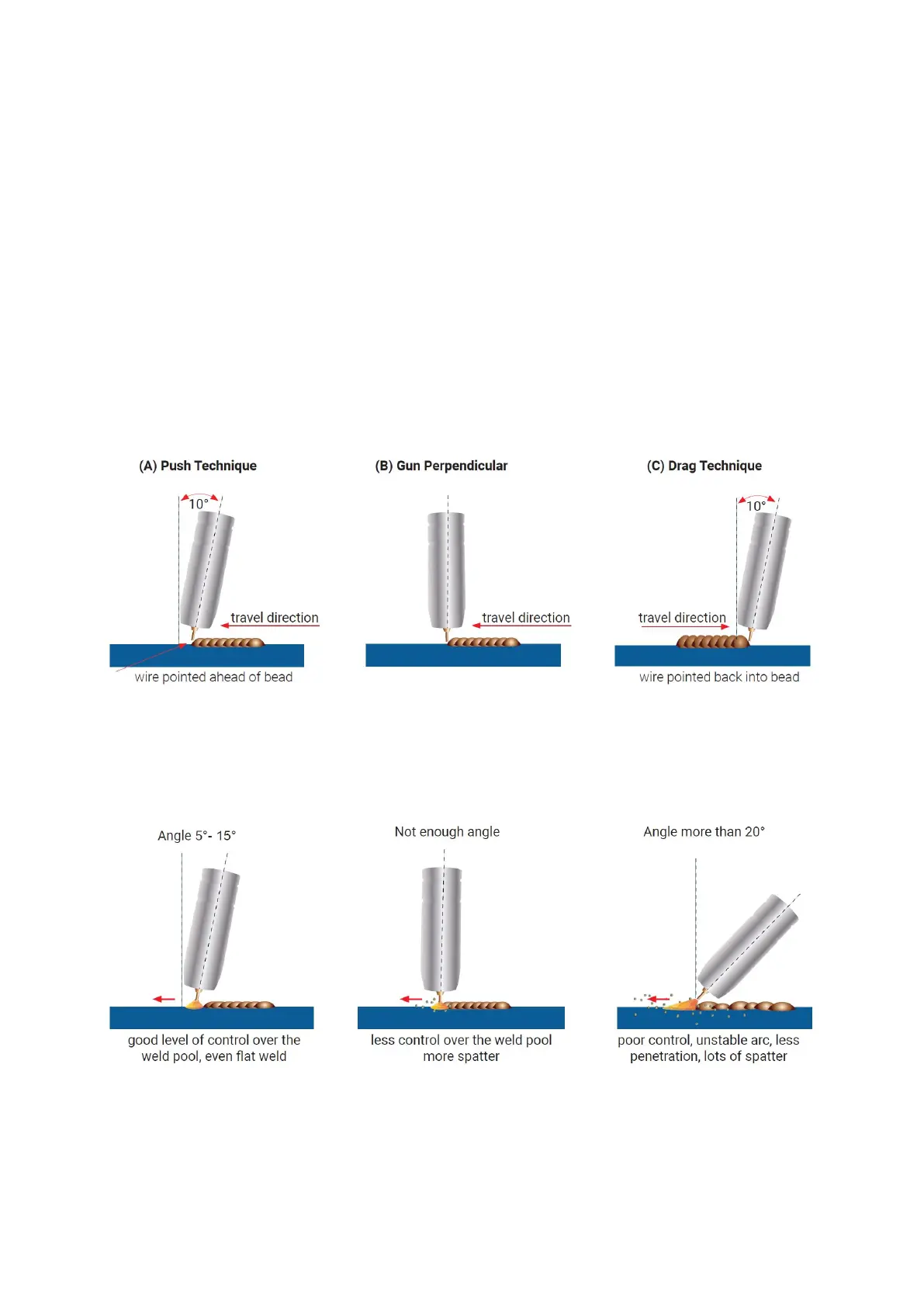
(A) Push Technique
The wire is located at the leading edge of the weld pool and pushed towards the un-melted work
surface. This technique offers a better view of the weld joint and direction of the wire into the weld
joint. Push technique directs the heat away from the weld puddle allowing faster travel speeds
providing a flatter weld profile with light penetration - useful for welding thin materials. The welds are
wider and flatter allowing for minimal clean up / grinding time.
(B) Perpendicular Technique
The wire is fed directly into the weld, this technique is used primarly for automated situations or
when conditions make it necessary. The weld profile is generally higher and a deeper penetration is
achieved.
(C) Drag Technique
The gun and wire is dragged away from the weld bead. The arc and heat is concentrated on the
weld pool, the base metal receives more heat, deeper melting, more penetration and the weld
profile is higher with more build up.
2) Travel Angel
Travel angle is the right to left angle relative to the direction of welding. A travel angle of 5°- 15° is
ideal and produces a good level of control over the weld pool. A travel angle greater that 20° will
give an unstable arc condition with poor weld metal transfer, less penetration, high levels of spatter,
poor gas shield and poor quality finished weld.
3) Angle to Work
The work angle is the forward back angle of the gun relative to the work piece.The correct work
angle provides good bead shape, prevents undercut, uneven penetration, poor gas shield and poor
quality finished weld.
Digital Welder Expert, Know You More
https://www.arccaptain.com


 To Next Page