507405-05 Page 5 of 72Issue 1621
In Canada, installation must conform with current National
Standard of Canada CSA-B149 Natural Gas and Propane
Installation Codes, local plumbing or waste water codes and
other applicable local codes.
In order to ensure proper unit operation in non-direct vent
applications, combustion and ventilation air supply must be
provided according to the current National Fuel Gas Code
or CSA-B149 standard.
Locations and Clearances
This furnace is CSA International certied for installation
clearances to combustible material as listed on the unit
nameplate and in the table in Figure 13. Accessibility
and service clearances must take precedence over re
protection clearances.
NOTE: When furnace is installed on a combustible oor,
a downow combustible ooring base must be installed
between the furnace and the oor.
For installation in a residential garage, the furnace must be
installed so that the burner(s) and the ignition source are
located no less than 18 inches (457 mm) above the oor.
The furnace must be located or protected to avoid physical
damage by vehicles. When a furnace is installed in a public
garage, hangar, or other building that has a hazardous
atmosphere, the furnace must be installed according to
recommended good practice requirements and current
National Fuel Gas Code or CSA B149 standards.
Note: Furnace must be adjusted to obtain a temperature
rise within the range specied on the unit nameplate. Failure
to do so may cause erratic limit operation and premature
heat exchanger failure.
This gas furnace must be installed so that its electrical
components are protected from water.
Installed in Combination with a Cooling Coil
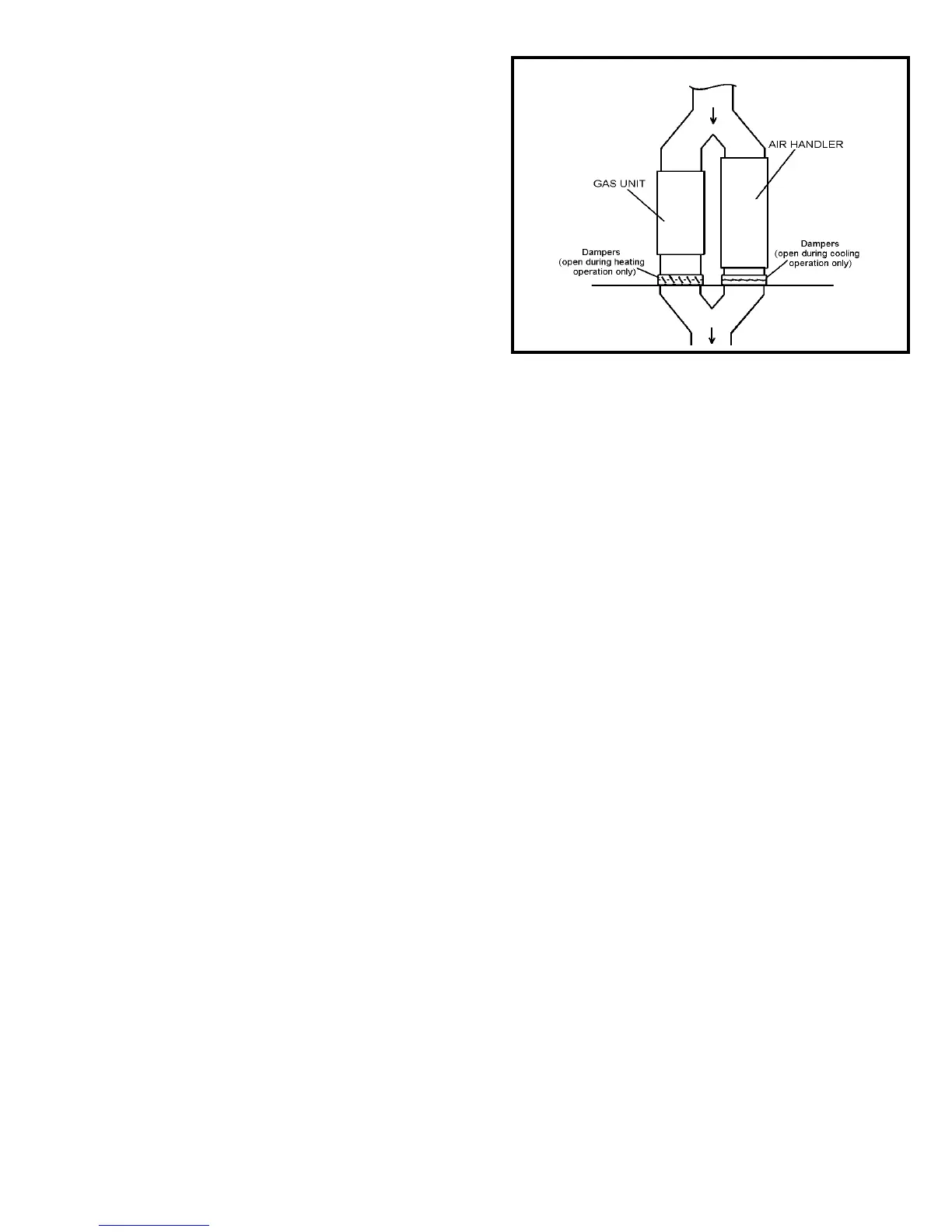
When this furnace is used with cooling units (Figure 3),
it shall be installed in parallel with, or on the upstream
side of, cooling units to avoid condensation in the heating
compartment. With a parallel ow arrangement, a damper
(or other means to control the ow of air) must adequately
prevent chilled air from entering the furnace. If the damper is
manually operated, it must be equipped to prevent operation
of either the heating or the cooling unit, unless it is in the
full HEAT or COOL setting.
When installed, this furnace must be electrically grounded
according to local codes. In addition, in the United States,
installation must conform with the current National Electric
Code, ANSI/NFPA No. 70. The National Electric Code
(ANSI/NFPA No. 70) is available from the following address:
National Fire Protection Association
1 Battery March Park
Quincy, MA 02269
In Canada, all electrical wiring and grounding for the unit
must be installed according to the current regulations of
the Canadian Electrical Code Part I (CSA Standard C22.1)
and/or local codes.
NOTE: This furnace is designed for a minimum continuous
return air temperature of 60°F (16°C) or an intermittent
operation down to 55°F (13°C) dry bulb for cases where a
night setback thermostat is used. Return air temperature
must not exceed 85°F (29°C) dry bulb.
This gas furnace may be installed in alcoves, closets, attics,
basements, garages, and utility rooms.
This furnace design has NOT been CSA certified for
installation in mobile homes, recreational vehicles, or
outdoors.
Never use an open ame to test for gas leaks. Check all
connections using a commercially available soap solution
made specically for leak detection.
Use of Furnace as Construction Heater
These units are not recommended for use as a construction
heater during any phase of construction. Very low return air
temperature, harmful vapors and operation of the unit with
clogged or misplaced lters will damage the unit.
These units may be used for heating of buildings or
structures under construction, if the following conditions
are met:
• The vent system must be permanently installed per
these installation instructions.
• A room thermostat must control the furnace. The use
of xed jumpers that will provide continuous heating is
not allowed.
• The return air duct must be provided and sealed to the
furnace.
• Return air temperature range between 60°F (16°C) and
80°F (27°C) must be maintained.
• Air lters must be installed in the system and must be
maintained during construction.
Figure 3


 To Next Page