507405-05 Page 9 of 72Issue 1621
INSTALLATION – Setting Equipment
WARNING
Blower access panel must be securely in place when
blower and burners are operating. Gas fumes, which
could contain carbon monoxide, can be drawn into living
space resulting in personal injury or death.
WARNING
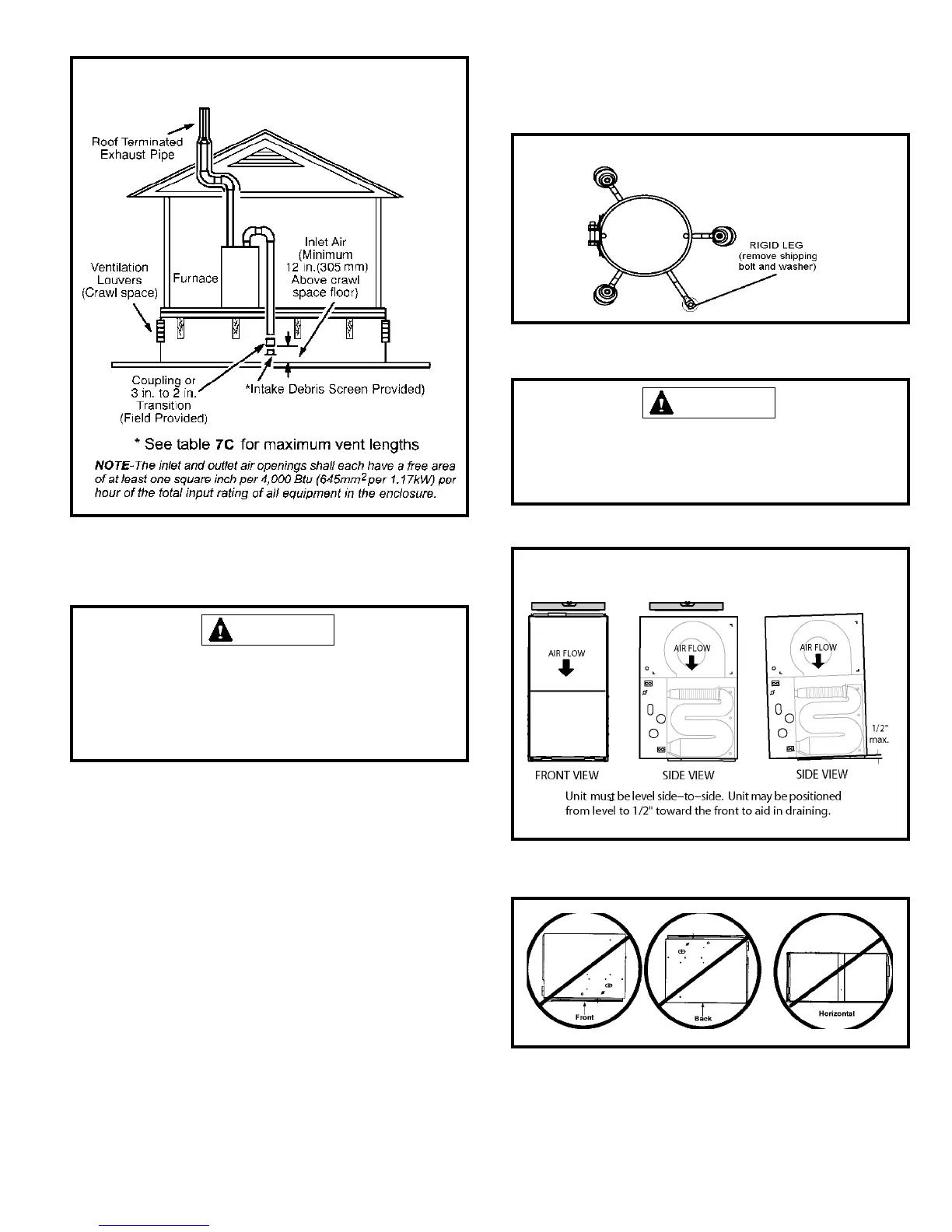
Do not install the furnace on its front, back or in the
horizontal position. See Figure 12. Do no connect the
return air ducts to the back of the furnace. Doing so
will adversely affect the operation of the safety control
devices, which could result in personal injury or death.
Select a location that allows for the required clearances that
are listed on the unit nameplate. Also consider gas supply
connections, electrical supply, vent connection, condensate
trap and drain connections, and installation and service
clearances [24 inches (610 mm) at unit front]. The unit must
be level from side to side. Tilt the unit slightly (maximum
1/2 in. from level) from back to front to aid in the draining of
the heat exchanger. See Figure 11.
Shipping Bolt Removal
NOTE: Units with a 1/2 hp blower motors are equipped with
three exible legs and one rigid leg. The rigid leg is equipped
with a shipping bolt and a at white plastic washer (rather
than the rubber mounting grommet used with a exible
mounting leg). See Figure 10. The bolt and washer must
be removed before the furnace is placed into operation.
After the bolt and washer have been removed, the rigid leg
will not touch the blower housing.
Allow for clearances to combustible materials as indicated
on the unit nameplate. Minimum clearances for closet or
alcove installations are shown in Figure 13.
Figure 11
Setting Equipment
Figure 10
Units with 1/2 HP Blower Motor
Figure 12
Figure 9
Equipment in Conned Space
(Inlet Air from Ventilated Crawlspace & Outlet Air to Outside)


 To Next Page