507405-05 Page 7 of 72Issue 1621
All gas-red appliances require air for the combustion
process. If sufcient combustion air is not available, the
furnace or other appliance will operate inefciently and
unsafely. Enough air must be provided to meet the needs of
all fuel-burning appliances and appliances such as exhaust
fans which force air out of the house. When replaces,
exhaust fans, or clothes dryers are used at the same time
as the furnace, much more air is required to ensure proper
combustion and to prevent a down draft. Insufcient air
causes incomplete combustion which can result in carbon
monoxide.
In addition to providing combustion air, fresh outdoor air
dilutes contaminants in the indoor air. These contaminants
may include bleaches, adhesives, detergents, solvents and
other contaminants which can corrode furnace components.
The requirements for providing air for combustion and
ventilation depend largely on whether the furnace is installed
in an unconned or a conned space.
Unconned Space
An unconned space is an area such as a basement or large
equipment room with a volume greater than 50 cubic feet
(1.42 m³) per 1,000 Btu (.29 kW) per hour of the combined
input rating of all appliances installed in that space. This
space also includes adjacent rooms which are not separated
by a door. Though an area may appear to be unconned,
it might be necessary to bring in outdoor air for combustion
if the structure does not provide enough air by
Do not install the furnace in a corrosive or contaminated
atmosphere. Meet all combustion and ventilation air
requirements, as well as all local codes.
CAUTION
air is brought into the house for combustion, negative
pressure (outside pressure is greater than inside pressure)
will build to the point that a down draft can occur in the
furnace vent pipe or chimney. As a result, combustion
gases enter the living space creating a potentially dangerous
situation.
In the absence of local codes concerning air for combustion
and ventilation, use the guidelines and procedures in this
section to install these furnaces to ensure efcient and safe
operation. You must consider combustion air needs and
requirements for exhaust vents and gas piping. A portion
of this information has been reprinted with permission from
the National Fuel Gas Code (ANSI-Z223.1/NFPA 54). This
reprinted material is not the complete and ofcial position
of ANSI on the referenced subject, which is represented
only by the standard in its entirely.
In Canada, refer to the CSA B149 Installation codes.
inltration. If the furnace is located in a building of tight
construction with weather stripping and caulking around
the windows and doors, follow the procedures in the “Air
from Outside” section.
Conned Space
A conned space is an area with a volume less than 50
cubic feet (1.42 m³) per 1,000 Btu (.29 kW) per hour of
the combined input rating of all appliances installed in that
space. This denition includes furnace closets or small
equipment rooms.
When the furnace is installed so that supply ducts carry
air circulated by the furnace to areas outside the space
containing the furnace, the return air must be handled by
ducts which are sealed to the furnace casing and which
terminate outside the space containing the furnace. This
is especially important when the furnace is mounted on
a platform in a conned space such as a closet or small
equipment room. Even a small leak around the base of the
unit at the platform or at the return air duct connection can
cause a potentially dangerous negative pressure condition.
Air for combustion and ventilation can be brought into the
conned space either from inside the building or from
outside.
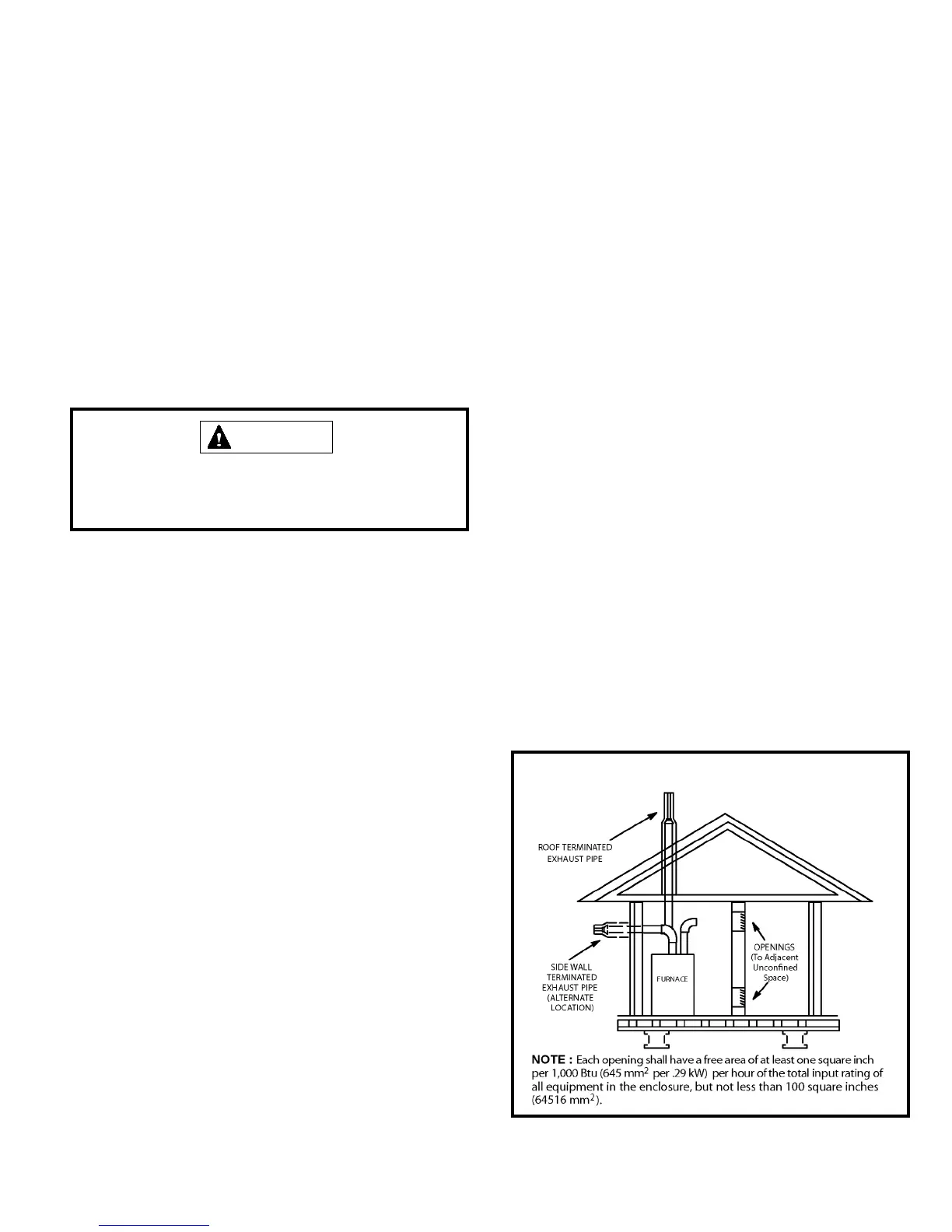
Air from Inside
If the conned space that houses the furnace adjoins a
space categorized as unconned, air can be brought in by
providing two permanent openings between the two spaces.
Each opening must have a minimum free area of 1 square
inch (645 mm²) per 1,000 Btu (.29 kW) per hour of total
input rating of all gas-red equipment in the conned space.
Each opening must be at least 100 square inches (64516
mm²). One opening shall be within 12 inches (305 mm) of
the top of the enclosure and one opening within 12 inches
(305 mm) of the bottom. See Figure 4.
Figure 4
Equipment in Conned Space - All Air from Inside


 To Next Page
 Loading...