NNNMxNh
VC0
2
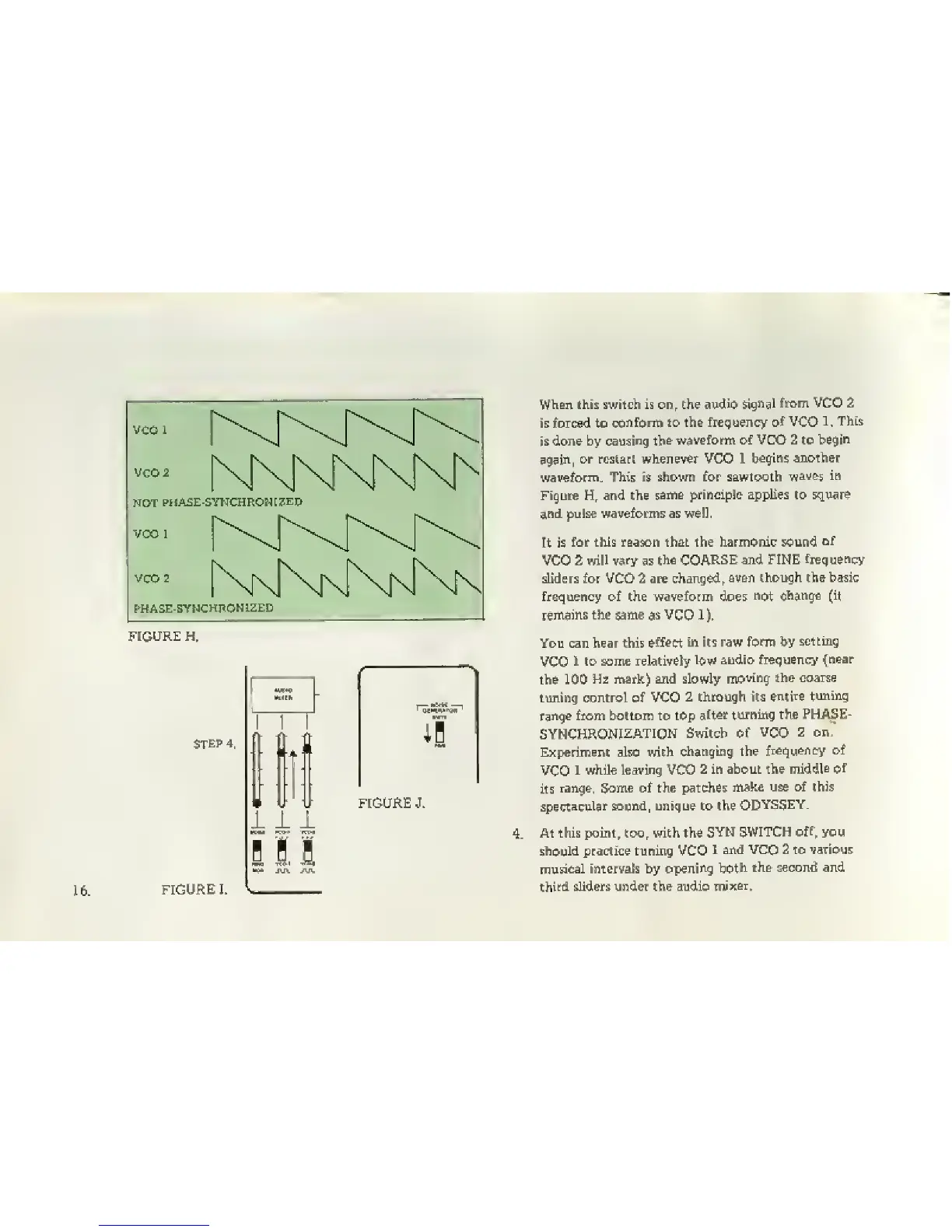
NOT
PHA£E-3THCHKOH[ZED
[VjVJVJVv
PHASE-STHCHPOH
IZED
I 1 I
!!.!
;h
When
this switch is on, the
audio signal
from VCO 2
is forced to
conform to the frequency
of
VCO
1
.
This
is done by
causing the
waveform of VCX!J 2 to hsgid
a9ain,
or restart
whenever
VCO 1
begins another
wavefofm.
This
is
shown for sawtooth
wave?
in
Figure H, and the
sanoe jjrinciple applies to square
and puSse waveforms as we!].
It is
for this reason that the harmo-nic sound
of
VCO 2
will vary
as
the
COARSE
and FINE
frequency
sliders for VCO 2 are changed,
even though the basic
frei^juency of the waveform does
not
change (it
TEniains the same
as
VCO
1
).
You can hear
this
effect in its raw
form
by
setting
VCO
1 to some relatively
low
audio frequency
(near
the
100
Hi mark) and slowly
moving the coarse
tuning control
of VCO
2 through its
entire
tuning
range from bottom to top
after turning the PHASE-
SYMCHRONIZATION
Switch of VCO
2 on.
Experiment also
with
changing the
frequency of
VCO
1 while
leaving
VCO
2 in about the
middle
of
its
range, Some of the
patches
make use of this
spectacular
soynd, unique to the
ODYESEY.
At this point, too, with the
SYH SWITCH
off,
you
should practice tuning VCO
1 and VCO 2 to various
musical
intervals by opening
both
the second and
third
sliders under the audio mixer.


 To Next Page