EasyManua.ls Logo

ARP ODYSSEY - Page 35

ARP ODYSSEY
58 pages
Print Icon
To Next Page IconTo Next Page
To Previous Page IconTo Previous Page
Loading...
1
1
III
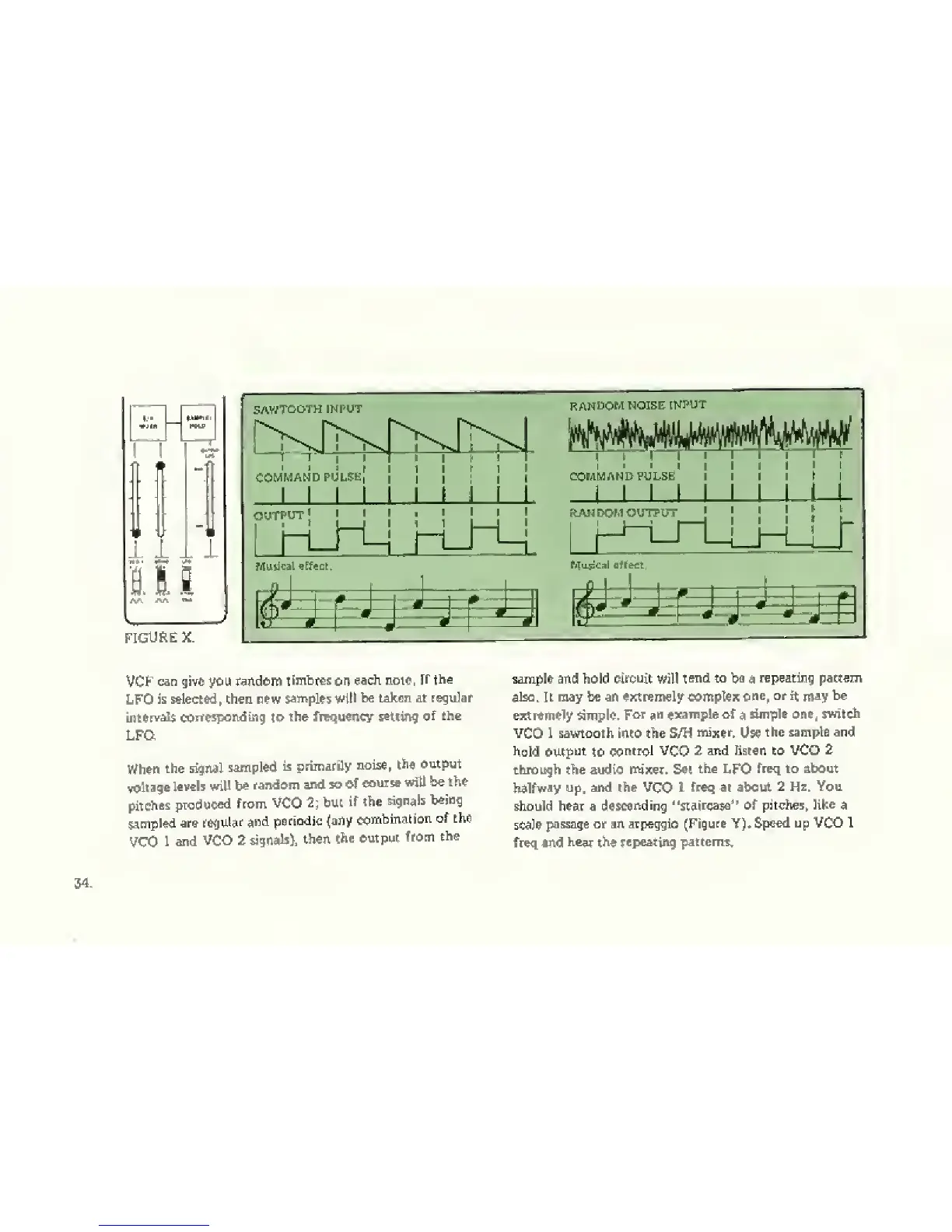
FIGURE
X.
SAWTOOTH
INPUT
RANDOM NOISF.
ENPUT
h>rj>
r>^rf>|
'mihiifimpf^M
1 1 1 1
1
1 1 1
1
OUTPUT
I
I I I I
1
i
I
I I ^ 1 |
_
I
I
I I
COMM AH D PULSE I I I I I I
'
'
ftAH DOM OUTPUT
'
I I !
hrhhrti
i
tP
^
J
r
J
j
tf
VCF
can give you random
timbtescn each noie,
]i
th^
LFO
is wlectfld, then new
samples will
be tak«n at [-eguJar
inurvaJls
oortesponding
to
the fremucflcy s&ttin^
of the
LFO
When
the
signal
sampled
is primarily
noise,
the
output
voltage
levels
will
be
random
and
s> of
coutm
will
be the
pitches
pioduoed
from VCO
2;
but
if the
agnals
teing
sampled
ate
regular
and
periodic
{any
wmbination
of the
VCO
1 and
VCO 2
signals},
then
the
output
from
the
sample and hold
cireuit
will
tend to be a repeating pattern
also.
It
may be an extremely complex
one,
or
it may
be
extremity ^Tnpl?.
For
an
example of a simple one,
switch
VCO
1 sawtooth Into the S/H
mixer.
Use
the sample and
hold
output
to
control
VCO
2 and hsien to VCO
2
throLtgh the audio
nuxer. S?t
the LFO freq to about
halfway
up, and the
VCO
1 freq at
about 2
Hz. You
should hear a
descending "staircase"
of pitches,
like
a
scale
passage or an arpeggio
(Figure
Y) ,
Speed up VCO 1
freq
jnd h&ar the
repeatiifig patterns:.
34.

Other manuals for ARP ODYSSEY

Related product manuals