INSTALLATION & USER MANUAL ENERGY EFFICIENT WOODSTOVE | PHOENIX
15 | Page
Wood combustion rules
If you want less heat, put a smaller quantity of wood in the woodstove and reduce the amount of air. It is however important to maintain
an adequate layer of cinder.
Less heat = Less wood = Less air.
More heat = More wood = More air.
When the woodstove operates at excessively low power or if the wood is not sufficiently dry, soot might deposit on the glass.
8. TERTIARY COMBUSTION (PATENTED)
The three combustion points
The combustion of wood requires a process of primary, secondary, and tertiary combustion to be efficient.
1. Primary combustion
Primary combustion is the initial wood burning at relatively low temperatures. During the primary combustion, large amounts of soot, creosote
and gas are produced due to the existence of water in the wood. Creosote, in primary combustion, contains 60% of the potential energy of
wood, but it is deposited in the form of soot inside the woodstove and the flue without imparting any heating.
2. Secondary combustion
The combustion chamber is insulated so as to increase the temperature of the core and by providing just the right amount of oxygen
necessary to 600
O
C, the creosote ignites spontaneously. This creates a chain reaction that increases the temperature inside the woodstove
from 600
O
C to about 870
O
C without having to add any more fuel. This is the secondary combustion.
Thereby, the more proper secondary combustion is achieved the higher temperatures are produced
and the less residue is left (gas and particles). The vast majority of secondary combustion is only done in
the upper part of the chamber near the outlet of the flue. Thus a large part of the heat that is achieved,
is discharged directly through the draft of the flue to the exterior and not in the heating area.
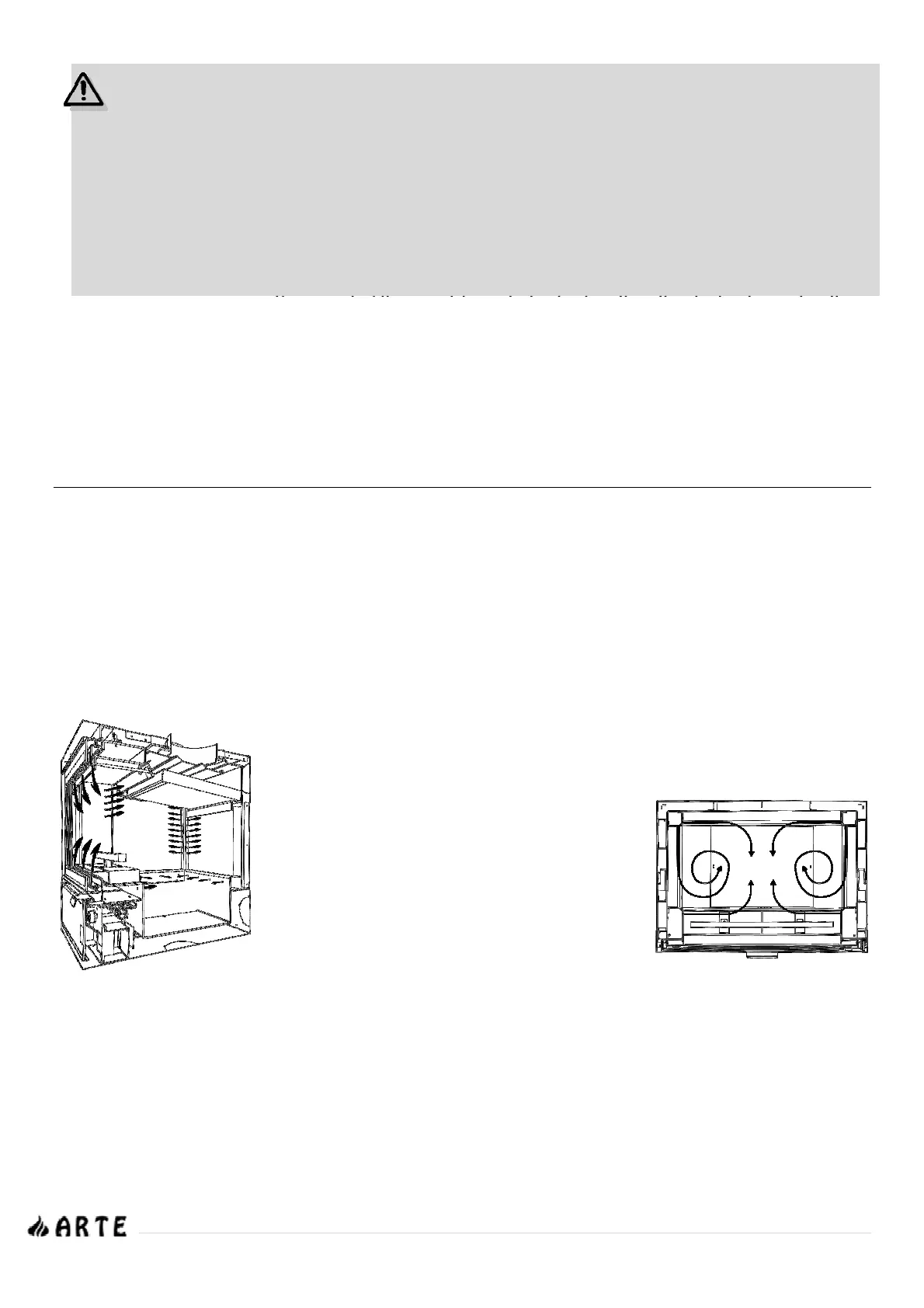
ARTE’s® patented chamber manages to provide the maximum
secondary combustion performance. An automatic air intake
regulating system in cooperation with four or five vertical ducts
and the combustion space having openings, in such a way as to
insert the appropriate amount of hot air through the entire
length of the pipeline, onto the calcined side of the combustion
space and the aircurtains of the ceramic glass (Pic. 8.1.1), results
in the fire receiving the right amount of preheated oxygen
throughout the combustion chamber (Pic. 8.1.2). This way the
whole area of the chamber is converted in a secondary
combustion chamber, not only the upper part, and thus its
performance dramatically increasies and inversely gas residue
reduces.
3. Tertiary combustion
The tertiary combustion occurs when the coal that remains on the bottom burns in a proper and coordinated way. Coal contains a large
amount thermal energy that when used provides a large amount of heat. Proper air flow directly on the coals within such a hot room, results
in almost complete consumption and minimizing the amount of ash that collects on the bottom.
The fire should be vigorous and the smoke exiting from the flue must be almost
unnoticeable.
The fire should not be smoldering because it is causing more pollution.
If the door remains slightly open, fire gases and flames may escape from the
opening of the woodstove causing a risk of fire or asphyxiation. We
recommend installing a smoke detector in the room where the woodstove is
located.
Under no circumstance should you operate the woodstove with the main door
open. You run a serious risk of destroying the device.
DO NOT OVERHEAT THE WOODSTOVE! There is risk of fire or permanent damage.
starts glowing, then the device is overheating.
Pic. 8.1.1
Pic. 8.1.2


 To Next Page