INSTALLATION & USER MANUAL ENERGY EFFICIENT WOODSTOVE | PHOENIX
7 | Page
In case of an existing flue the construction material should be checked. Materials such as cement with lime, galvanized steel and rough or
porous materials are contraindicated as they create issues in the correct operation of the woodstove. Also, a proper study for the flue size
must be conducted because often old flues have quite large diameters. This means that the amount of air draft is not proportional to the
heat generated by the woodstove and by extension means that you consume more wood than necessary and will spend more time on
maintenance. The solution proposed in these cases is the connection of an inner tube inside the flue. This tube should extend over the whole
length of the flue and at no point should exceed in diameter the outlet flue of the woodstove. If the existing flue has the desired diameter a
proper cleaning by qualified personnel should be done.
Inserting the pipe along the outer wall must be properly studied to avoid heat loss. This solution, however, is contraindicated, as positioning
the flue inside the house warms more spaces as heat of the flue remains in the house.
5.4.2. Chimney placement
The placement of the chimney on the roof is a particularly decisive factor in the convection of the woodstove.
An incorrectly fitted chimney may generate reimbursement of exhaust into the heating space due to down flow of the air.
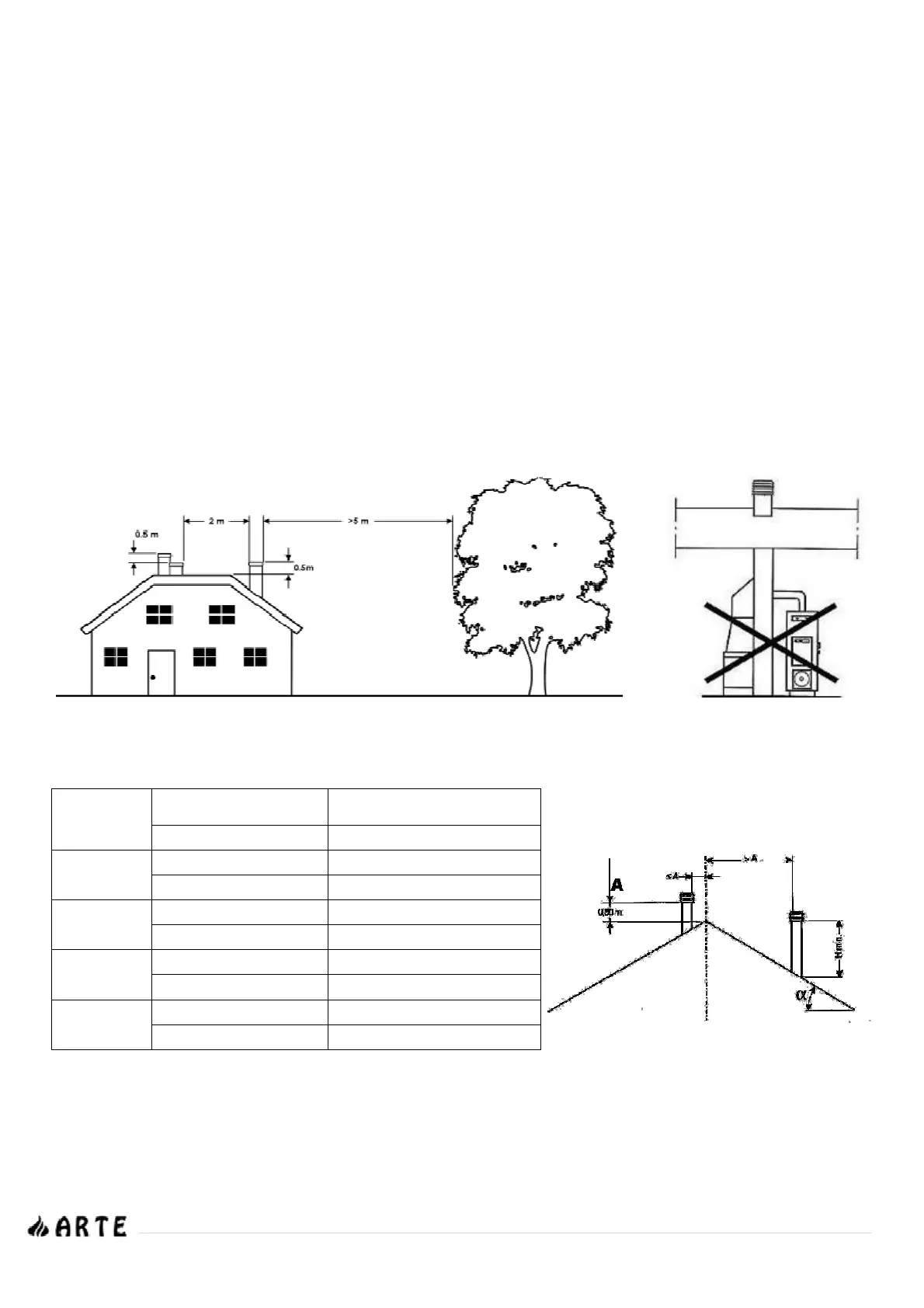
Follow the instructions below to ensure proper dissipation of smoke. (Pic. 5.4.2.1)
The ending of the chimney must be at least 50cm above the top of the roof.
If there is more than one chimney on the roof, they must be positioned at least 2m apart.
If there are two adjacent chimneys, their ends must be at least 50cm apart.
If there is a tall building or tree next to the house, then you should place the chimney at a distance greater than 5m from the obstacle.
It is prohibited to connect several devices to the same chimney. Every chimney should be autonomous. (Pic. 5.4.2.2)
In case of an inclined roof, the height of the chimney is defined depending on the inclination and the distance of the chimney from the
ridge according to the following table. (Pic. 5.4.2.3)
Inclination
α
ο
RIDGE – CHIMNEY
DISTANCE
MIN HEIGHT
ABOVE THE RIDGE
Α (m) H (m)
15
ο
< 1,85 m 0,50 m OVER THE RIDGE
> 1,85 m 1,00 m OVER THE ROOF
30
ο
< 1,50 m 0,50 m OVER THE RIDGE
> 1,50 m 1,30 m OVER THE ROOF
45
ο
< 1,30 m 0,50 m OVER THE RIDGE
> 1,30 m 2,00 m OVER THE ROOF
60
ο
< 1,20 m 0,50 m OVER THE RIDGE
> 1,20 m 2,60 m OVER THE ROOF
Pic. 5.4.2.3
5.4.3. Chimney cap
The chimney draft depends broadly on the adequacy of the cap.
So, in case the chimney is built, its exhaust diameter should be at least twice the inside diameter of the chimney. Knowing that it is necessary
to protrude from the ridge of the roof, the cap must ensure the proper smoke dissipation in case of strong wind.
A chimney cap must meet the following requirements:
Pic. 5.4.2.1
Pic. 5.4.2.2


 To Next Page