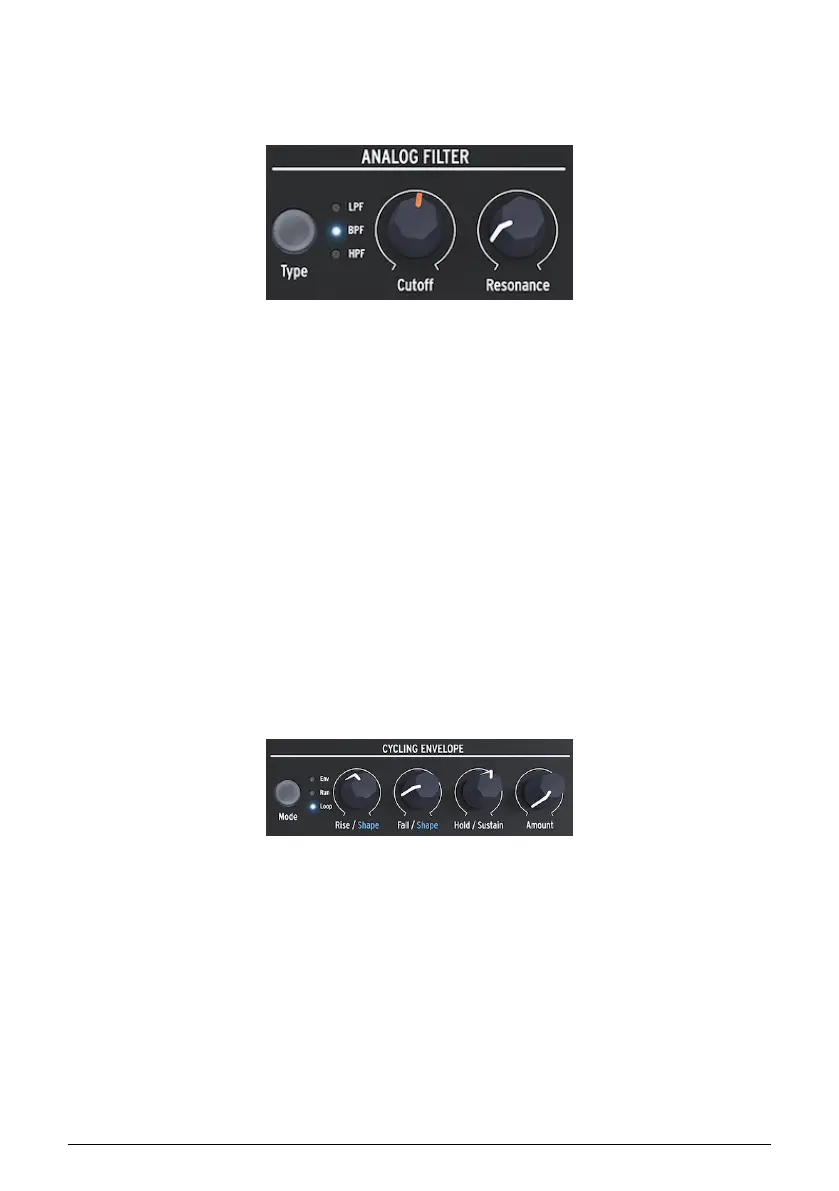
3.1.2.3. Analog filter
The Analog Filter enables you to emphasize or suppress the harmonics contained in the
sound of the Digital Oscillator. Simply put, the filter changes the timbre of the oscillator.
The Analog Filter [p.45] is like a magnifying glass that reveals everything that is present in
the sound of the Digital Oscillator. Or to use a better analogy; it is a searchlight that moves
over the waveform generated by the Digital Oscillator, dynamically revealing its harmonic
content. It can sweep over the sound with a broad beam or with a very focused, narrow
beam. The focus of this beam is called Resonance. The point where the filtering becomes
effective is called the cutoff point.
The are three types of filters in the MicroFreak: a Low Pass Filter (LPF), a Band Pass Filter
(BPF), and a High Pass Filter (HPF). The Low Pass Filter attenuates (weakens) or removes
frequencies above the cutoff frequency. The Band Pass Filter attenuates (weakens) or
removes frequencies above and below the cutoff frequency. The High Pass Filter attenuates
(weakens) or removes frequencies below the cutoff frequency.
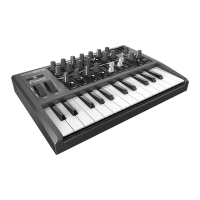
3.1.2.4. Cycling Envelope
The Cycling Envelope Generator is an excellent tool for generating complex modulation
signals. An envelope is often used to control the loudness of a sound, but it can be used
for many other purposes. The Cycling Envelope is a general purpose envelope, the output of
which you can use to modulate all destinations on the Matrix.
Unlike a standard envelope that cycles through its stages only once, the Cycling Envelope
[p.54] can retrigger itself after the last stage has finished.
The Analog Filter
The Cycling Envelope Generator
13 Arturia - User Manual MicroFreak - MicroFreak Overview



 To Next Page