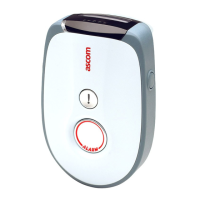
The 9dLD Locator, Version D, is a DECT-based location device designed for use within the Ascom IP-DECT System to provide location functionality. Handsets within the system can be programmed to measure the radio signal of the 9dLD and evaluate whether it represents the best location. This location information is then transmitted along with an alarm, indicating the handset's position.
Function Description
The 9dLD Locator enables location tracking for handsets in an Ascom IP-DECT System. It broadcasts a DECT signal that handsets can detect and measure. By comparing the strength of the signal from different 9dLDs and their configured RSSI threshold values, a handset can determine its "best" location. This location information is crucial for alarm transmission, providing an indication of the handset's position when an alarm is triggered. The device supports up to two distinct location IDs, each with its own configurable RSSI threshold. Tamper monitoring is a key feature, detecting if the device's lid is opened, if external antennas are disconnected, or if there's a supply voltage issue. The device can be configured and updated using the Portable Device Manager (PDM) Windows version via an RS232 serial connection.
Important Technical Specifications
- Supply Voltage: 12-24 V DC.
- Power Consumption: 0.7 W.
- Cable Entries: The 9dLD is delivered with five IP65 classified cable entries for power and antenna cables. Drill holes for these entries are 12.5 mm for power cables (3-5 mm cable diameter) and 16.5 mm for antenna cables (5-7 mm cable diameter).
- Antenna Support: Supports up to four antennas (one internal and up to three external, or up to four external if no internal antenna is used).
- Mounting: Recommended mounting height for internal antenna is 1.5 m (1.2 - 1.8 m), aligning with handset carrying height. For external antennas, it's also recommended to be at handset carrying height, and no more than 10 m of cable length from the 9dLD box due to signal attenuation (approx. 0.8 dB/metre).
- RSSI Threshold Range: Configurable from 45 to 93, corresponding to radio signals of -45 to -93 dBm.
- Monitor Output: Galvanically isolated relay contact (< 15 ohm) for supervision. Opens to > 1 M ohm on fault detection.
- Regulatory Compliance: Complies with Radio Equipment Directive 2014/53/EU, RoHS3 2015/863, and FCC Part 15 for Class B digital devices.
Usage Features
- Location Area Level (LAL), Primary Access Rights Key (PARK), PARK Length Indicator (PLI): These system registration parameters are essential for the 9dLD to function within the DECT system and can be configured via the PDM.
- Location ID: Each 9dLD can be programmed with up to two unique location IDs (000-FFF hexadecimal). These IDs are transmitted with location information.
- RSSI Threshold Setting: The RSSI threshold value determines how close a handset needs to be to the 9dLD antenna to consider it the "best" location. This can be set via the PDM or manually adjusted using switches (SW01-SW02 for location 1, SW03-SW04 for location 2) on the 9dLD board. Each press of a switch increases/decreases the value by 1 dBm. Holding the switch sets it to the maximum/minimum value.
- Immediate Alarm Transmission: When enabled, if a handset with special location features receives the location, an alarm of type "Special Location" is sent immediately.
- Tamper Monitoring: The device includes a reed relay (SW1) for tamper protection. If the lid is opened or external antennas are disconnected, the monitor output relay contact will open, signaling a fault. Jumpers (1A-1B, 2A-2B, X, Y) on the board enable monitoring for open circuit and/or short circuit detection for external antennas, depending on the antenna design.
- LED Indicator (LED1): A green LED indicates that the 9dLD is operational and synchronized to the system. It flashes orange once upon power-on.
Maintenance Features
- Parameter Configuration: All system registration and location parameters can be changed using the PDM Windows version. This allows for fine-tuning of the device's behavior and range.
- Software Upgrade: The 9dLD's software can be upgraded via an RS232 connection using the PDM. This ensures the device can be kept up-to-date with the latest features and bug fixes.
- Troubleshooting Software Download: If a software download is interrupted or fails, disconnecting and reconnecting the power supply allows for a restart of the download process.
- Installation Check: After installation, a check involves verifying the LED status (steady green indicates operational and synchronized) and using a handset to confirm correct coverage and reception of location and threshold values.
- Monitor Output for Supervision: The galvanically isolated relay contact provides a continuous supervision signal. An open circuit on this output indicates a fault, such as tamper protection activation or supply voltage disconnection, facilitating remote monitoring and maintenance.
- Antenna Modification (for Huber+Suhner 22649572): For specific third-party antennas, a modification involving soldering a 1/8 W, 3.3 kOhm carbon resistor to the PCB is required if open circuit detection is desired. This ensures proper tamper monitoring for these antennas.

 Need help?
 General

 To Next Page