BOATING SAFETY
|
41
Aids to Navigation
Learn to recognize the different buoys and day markers; they are the signposts
of the waterways. The United States Aids to Navigation System (USATONS) is the
primary marking system used on inland water, coastal waters and rivers in the
United States. This system is maintained by the U.S. Coast Guard (USCG).
There are two primary marking systems in use in the U.S.: the Uniform State
Waterway Marking System (USWMS), used on inland waters and maintained by
each state, and the Federal Waterway Marking System (FWMS), used on coast-
al waters and rivers and maintained by the USCG. In addition, the FWMS has two
modified systems: the Western River Buoyage, and the Intercoastal Waterway
Buoyage. Be sure to check with local authorities on the buoyage system in use.
The type of hazard/warning buoys and markers depends on the area of juris-
diction. Check with local boating authorities.
USWMS System
In the USWMS Lateral System, well-defined channels are marked with red and
black buoys. Lateral means the sides of the channel are marked and the boat
should pass between them. The USWMS Cardinal System is used when there
is no well-defined channel or where an obstruction may be approached from
more than one direction. With the cardinal system:
• Pass north or east of BLACK-TOPPED WHITE buoy.
• Pass south or west of RED-TOPPED WHITE buoy.
• RED and WHITE VERTICALLY STRIPED buoy indicates boat should pass
outside of the buoy (away from shore).
FWMS System
The FWMS Lateral System is for use on navigable waters except Western Riv-
ers and Intercoastal Waterways. The markings on these buoys are oriented from
the perspective of being entered from seaward (the boater is going toward
the port). This means that red buoys are passed on the starboard (right) side
of the vessel when proceeding from open water into port, and green buoys to
the port (left) side.
The right side (starboard) of the channel is marked with RED,
even numbered buoys.
The left (port) side of the channel is marked with GREEN, odd numbered buoys.
The middle of the channel is marked with RED and WHITE vertically striped
buoys; pass close to these buoys.
Obstructions, channel junctions, etc. are marked with RED and GREEN hori-
zontally striped buoys. A RED band at the top means the preferred channel is to
the left of the buoy; a GREEN top band means the preferred channel is to the
right of the buoy.
Day markers are colored and numbered the same as buoys. RED, triangular day
markers with even numbers mark the starboard side of the channel. GREEN,
square day markers with odd numbers mark the port side of the channel.
Lights, bells and horns are used on buoys for night or poor visibility conditions.
Buoys with unique light flashing characteristics are identified on nautical charts
with the specific flashing pattern.
Types of Buoys
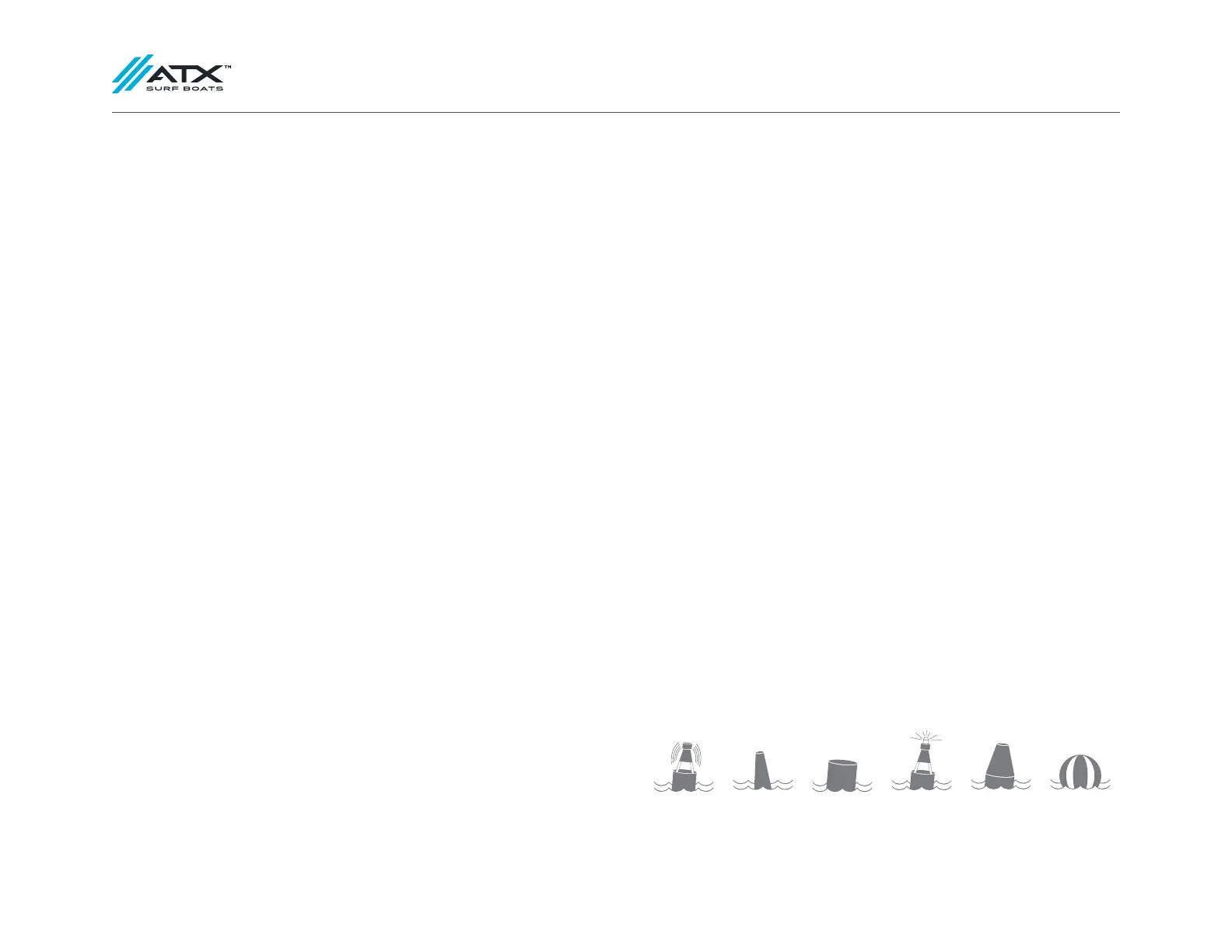
There are several types and shapes of buoys. Buoys may be unlighted, lighted,
with sound or may have both an audible and a visual signal. Lights, bells and
horns are used on buoys for night or poor visibility conditions. Different shapes of
buoys are shown below.
UNLIGHTED
BELL BUOY
SPAR BUOY CAN BUOY LIGHTED
BUOY
NUN BUOY SPHERICAL
SAFE WATER
MARKER



 To Next Page