OPERATION
|
66
Follow these guidelines when docking:
• Approach docks slowly with the starboard side of the boat if possible.
• Come to a stop a short distance from the dock, then proceed slowly.
• Have fenders, mooring lines and crew ready.
• Observe how the wind and current are moving your boat. Approach the
dock with the boat pointed into the wind, if possible. If the wind or current is
pushing you away from the dock, use a sharper angle of approach. If you
must approach the dock downwind or down current, use a slow speed and
shallow angle. Be ready to reverse to stop and maintain position.
• If there is no wind or current, approach the dock at a 10- to 20-degree angle.
• If possible, throw a line to a person on the dock and have that person
secure a bow line.
• With the bow secure, swing the stern in with the engine, or pull it in with a boat
hook.
If the boat is to be moored for a long period of time, use chafing protectors on
lines to protect the gelcoat finish. Leave slack in the lines to allow for some wave
movement or tidal action if applicable.
Follow these guidelines when departing:
• Very slowly shift into forward at idle speed.
• When the stern moves away from the dock, turn the engine away from
the dock.
• Cast off bow line and back away.
If the wind or current is pushing away from the dock, cast off all lines and allow
to drift until you are clear.
STARTING
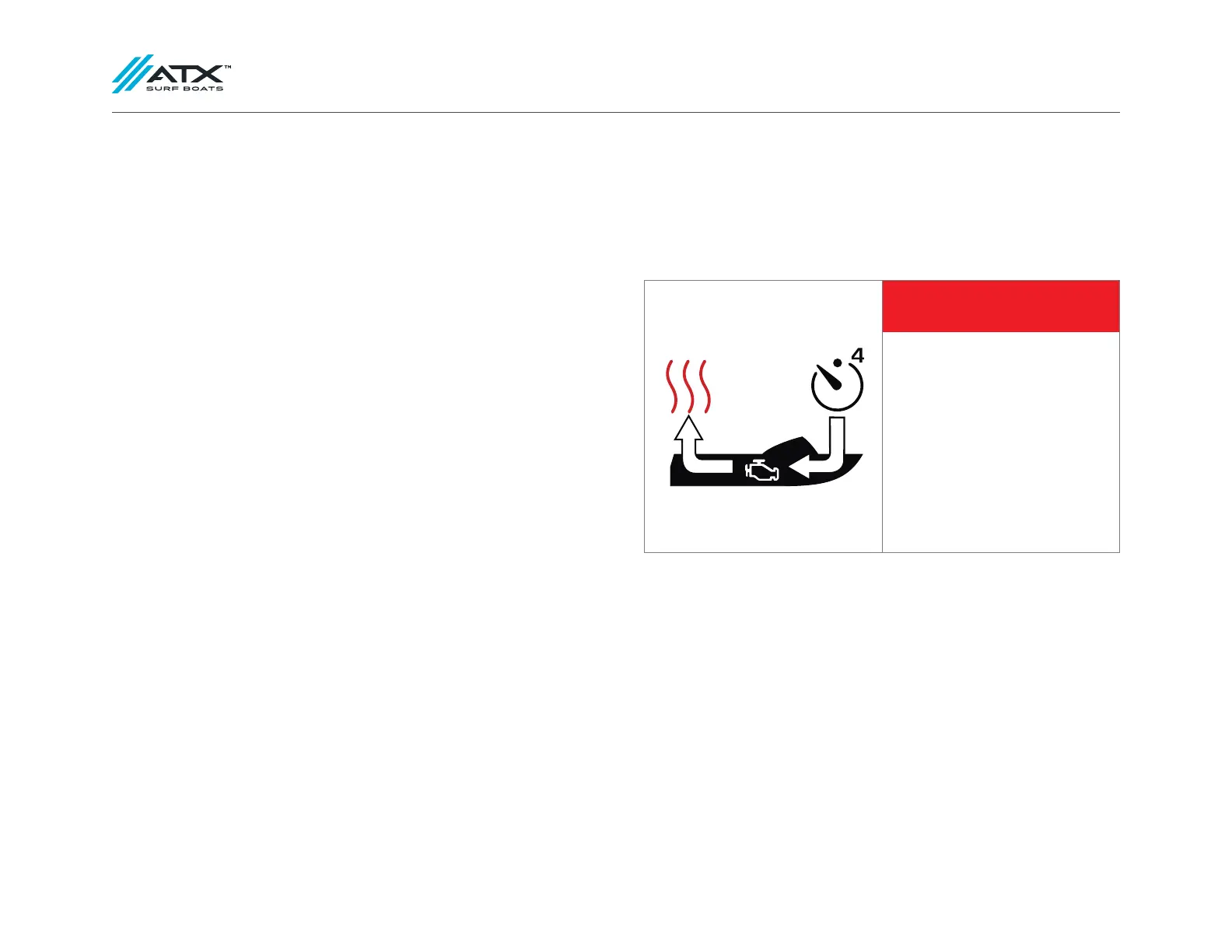
• Run the blower for at least four minutes before starting the engine. If you
smell gasoline fumes, do not start the engine. Continue to run the blower
until fumes have dissipated.
DANGER
GASOLINE VAPORS CAN EXPLODE
RESULTING IN SERIOUS INJURY
OR DEATH
• Before starting engine, check the
engine compartment for gasoline or
gasoline vapors, then run blower for
4 minutes.
• Run blower at idle or below cruising
speed and after stopping to clear
vapors from engine compartment.
• Make sure the Saltwater Flush Kit shut-off valve (if equipped) and
seacock on water pickup are open (handle in-line [OPEN] with hose,
not perpendicular [CLOSED]).
• Make sure the emergency stop switch is attached to the switch and the
lanyard is attached to the operator.
• Make sure the shifter/throttle control handle is in NEUTRAL.
• Turn the key clockwise to the START position. After the motor starts, release
the key.
• Push shifter/throttle control handle forward to go forward, pull back
for reverse.
Always pause in NEUTRAL before going into REVERSE to avoid taking water
in over the transom.



 To Next Page