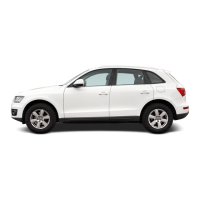
Breakover angle
Indicat es t he ang le up t o which t he vehicle
can drive over a ramp at low speed wit hout
the unde rside of the vehicle hitting the edge
of t he ramp. Maximum permitted breakover
angle: 17°
Approach/departure angle
Transition from the horizont al plane to a gra-
dient or from a grade back to level ground. In-
dicates the angle up to which t he vehicle can
drive onto or off a slope at low speed without
stri king the bumper or the underbody. Maxi-
mum permitted approach/departure angle :
25° (front), 20° (rear)
Ground clearance
The distance between the road surface and
the lowest point of the vehicle unde rbody.
Ground clearance 7.9 in (200 mm)
A WARNING
Exceeding the stated maximum figures
-
can result in severe injuries or vehicle dam-
age.
- All the information was gathered on lev-
el, firm and non-slip pery road surfaces,
and unde r dry weat her condit ions.
- Ideal conditions do not prevail offroad .
Never ut ilize t he maximum readings to
t heir fullest, always leave a safety re-
serve.
Driving tips
On poor road and offroad, there is always on-
ly one motto: Plan ahead and drive slowly!
Please observe the following when driving
away from paved roads:
... Drive only on roads and offroad sections
which match the design of your vehicle and
your abilities as a driver. Never ta ke risks!
... Drive slowly and plan ahead!
... Take into cons ide ration the
ground clear-
ance
of your vehicle.
.,. Activate the ESP offroad mode ¢ page 196
as needed.
Driving off road 211
... Use the hill descent assist ¢ page 198 when
driving down steep sect ions on hills.
Unpaved roads and offroad
Drive slowly on unfamiliar roads and unknown
offroad sections, and look out for unexpect ed
obst acles (e.g. potholes, rocks, tree stumps,
etc .).
To prevent the vehicle from bottoming and
avoid da mage to the unde rbody, you should
drive st raight across severe bumps in the
ground with only one side of t he vehicle so
that only two of your whee ls cross the bumps.
Drive briskly through sandy or marshy offroad
sections and do not stop, if at all possib le.
Driving through water
Note t he following to avoid vehicle damag e
when driving through wate r, for examp le on
flooded roads:
- The water must not be any highe r t han the
bottom of the vehicle body.
- Do not drive faster tha n walking speed .
Driving on a slope
If you ever find yourse lf not able to climb a
slope, do not t ry to tur n arou nd, drive back
down in
reverse. Othe rwise, you run the risk
of tipp ing over.
If the vehicle threatens to tip over when
driving across a slope, you must immediate-
ly steer downhill in the direction of the
slope.
Do not park your vehicle on steep slopes or
grades.
To reduce the risk of tipp ing over, drive on
slopes in the direction of the downward slope
(fall line) -
not crosswise .
Driving on snow-covered ground
The standard tires fitted to your vehicle are
not snow tir es. So you should mount wheels
wit h snow t ires in good t ime whe re winter
road conditions prevail. Before driving on unp-
lowed stretches of deep snow, install tire
chains. For technical reasons, tire chains may ..,_
•
•



 To Next Page