ELEVATING POPTOP ROOF
31 TOGETHER WE’RE GOING PLACES For more information visit www.auto-trail.co.uk 32
The below instructions are relevant only for the Expedition 67 and Expedition 68
models which have a pop-top roof upgrade.
Some compact models may be fitted with an elevating pop-top roof that must be
raised with the front ventilation slot unzipped when the vehicle is used for habitation
purposes. When the roof is in the raised position, it provides an additional double bed.
Upper bunks are for sleeping only, with protection against falling out in position. Care
should be taken against the risk of falling out when this bunk is used by children, and
we would advise that the upper bunks are not suitable for children under six years of
age without supervision.
Raising the roof
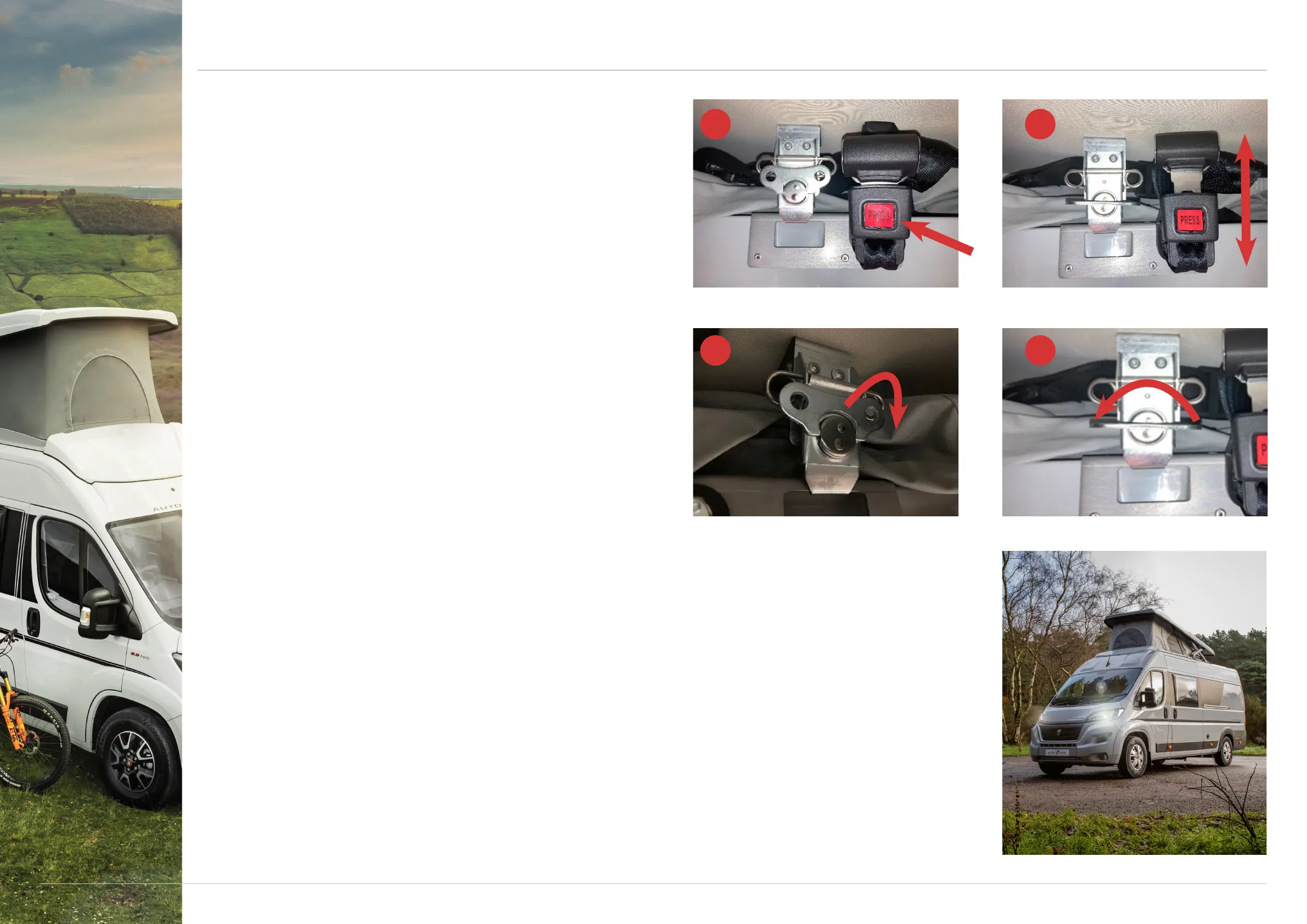
• Release the secondary retaining clips (1) at each side of the roof. This is achieved
by pressing the release buttons and sliding the clips apart (2).
• Rotate the primary catch (3) down from its stored position.
• Rotate the primary catch anti-clockwise (4) to release the tension on the clip.
Unlatch it.
• Push the roof upwards until the gas struts elevate the roof automatically to its full
height.
Closing the roof
Pull down the elevating roof using the two straps attached to the handles on the roof
panel. It is advised that this process is stopped when the roof is half closed to ensure
the roof fabric is folding ‘inside’ the vehicle and will not get trapped between the
vehicle and the GRP roof moulding, or in the latching mechanism.
Securing the primary and secondary catches is just a reversal of the un-latching
procedure, but please ensure no fabric is trapped in the mechanism as this will damage
the material.
Please note: Open a window or door to let increased air pressure in the vehicle escape
when lowering.
Condensation
When the roof is elevated, especially in colder months, there may be signs of
condensation inside the sleeping area. This is perfectly normal. The roof should be
well ventilated to allow air to circulate freely around the sleeping area, drying out
any condensation that may have formed on the material. Failure to dry the canvass
material before lowering and storing the roof for a prolonged period of time may allow
mould to form on the fabric.
You should periodically elevate the roof when not in use to allow air circulation around
the sleeping area.
1 2
3 4
Re-proofing the fabric material
The fabric of the elevating roof should be re-proofed
to maintain the waterproof properties of the material.
This should be done at regular intervals, following the
application instructions of the particular chemical that
you have chosen to use. Likewise, the seams of the
fabric should be treated with a propriety seam seal
chemical, following the manufacturer’s instructions.
The seams will show light transmission points when
new, and are less airtight after repeated use as the yarn
swells and dust and dirt particles settle in the seam
holes. The cotton fabric is made on weaving machines
and then impregnated with a waterproofing treatment
during the manufacturing process. However, cotton is
a natural product, and these micro-holes are caused
by yarn fluctuations that are within the manufacturing
tolerances of the fabric. There is no reduced water
tightness at these points.



 To Next Page