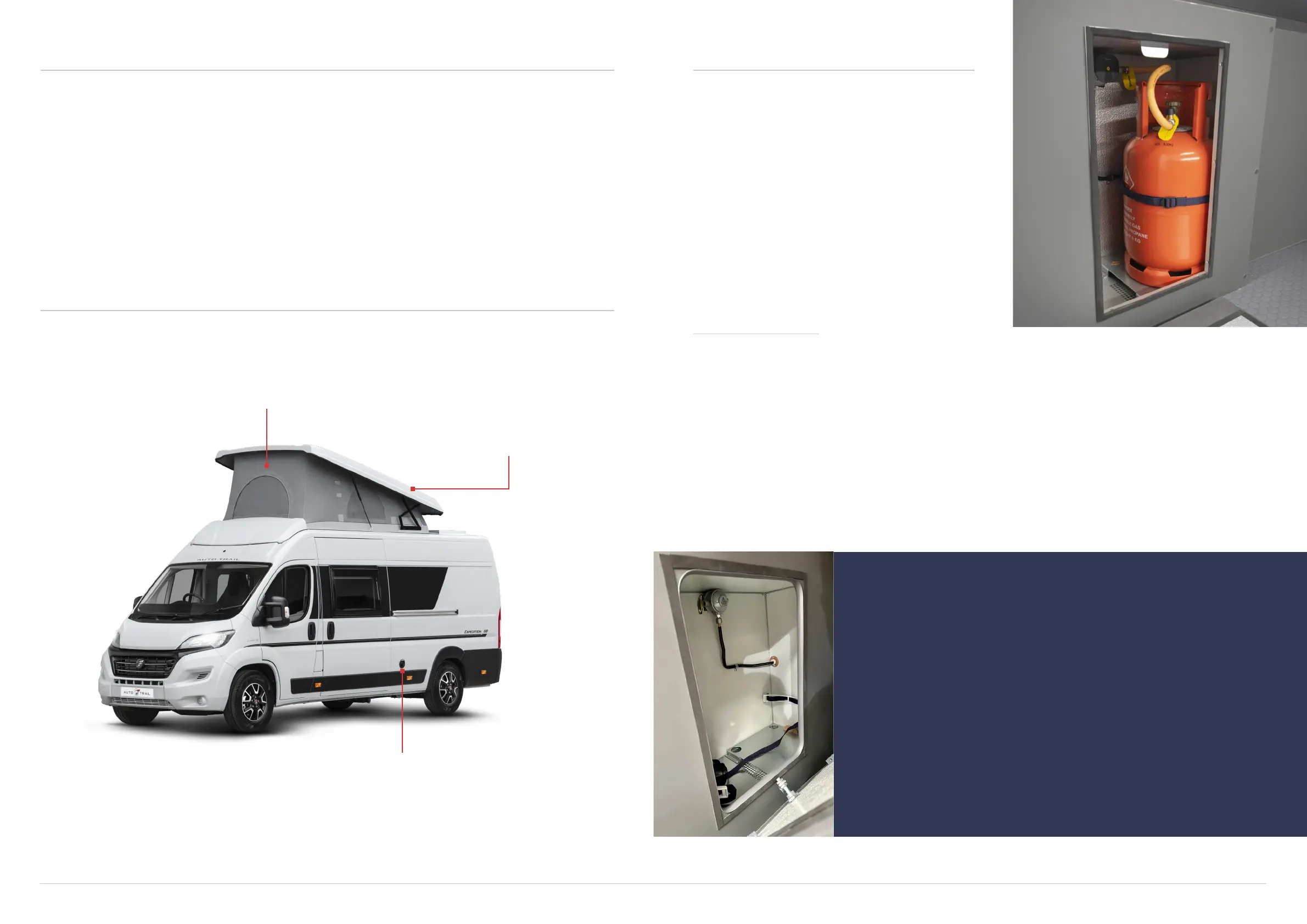
Cylinder compartment
Your vehicle is designed to accept two 3.9kg gas
cylinders (66 and 67) or two 7kg gas cylinders (68),
with the compartment easy to access via a hatch
behind the rear opening doors. The compartment has
low level ventilation to ensure the safe operation of
the cylinders and should not be obstructed in any way.
Please ensure that items stored in close proximity to
the hatch cannot damage any pipe work and fittings,
and cannot block the ventilation.
Gas hoses
Your supplying dealer will advise on the correct type
of high-pressure hose to connect your gas cylinder to
the pressure regulator. This will depend on the type of
gas cylinders you have chosen to carry in your vehicle.
Please inspect flexible hoses regularly for deterioration
or damage and renew, as necessary, with an approved
type. These must also be renewed no later than the
expiry date displayed.
7 TOGETHER WE’RE GOING PLACES For more information visit www.auto-trail.co.uk 8
GAS SERVICES
Elevating pop-top roof (if fitted)
100w solar panel (if fitted)
Fresh water inlet
The gas appliances in your vehicle are fed
from a gas cylinder that is housed in a sealed
cylinder compartment or an under-slung
LPG tank located outside your vehicle.
Gas flows from the gas container to the appliances via
a gas regulator. This regulator provides a working gas
pressure of 30mbar (1.5kg of gas per hour).
All appliances installed by Auto-Trail are designed to
work within this pressure range. Please ensure that
any additional appliances not fitted by Auto-Trail are
capable of working within this pressure.
CONNECTING AND CHANGING A GAS CYLINDER
Before you can connect a gas cylinder to your vehicle, ensure you have the
correct high-pressure hose for the type of bottle chosen. Dierent European
countries have dierent connections. The hose should be fitted to the
bulkhead mounted gas regulator inside your gas compartment.
To connect or change a gas cylinder:
• Extinguish any fire, flame or source of ignition.
• Carefully position the gas cylinders into the gas compartment, locating
the bottle into the retaining devices and taking care not to damage any of
the pipe work or fittings.
• Tighten the straps that will hold the cylinders firmly in the compartment.
• Connect the high-pressure hose to the gas cylinder using a suitable tool.
Please ensure that it is connected properly before opening the cylinder
valve.
PREPARING FOR THE ROAD
EXTERNAL FEATURES
Instructions on how to change a wheel
• Ensure handbrake is fully applied and use wheel chocks if necessary to ensure the vehicle cannot move.
• Remove the wheel trims (if fitted). Use the wheel-brace to slacken o wheel nuts on the wheel to be changed.
• Position the jack under the axle or at the appropriate jacking point.
• Jack up the vehicle until the wheel to be changed is just o the ground.
• Remove the wheel nuts and wheel.
• Fit the spare wheel and reverse the above procedure.
• Tighten all nuts equally to the required torque setting.


 To Next Page