PREPARING FOR THE ROAD
Loading your vehicle
All models manufactured by Auto-Trail are of a well-balanced design. The most common causes of poor stability
include:
• Poor weight distribution inside the vehicle
• Incorrect tyre pressure (see table below)
Try to load heavy items as close to the floor as possible, between the axles and as evenly as possible side to side.
The table should remain in its dedicated storage position whilst the vehicle is in motion.
TOP TIP
Always adhere to the below tyre pressures in your Expedition campervan:
5 TOGETHER WE’RE GOING PLACES For more information visit www.auto-trail.co.uk 6
TYRE SIZE:
COLD BARS
TYRE PRESSURE: COLD BARS
Front Axle Rear Axle
225/75 R16 CP 5.5 5.5
Vehicle weights
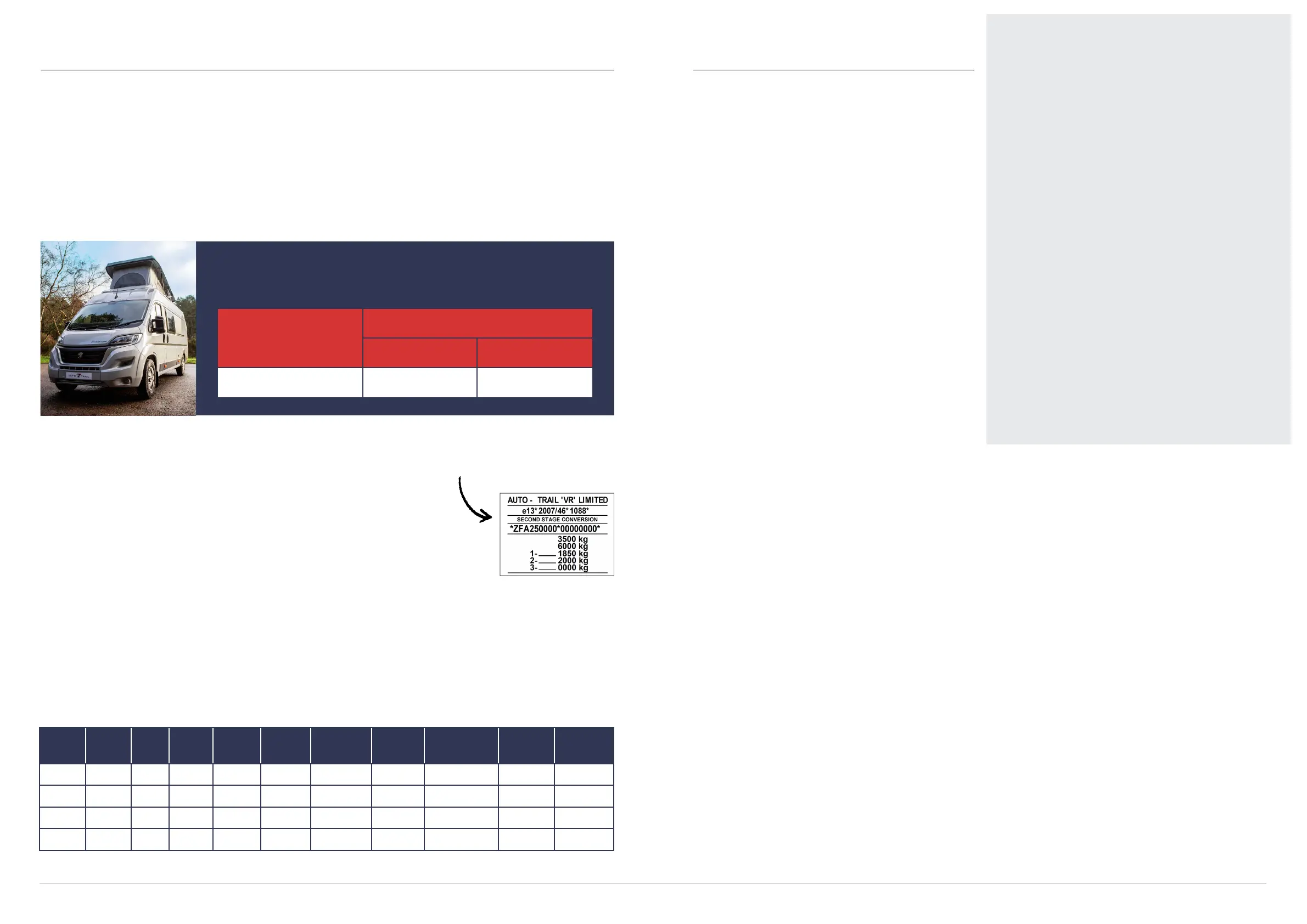
The weights of your vehicle are listed below, and can also be found on the type approval label located in the
engine bay of your vehicle.
Also included on the secondary weight plate is the following information:
• Type approval number of the vehicle
• Maximum authorised vehicle weight (must never be exceeded when vehicle is in use)
• Gross train weight (maximum authorised vehicle weight plus allowance for a trailer)
• '1' is the maximum authorised weight for the individual front axle
• '2' is the maximum authorised weight for the individual rear axle
Please note: if you add both maximum authorised axle weights together it will normally give you a larger figure
than the maximum authorised weight quoted on the plate. You must ensure that both the individual axle weights
and the overall vehicle maximum authorised weight are never exceeded.
When calculating the weight, please ensure you factor in all items you intend to carry in the motorhome. This
includes passengers, equipment, luggage, pets, food, sports equipment etc.
ON THE ROAD
*Numbers correct as of May 2023
MODEL LENGTH WIDTH HEIGHT
MAX.
GROSS
WEIGHT
MASS IN
RUNNING
ORDER
ESSENTIAL
HABITATION
EQUIPMENT
USER
PAYLOAD
MASS OF
CONVENTIONAL
LOAD
MASS FOR
PERSONAL
EFFECTS
MASS FOR
OPTIONAL
EQUIPMENT
66 5.99m 2.05m 2.68m 3,500kg 2,870kg 0kg 630kg 75kg 80kg 475kg
67 5.99m 2.05m 2.68m 3,500kg 2,930kg 0kg 570kg 225kg 100kg 245kg
67 Flex 5.99m 2.05m 2.68m 3,500kg 2,930kg 0kg 570kg 225kg 100kg 245kg
68 6.36m 2.05m 2.68m 3,500kg 2,990kg 0kg 510kg 225kg 103kg 182kg
Vehicle handling
Please remember that your campervan is much larger
than a standard car when carrying out any manoeuvres.
• Allow longer to speed up when overtaking.
• Do not swing out suddenly.
• Carry out all manoeuvres as smoothly as possible.
• Use the nearside wing mirror to check vehicle has
cleared obstacle when overtaking.
• Take care not to bump the kerbs with the wheels.
• Reduce speed accordingly in strong winds, going
downhill or in poor visibility.
• Large, high-speed vehicles can cause air bueting.
Please take extra care when passing or being
passed by a high-sided vehicle.
Driving abroad
Please ensure that you are familiar with the relevant
laws and regulations that apply in the country you are
travelling in. These vary from country to country and
are your responsibility to ensure you comply.
Reversing
Proficiency at reversing can only
be achieved with practice, and we
would recommend that you first
practice in a large, open area.
Many organisations also run training
courses which may help. If your
campervan has been fitted with a
visual reversing aid, please continue
to use self-judgement and remain
vigilant whilst reversing. Auto-Trail
will not accept any responsibility for
any accident caused by a driver's
negligence.
Satellite navigation
Your vehicle may be fitted with an
audio/visual navigation aid. This is
designed to assist the driver whilst
travelling, but it not to replace
the driver's self-judgement as to
the suitability of a specific route
for their vehicle. Auto-Trail will
not accept responsibility for any
accident caused by a driver's
negligence.
Selecting a pitch
When selecting a pitch, do not
park in a position that will obstruct
others, and try to find an area
which is dry, reasonably level and
preferably with a hard base. If you
have no alternative but to pitch on
a slope, ensure that when you leave
you are driving down the slope.
It is always good practice to chock
the wheels of the campervan
when parked on a slope or slippery
surface, even when the brakes are
applied. In poor site conditions,
please keep engine revs as low as
possible to try and avoid wheel
spin, and try to steer as straight as
possible.
Vehicle levelling
Levelling of the campervan on your
chosen pitch must be carried out in
both directions for the refrigerator
and other equipment to function
correctly. You can do this by using
proprietary levelling ramps or
boards.
Seatbelts
Passengers should only be carried
in designated passenger seats
fitted with three-point seat belts.
Children should be seated on
bolster cushions or correctly fitted
child seats when the vehicle is in
motion.
Refuelling
Please ensure that all appliances
and isolation valves are closed
before refuelling your vehicle.
PREJOURNEY CHECKLIST
• Ensure all items are stowed securely, with
minimal heavy items in overhead lockers.
• Close and secure all lockers and
cupboard doors.
• Secure all beds and bedding.
• Close and secure skylights.
• Secure table in its allocated position.
• Ensure fridge is on 12v operation.
• Close and latch all windows.
• Leave curtains and blinds open to aide
visibility.
• Ensure leisure battery is secure.
• Ensure all gas appliances are turned o
where applicable, and that the gas bottles
are correctly positioned and secured.
• Turn o the LPG supply at the gas bottle
valve.
• Ensure that seat swivels are locked in the
forward facing position.
• If relevant, ensure your pop-top roof is
lowered and securely latched.


 To Next Page
 Loading...