3-8
ST50 PLUS RADAR Operation and Installation Handbook
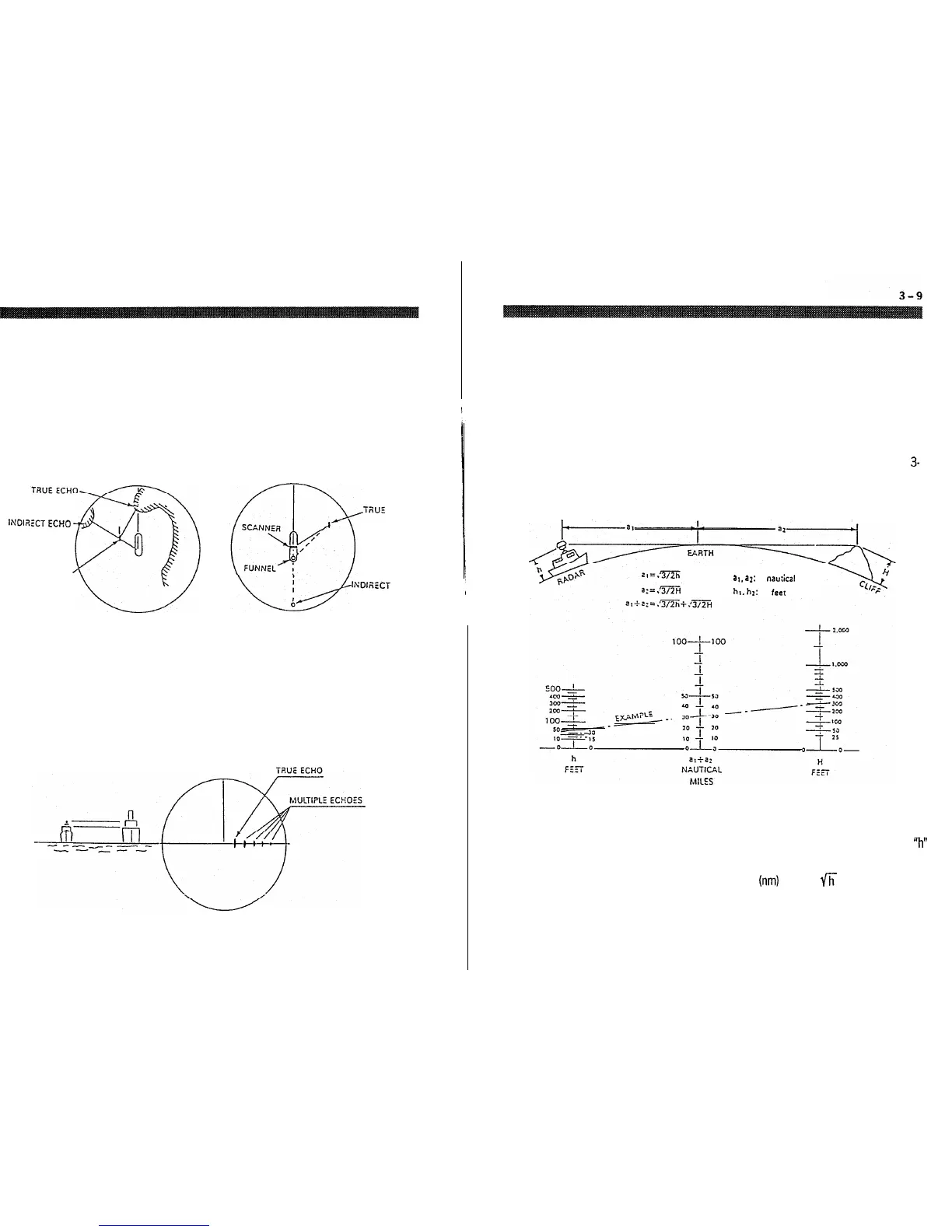
Indirect echoes may appear when there is a large target, such as a
passing ship at a short range, or a reflecting surface, such as a funnel
on your own ship in line with the antenna. The signal, on first striking
the smooth side of the large target, will be reflected, and these
subsequent echo returns to the antenna are shown on the display.
However, the same reflection hits other masts or obstacles and then
gets picked up by the radar antenna with enough strength to appear
as a target on the radar screen.
TiiUE ECHO
lNOlRECT ECHO
PASSING SHIP
INOliiECT ECHO
Multiple echoes could appear if there is a large target having a wide
vertical surface to your own ship at a comparatively short range. The
transmitted signal will be reflected back and forth between the wide
vertical surface of the target and your own ship.
Thus, multiple echoes will appear beyond the true target’s echo on the
same bearing as shown below. This is not a very common phenomena.
Section 3. Operation
3.2.10 Determining Radar Line-of-Sight Range
When searching for distant echoes, the radar line-of-sight range to the
echo can be a limiting factor. Radar waves behave like light waves but
are refracted slightly more, increasing the distance to the radar
horizon to slightly beyond the optical horizon (displayed range is
correct, however). As Fig. 3-1, below, shows, the radar line-of-sight
range is a combination of the radar horizon of the ship’s radar antenna
and the radar horizon of the target. The nomograph shown in Fig. 3-
1, below, provides a convenient method of determining any of the
three factors involved when the other two factors are known.
ai.
a2:
in
naudcal
miles
hl.
hz:
in
feer
Fig. 3-l Radar Line-of-Sight Range Nomograph
The distance to the radar horizon from the radar antenna of height
“h”
meter, under standard conditions, may be calculated from the formula
Distance
(nm)
= 2.23
fi
For example, an antenna at a height of 5 meters has a radar horizon
of 5.0 nm.


 To Next Page