Bandit51
MODEL 75 HYDRAULICS
HYDRAULIC MOTOR CHECK OUT
CORRECTING HYDRAULIC PROBLEMS
MACHINES WITH LIVE HYDRAULICS
To check out the hydraulic motor, the following will be needed: a pressure gauge capable of reading 3000
psi (207 bar), a Tee tting to install to the control valve, a plug tting to install in the control or relief valve, and
a clean 5 gallon (19L) pail.
1.
The following instructions are for machines
with Live Hydraulics, for machines without Live
Hydraulics contact your local dealer or Bandit
Industries.
In order to check out a hydraulic motor, it is
necessary to mechanically stop the motor from
turning while under load. The hydraulic pump
needs to be driven without turning the chipper
disc/drum (Live Hydraulics). Feed a reasonably
large size log into the machine until it contacts
the stationary disc/drum. This should stall the
hydraulic motor(s). It may also be necessary
to apply down pressure by operating the yoke
control valve (if equipped).
With the feedwheel(s) mechanically locked as
described, turn the engine o and keep the
key in your possession. If the hydraulic motor
does not have a case drain, unhook the hose
going from the hydraulic motor back to the
control valve at the valve, some machines will
be equipped with a ow divider between the
hydraulic motor and the control valve. If the
hydraulic motor has a case drain, unhook the
case drain hose that goes to the relief valve at
the valve and put the hose into the hydraulic
tank.
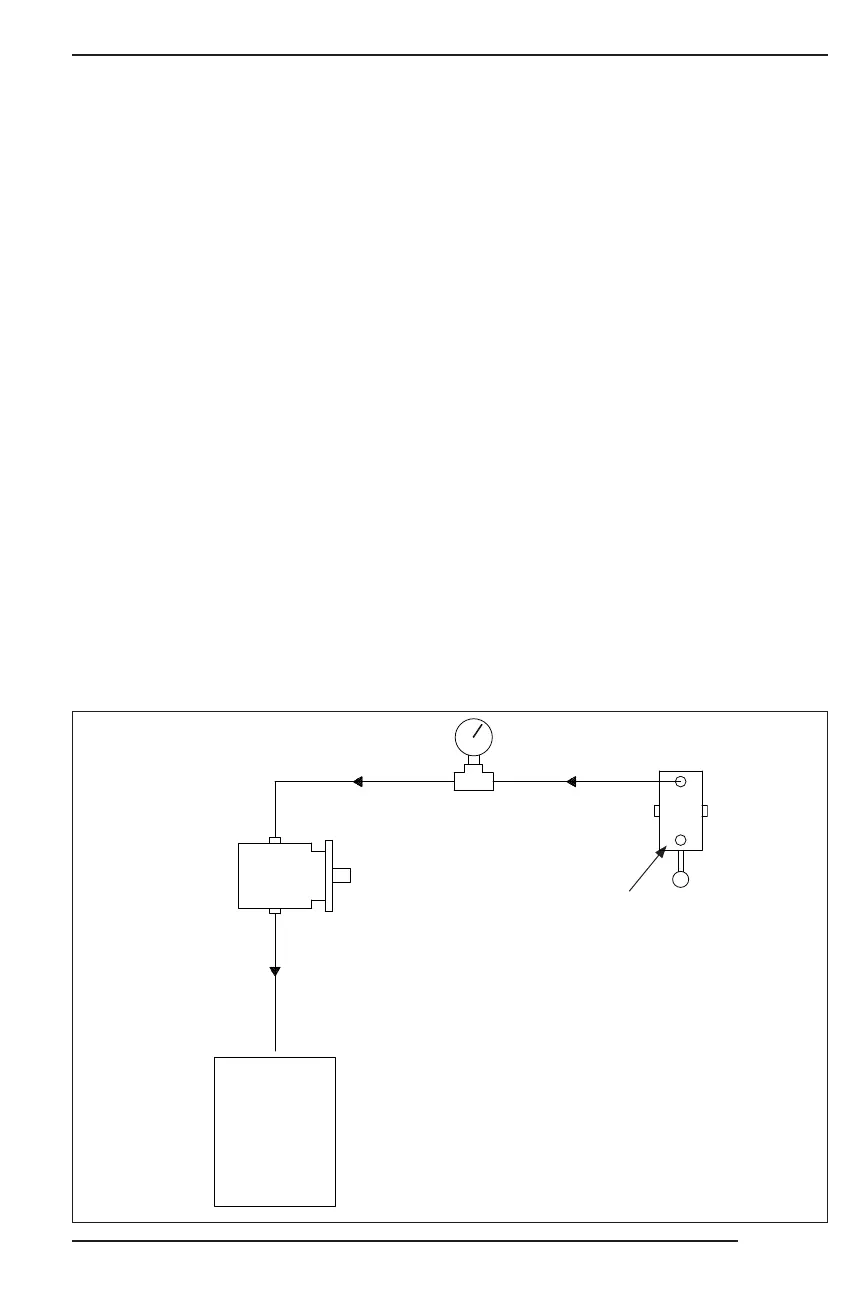
Hydraulic
Motor
Flow
Direction
Tee
Fitting
Flow
Direction
Control
Valve
Gauge
Clean
5 Gallon
Pail
Plugged
Port
0
0
0
0
0
0
0
0
0
0
0
4.
Place the end of the hose in a clean 5 gallon
(19L) pail.
5.
Plug the open port of the control valve or main
relief valve.
6.
Unhook the other hose in the control valve and
install a Tee tting into the control valve and
attach the hose to the Tee tting.
7.
Install a pressure gauge in the other port in the
Tee tting to monitor hydraulic pressure.
8.
Put the infeed control valve in the center
position and start the engine.
9. Increase the engine speed slowly to full rpm.
10.
Operate the infeed control valve to feed the log
into the stationary disc/drum. If the feedwheel(s)
try to turn, apply down pressure by using the
yoke control valve (if equipped).
11.
Providing the pump and the relief are functioning
properly, the pressure gauge should read the
speci ed main relief setting.
12.
Observe the amount of hydraulic uid coming
from the hose into the pail. If the amount of
leakage in the pail is 1 gpm. (3.8 Lpm) or less
the motor is good. If the amount of leakage in
the pail is over
1 gpm (3.8 Lpm) the motor needs to be
replaced.



 To Next Page