ENGLISH
1110
Operating Instructions
Familiarization
Searching
TrackerSoperatesusingthe457kHzinternationalstandardfrequency.
It is fully compatible with all avalanche transceivers adhering to
thisstandard.Donotusewith457kHztransceiversdesignedfor
firefighter rescue.
When searching, keep Tracker S at least 20” (50 cm) away from
electrical equipment, including cell phones and video cameras.
Turn all non-essential electrical equipment o if possible.
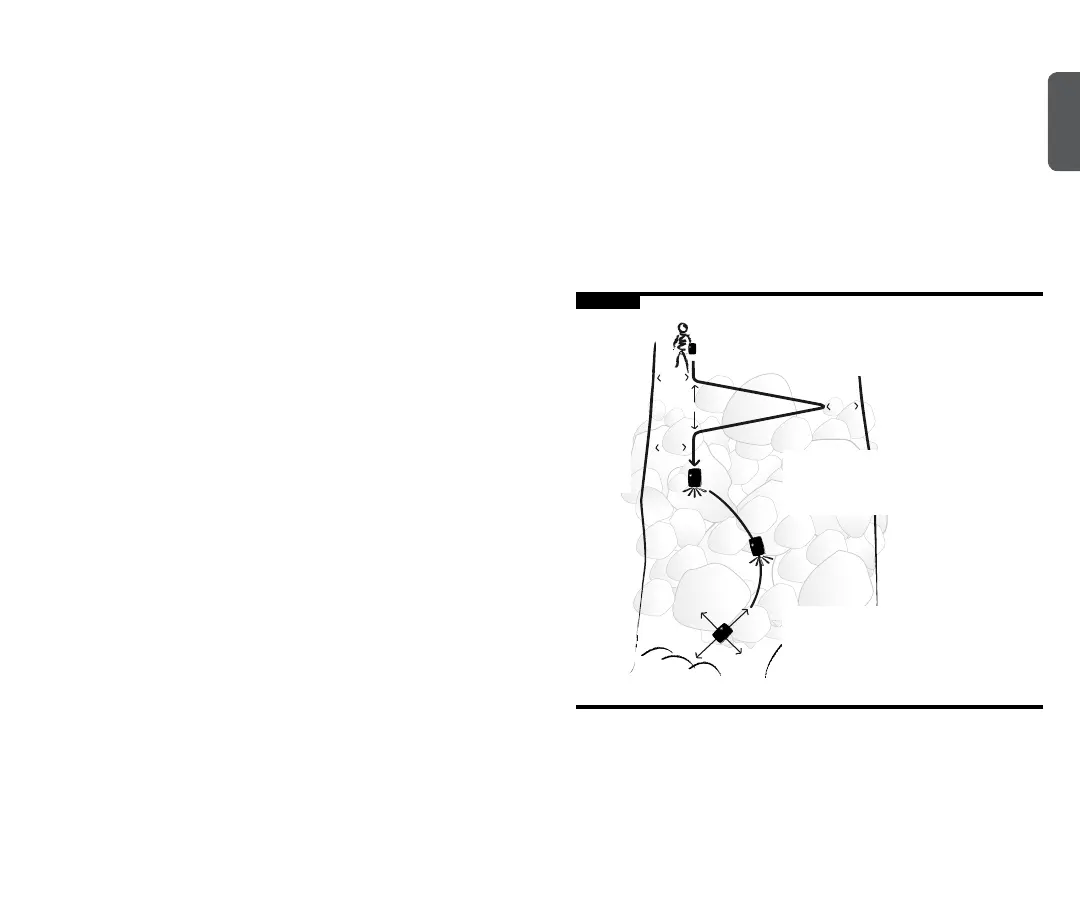
Thesearchprocessincludesfourphases:thesignalsearch,thecoarse
search,thenesearch,andthepinpointing/probingphase(SeeFigureE).
Figure E
20 m
20 m
20 m
avalanche path
40m
Objective: Locate signal
•Ifno"lastseenarea,"searchentirepath
•RotateTrackerbackandforthhorizontally
•Max40mbetweensearchersorswitchbacks
Objective: Locate smallest distance reading
(strongest signal)
•UseTrackerSclosetosnowsurface
•Confirmlowestdistancereadingby“bracketing”
•Beginprobingatlowestdistance
Objective: Move quickly to 10 m, slowly to 3 m
•Followgeneraldirectionofcenter3lights
•Makesuredistancereadingsaredecreasing
•Slowdownat10m
SIGNAL
SEARCH
> 40 m
FINE
SEARCH
< 3 m
COARSE
SEARCH
3–40 m
Signal Search: The signal search refers to the process of establishing a
searchpatternandlookingforasignal.Thesearchpatternwillbedened
by the victim’s last seen area, the size of the slide, and the number of
searchers.RefertoFigureFtoestablishasignalsearchpattern.Iftheslide
islessthan40meterswide,thesignalsearchpathwillbedirectlyupor
downthecenter.Ifthevictim’slastseenareaiswelldened,thesignal
searchwillfollowadirectpathalongthefallline(upordown)fromthispoint.
Distance/directional display should be against your body and transmit light
shouldbeexposedandvisible.
To search, remove Tracker S from its pouch, but keep the harness on and
lanyard attached. If using without a harness, keep Tracker S in a secure
pocket, preferably in your pants or other garment that won’t be removed
while traveling in the backcountry. Attach the lanyard clip to a belt or
othersolidxture.Ifthelanyardisremovedfromharnessorclothingfor
searching, keep it attached to your wrist with the loop provided.
Power Supply
Tracker S operates with three AAA alkaline batteries. Use only high-quality
alkaline batteries of identical age and brand. Do not use rechargeable,
lithium,Oxyride,PowerPixoranyothernon-alkalinebattery.Replacewith
fresh batteries at the beginning of every season.
IfTrackerSisexposedtoexcessivemoisture,openthebatterydoor
m
to help allow the unit to dry. To prevent corrosion of contacts, remove
batteriesduringextendedperiodsofinactivity.Themanufacturerdoesnot
warranty damage caused by battery corrosion.
Trailhead Test
Alwaysperformatrailhead(or“group”)functiontestatthestartofevery
trip. Make sure that your search and transmit functions work, the display is
readable, and the batteries have adequate charge. In addition, a range test
should be performed if there are any changes within the group.
Range Test
If your group has new members, new transceivers, or there is any reason to
suspect there is a transceiver with compromised performance, start your trip with
a range test in addition to the trailhead function test. Do not proceed to avalanche
terrainiftherangebetweenanytwotransceiversislessthan20meters.
For details on how to perform function and range tests, please see
www.backcountryaccess.com/education.


 To Next Page