ENGLISH
1514
Operating InstructionsOperating Instructions
Fine Search:Thene
searchisthenalpartof
the transceiver search,
which is performed on
foot with the transceiver
positioned at or near
the snow surface. The
objectiveofthene
search is to locate where
the signal is strongest
(distance reading is
lowest)andtoreduce
the area to be probed.
Move Tracker S slowly
in a straight line along
the surface of the snow
duringthenalthree
metersofthenesearch.
The directional lights do
notilluminateinthenal
two meters, so only pay
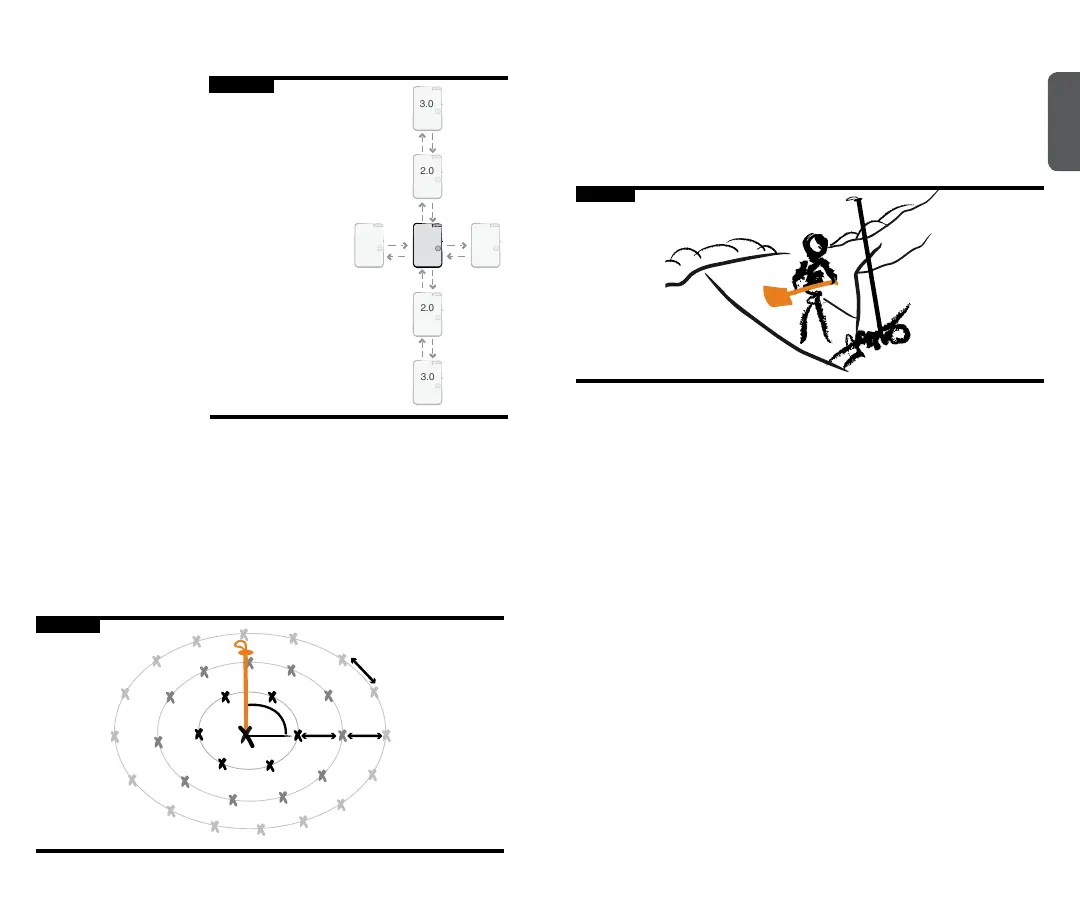
attention to the distance readings. From the point where you have located
thesmallestreading,“bracket”at90-degreeanglestotheleftandthento
therightinsearchofalowerreading(FigureH).Repeatifnecessaryalong
bothaxes.Beginprobingatthelowestdistancereading.
Pinpointing/Probing
At your lowest distance reading, probe in concentric circles, with each
probeholeabout10inches(25cm)apart(FigureI).Yourprobeshould
enterthesnowperpendiculartotheslope.Onceyouhaveconrmedthe
victim’s location, leave the probe in the snow.
90°
10” 10”
25 cm 25 cm
10”
25 cm
Figure I
Shoveling
Shovelingisdicultandconsumesthemajorityoftimeduringanavalanche
rescue.Forbestresults,startshovelingjustdownhilloftheprobe(FigureJ).
Makesureyourholeisatleastone“wingspan”wide.Inburialsdeeperthan
one meter, other shovelers should help move snow out the downhill side of
the hole.
Figure J
Multiple Burials
When more than one transmitting victim is within the receiving range
of Tracker S, the multiple burial icon
q
will illuminate and stay solid.
(Note:thisiconcanoccasionallyilluminateirregularlyinthepresence
ofelectromagneticnoiseorwhendetectingolderanalogtransceivers).
If there are more than two transmitting victims within range, then the
“+”iconwillilluminate.
If the multiple burial icon is illuminated and/or Tracker S displays more
than one distance and direction, then there are probably several victims
within range. Stay in search mode and focus on the closest distance
reading, attempting to engage that signal in the center search light.
Onceyouaresignicantlyclosertoonesignalthantheother,TrackerS
will“lock”ontothatsignalandmaskouttheothers.Oncethissignal
is isolated, Tracker S will behave very similar to how it does in a single
transceiversearch.Onceyouhavelocatedandexcavatedtherstvictim,
turnhisorhertransceiveroifyoudeterminetheconditionsaresafe.
Ifyouhaveaclearsignal,thenbeginsearchingforthenextvictim.
Ifitisnotpossibletoturnotherstvictim’stransceiver—andyouhave
enough people to begin shoveling—then we recommend isolating the
nextsignalusingSignalSuppression.
3.0
2.0
1.0
2.0
3.0
1.6
1.6
Bracketing:Makesure
you go well past the
lowreadingtoconrm
it is the lowest. When
bracketing, ignore the
directional lights, which
no longer illuminate at
less than two meters.
Do not rotate the
transceiver during
this process, as it can
change the distance
readings.
Figure H


 To Next Page