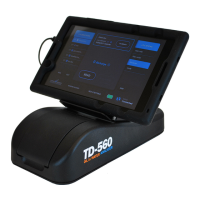
General Considerations for Analysis TD-550/560 Oil in Water Analyzer
14 TD-550/560 Oil in Water Analyzer
Operation Manual
PN 106737
REV H
3.2 GENERAL INFORMATION AND PRECAUTIONS
• The sample well is tted with a cuvette adapter that accepts either 8 mm round cuvettes or 10 mm
square cuvettes. See Section 2.3 Cuvette Selection Guidelines.
• Do not change the cuvette type once the calibration has been performed. If measurements are
made with the wrong cuvette type relative to the cuvette used during the calibration, incorrect
measurements will result.
• Make sure to complete the calibration with both the blank and calibration solution within the ve
minute timeout period, otherwise the calibration may not be properly recorded. The timeout period
may be extended in the tablet settings if desired.
• Take care not to spill samples into the sample well. If a sample is spilled into the well, do not move
or turn over the analyzer. Rather, use laboratory tissues to absorb the excess solvent. Clean around
the optical surface with 99% or greater purity isopropyl alcohol and laboratory tissues. Do not
attempt to disassemble the analyzer as this will cause incorrect measurements.
• Do not allow any liquids to spill around the analyzer as they can cause damage to the analyzer. The
analyzer is not waterproof.
• The TD-550/560 is very sensitive and even small amounts of material from a previous sample
may result in errors. Use a clean cuvette for each reading. Wipe the outside of the cuvette with a
Kimwipe or similar laboratory tissue. Do not use paper towels or kitchen wipes because the optical
brighteners in the paper may cause a false reading. Do not touch the optical surfaces where the
cuvette adapter is located. If the optical surface has deposits, clean with 99% or greater purity
isopropyl alcohol and laboratory tissues. Particles can be cleaned from the surface with optical grade
canned gas dispensers.
• Fill the round or square cuvettes at least 75% full; signicant error will result if the cuvette is not
properly lled.
• The cuvette must be clean and dry on the outside when taking readings. Moisture and condensation
or ngerprints on the outside can result in error. Use laboratory grade tissues or wipes for wiping the
cuvettes.
• Avoid air bubbles in the cuvette. Bubbles in samples may cause drifting of the reading. Slight tapping
on the outside cuvette wall should help remove any bubbles.
• Avoid getting water droplets and dissolved residue from water on the inside of the cuvette. These will
interfere with the measurement.
• If using the 10 mm square cuvette, be sure to install in the cuvette adapter with the mark on the
cuvette facing forward.
• Avoid transferring emulsions to the cuvette since bubbles of water in the extract will cause incorrect
measurements.
• Always make sure to analyze the samples on the calibrated channel only (TD-560). Using a different
channel for sample analysis will give incorrect readings.
• If using the fastHEX
TM
method, use the same solvent that was used for the calibration. Using a
different solvent will result in incorrect measurements.
• If analyzing an unknown sample, always check for linearity of the sample extract as discussed in
Section 6 Troubleshooting.
• If measuring samples with measured concentrations near zero, see Section 6.3 Measurement Of
Samples Close To Zero.
• The measurements with both the square cuvette adapter and round cuvette adapter will be slightly
sensitive to the cuvette adapter position. Make sure to install the cuvette adapter in a consistent
position. We do not recommend changing the cuvette adapter position unless needed.


 To Next Page