28
2.9 ENGINE COMMUNICATIONS
(J1939) TEST PROCEDURE
NOTE: Remove all non-factory-equipped components
– such as Electronic Drivers' Logs (EDLs), GPS, and
telematic systems – prior to testing communications.
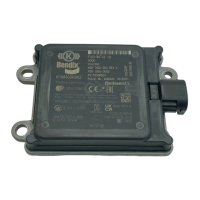
The Bendix
®
Fusion
™
FLR-25
™
Radar Sensor requires
several J1939 messages from the engine Electronic Control
Unit (ECU) to control the engine and retarder torque for
distance control and braking. The Fusion system will set a
Diagnostic Trouble Code (DTC) if one of these messages
is not present.
Use the engine manufacturer’s diagnostic test procedures
to verify that there are no errors present in the engine that
may prevent the Fusion system from controlling the engine
or retarder torque.
2.10 J1939 TROUBLESHOOTING
PROCEDURE
1. Take all measurements at the harness connector unless
otherwise indicated.
Do not insert probes into the back of the connector as
this will damage the seal around the wire.
Do not insert any probe into the pin on the mating
connector of the radar sensor that is greater than
the dimension of the mating connector. Damaged
connector pins will require the replacement of the
harness.
2. Check for damaged or reversed J1939 wiring.
If the J1939 HIGH or J1939 LOW wiring circuits are
damaged, such as shorting together, the entire J1939
link will be lost. The problem may be intermittent,
enabling the J1939 link to sometimes operate normally.
If this occurs, multiple DTCs will be logged in multiple
engine and vehicle controllers.
If the J1939 HIGH and J1939 LOW wiring circuits are
reversed, communication over the entire J1939 link will
not be lost. Only those devices that are outside of the
problem point from other devices will not receive, or be
able to transmit, data messages.
3. Check for corroded or damaged wiring connector
problems such as opens or shorts to voltage or ground.
If the connector terminals are corroded, this may be
an indication of water intrusion into the wiring system
and possibly into the radar sensor. Replacement of the
entire harness is recommended. If the terminals of the
radar sensor are corroded, replacement of the radar
sensor is recommended.
4. Check for other J1939 devices which may be inhibiting
J1939 communication. The service technician should
consult the vehicle manufacturer’s procedures for
other J1939 troubleshooting procedures. The device’s
power should be removed and measurements made at
the ECU pins for shorts to ground and power pins and
resistance between the J1939 HIGH or J1939 LOW
input circuits.
5. Unplugtheradarsensor.Withtheignitionswitcho,
measure the resistance (ohms) using a multimeter
between harness pins 4 and 7. The reading should be
approximately 60 ohms. If it is not, the vehicle wiring
should be investigated using procedures described by
the manufacturer.
2.11 TROUBLESHOOTING
WIRING HARNESSES
All wire harness connectors must be properly seated to
maintain environmental seals. Push the mating connector
until it seals with a click. When replacing an FLR-25 radar
sensor, check that the wire harness connector is free of
corrosion before plugging it into a new radar sensor. Check
for corroded or damaged wiring connector problems such
as opens or shorts to voltage or ground.
If the connector terminals are corroded, this may be an
indication of water intrusion into the wiring system and
possibly into the radar sensor. Replacement of the entire
harness is recommended. If the terminals of the radar
sensor are corroded, replacement of the radar sensor is
recommended


 To Next Page