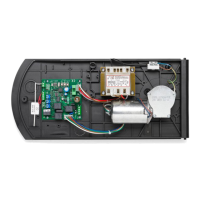
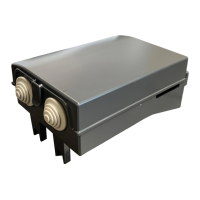
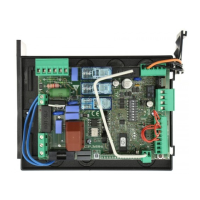
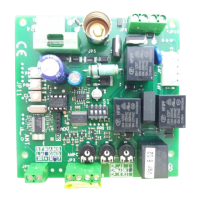
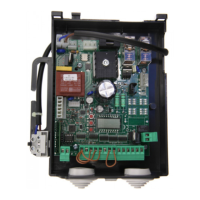
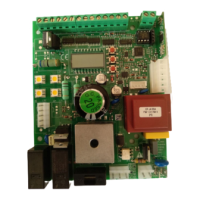
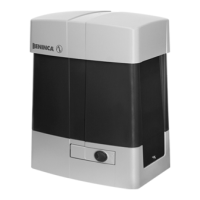
The Benincà CP.ZED230-E is a control unit designed for automating gates, doors, and similar systems, compatible with ZED series gear motors. It supports both 230 Vac and 115 Vac power supplies (50/60 Hz) and can manage up to two 230 Vac motors with a maximum power of 300+300 W. The unit provides a 24 Vac, 1A max output for accessories and has an IP54 protection level, making it suitable for various environmental conditions. Its operating temperature range is -20°C to +70°C.
Function Description
The CP.ZED230-E offers comprehensive control over gate operations, including opening, closing, and safety features. It integrates a built-in 433.92 MHz radio receiver that supports up to 64 rolling-code transmitters, allowing for secure remote control.
Key inputs and outputs include:
- Power Supply (1-2): 230VAC 50Hz (1-Phase/2-Neutral) for the control unit.
- Flashing Light (3-4): Connection for a 230Vac 40W max flashing light.
- Motor Light (4-5): Connection for a courtesy light (230Vac 40+40W max).
- Motor 1/2 (6-7-8): Connections for one or two motors. If two motors are used, the second motor is connected in parallel.
- COM (9): Common for limit switches and all control inputs.
- Limit Switches (10-11): Inputs for OPEN (SWO) and CLOSE (SWC) limit switches (N.C. contact).
- STOP (12): Input for a STOP push button (N.C. contact).
- PHOT (13): Input for safety devices like photocells (N.C. contact).
- Push Buttons (14-16): Inputs for OPEN (N.O.), CLOSE (N.O.), and Step-by-Step (N.O.) push buttons.
- Accessories Power (17-18): 24 Vac, 1A max output for accessories.
- AUX (19-20): Normally Open (N.O.) contact, not powered, configurable as SCA (open gate indicator light), second radio channel, PHOT TEST, or flashing light.
- Safety Edge (21-22): Input for safety edge contacts, configurable for resistive (Closed "DAS" jumper) or mechanical (Open "DAS" jumper) edges. If activated during opening, the gate stops. If activated during closing, the gate stops and reverses movement for 3 seconds.
- Aerial (23-24): Connection for the radio receiver card aerial.
- Capacitor (CM-CM): Connected to the motor capacitor.
- Radio Receiver (J3): Built-in radio receiver.
The unit supports various operating modes and logics:
- Automatic Closure (EcA): Enables or disables automatic gate closure after a preset time (1-240 seconds, default 40s).
- Motor Operating Time (ΕΠ): Adjusts the total stroke time for motor opening and closing (2-180 seconds, default 60s). With encoder enabled, this is automatically set by self-adjustment.
- Braking (ESN): Adjusts the braking space during closing (0-99%, default 10%). Braking in opening is automatically preset. Can be disabled (0). For non-encoder motors, this value is in seconds.
- Motor Torque (РПо, РПс, P50, P5c): Adjusts torque during opening, closing, and braking phases. Incorrect settings can be dangerous.
- Service Light (ELS): Adjusts activation time (0-240 seconds, default 60s). Can be set to activate when the motor is moving and during TCA dwell time.
- Anti-Crash Device (SERU, SEA): Sets sensitivity thresholds for the encoder-based anti-crash device during normal speed and braking phases (0-99%, 99=max sensitivity, 0=min sensitivity).
- Auxiliary Output (AUH): Configures the function of terminals 19/20 (SCA, radio channel II, PHOT TEST, flashing light, additional service light).
- Multi-Flat Function (16L): Disables the effect of step-by-step impulses or transmitter impulses during the opening phase.
- Push Button Operation (PP): Selects operating mode for push buttons and transmitters (OPEN > CLOSE > OPEN or OPEN > STOP > CLOSE > STOP).
- Forewarning Flashing Light (PrE): Activates the flashing light 3 seconds before motor start.
- Lock Function (bLc): Enables or disables the lock function in the closing phase.
- Blinker during TCA (LECA): Activates or deactivates a blinker during the automatic closure time.
- Pick-up Function (SP): Enables or disables a pick-up function where the first two seconds of operation are at maximum torque (for non-encoder motors). Automatically adjusted with encoder.
- Operator Function (Her): Requires OPEN/CLOSE push-buttons to be kept pressed during operation for manual control.
- Controls during TCA (16cA): Enables or disables PP and PED controls during the automatic closure phase.
- Encoder (Enc): Enables or disables the encoder. If disabled, the unit can be used with ZED series motors without built-in encoders. A new self-calibration procedure is required if reset.
- Transmitter Code (cuar): Configures the radio receiver for rolling-code only or rolling-code and programmable code transmitters.
- Photocell Operating Mode (Phto): Selects how the PHOT input operates in opening and closing phases (stop, reverse movement).
- Remote Storage (ГЕП): Enables or disables remote storage of radio transmitter codes.
Usage Features
The CP.ZED230-E features an LCD display for programming and diagnostics, making it user-friendly for qualified fitters. Programming is done via a menu system using ↑, ↓, and PG keys to navigate and set parameters.
- Self-Learning Procedure: The unit can perform a self-test and self-learning procedure to automatically determine stroke length and braking phases, especially when an encoder is enabled. This involves manually positioning the gate, then initiating the AUTO menu.
- Encoder Management: When the encoder is enabled (ENC=ON), the anti-crash sensor is active, and sensitivity is adjusted via SEAV and SEAR parameters. The unit automatically manages braking phases, and stroke length is stored in memory. If the BLOC logic is ON, the stop is delayed after the limit switch is triggered. When the encoder is disabled (ENC=OFF), the anti-crash sensor is deactivated, and braking duration is preset via the TSM parameter.
- Remote Learning: New transmitter codes can be stored remotely without accessing the control unit, provided an existing code is already stored. This is typically done during the gate's opening phase within the TCA dwell time.
- Protection Code: An optional four-character alphanumeric code can be set to restrict access to the programming menus, enhancing security.
- Cycle Counter: The unit displays the total number of complete open+close cycles performed by the automation.
Maintenance Features
The control unit includes features to assist with maintenance and diagnostics:
- Maintenance Cycles (MAC 1): Allows setting a number of manoeuvres after which a maintenance request notice will be activated. This is indicated by the indicator lamp lighting up for 10 seconds after an operation and by the flashing of courtesy light LEDs during opening and closing.
- Diagnostics: The display segments are linked to each input, switching on to indicate a failure. This provides a visual aid for troubleshooting.
- Error Messages: The unit displays specific error messages (Err, Err1, Err2, Err3) to indicate issues such as self-learning stroke errors, activation of inputs by the user, failed circuit integrity checks, photocell errors, or a broken encoder.
- Reset Function (rES): Allows resetting the control unit to its default values. Transmitters and access passwords are not erased during a reset.
Important Notes for Installation and Maintenance:
- Installation, maintenance, and repair should only be performed by qualified fitters.
- Always interrupt the power supply before accessing electrical parts.
- Ensure leads with different voltages are physically separate or adequately insulated.
- Secure leads near terminals.
- Bridge unused N.C. inputs.
- Verify the electrical system has a differential interrupter and overcurrent protection.
- Some installations may require connecting the shutter to ground.
- The manufacturer reserves the right to make technical, constructive, or commercial changes without updating the publication, provided essential characteristics remain unchanged.
- In case of a lost protection code, contact an authorised service center for a total reset.
- The product must be disposed of according to regulations for differentiated waste disposal and recycling of components.

 Need help?
 General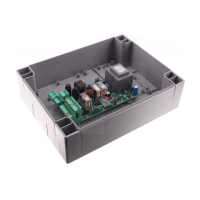

 To Next Page