01/ 2019
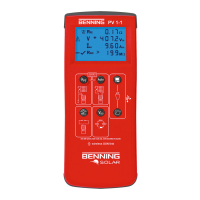
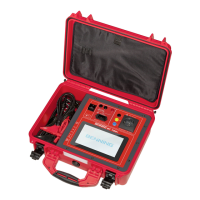
BENNING PV 3
12
Operating instructions
BENNING PV 3
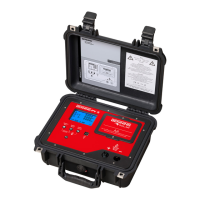
Battery-operated photovoltaic tester for installation testing and periodic inspection of mainscoupled 1500 V
photovoltaic systems. The following tests according to VDE 0126-23 (DIN EN 62446) can be carried out on
PV strings connected in parallel (max. 40 A):
- automatic display of the voltage polarity with visual warning in case of wrong polarity
- open-circuit voltage measurement at the PV module/ PV string/ PV field with up to 1500 V DC
- short-circuit current measurement at the PV module/ PV string/ PV field with up to 40 A DC
- measurement of the insolation, PV module temperature and ambient temperature by means of the
optional insolation and temperature measuring instrument BENNING SUN 2
Table of contents
1. User notes
2. Safety notes
3. Scope of delivery
4. Unit description
5. General information
6. Environment conditions
7. Electrical specifications
7.1 PV module/ PV string/ PV field, open-circuit voltage (Vo/c)
7.2 PV module/ PV string/ PV field, short-circuit current (Is/c)
8. Measuring with the BENNING PV 3
8.1 Preparation for measuring
8.1.1 Charging the rechargeable batteries
8.1.1 Switching the BENNING PV 3 ON/ OFF
8.1.2 Setting the automatic switch-off time (APO, Auto-Power Off)
8.1.4 Setting the date and the time
8.1.5 Testing the battery condition
8.2 Measurement of open-circuit voltage and short-circuit current of the PV generator
8.3 Measured value memory
8.3.1 Storing measured values
8.3.2 Calling measured values
8.3.3 Deleting the measured value memory
8.3.4 Reading out the measured value memory via the USB interface
8.4 Radio connection to insolation / temperature measuring instrument BENNING SUN 2
8.4.1 Coupling with BENNING SUN 2
8.4.2 Decoupling from the BENNING SUN 2
8.4.3 Activating / deactivating the radio transmission of the BENNING SUN 2
9. Maintenance
9.1 Error codes
9.2 Securing the instrument
9.3 Cleaning
9.4 Battery replacement
9.5 Calibration
9.6 Spare parts
10. Environmental notice
1. User notes
This operating manual is intended for qualified technical personnel! Qualified techni-
cal personnel is competent to identify risks and to prevent possible hazards. Improper
handling involves the risk of injury! Always wear personal protective equipment (PPE)
when carrying out the test.


 To Next Page