724-746-5500 | blackbox.com
Page 25
Chapter 5: Making Network Connections
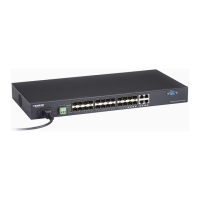
Figure 5-2. Network Wiring Connections.
5.3 Fiber Optic SFP Devices
An optional Gigabit SFP transceiver can be used for a backbone connection between switches, or for connecting to a high-speed
server.
Each single-mode fiber port requires 9/125 micron single-mode fiber optic cable with an LC connector at both ends. Each
multimode fiber optic port requires 50/125 or 62.5/125 micron multimode fiber optic cabling with an LC connector at both ends.
WARNING: This switch uses lasers to transmit signals over fiber optic cable. The lasers are inherently eye safe in normal operation.
However, users should never look directly at a transmit port when it is powered on.
WARNING: When selecting a fiber SFP device, consider safety. Make sure that it can function at a temperature that is not less
than the recommended maximum operating temperature of the product. You must also use an approved Laser SFP
transceiver.
Step 1: Remove and keep the LC port’s rubber plug. When not connected to a fiber cable, replace the rubber plug to protect the
optics.
Step 2: Check that the fiber terminators are clean. You can clean the cable plugs by wiping them gently with a clean tissue or
cotton ball moistened with a little ethanol. Dirty fiber terminators on fiber optic cables will impair the quality of the light
transmitted through the cable and lead to degraded performance on the port.
Step 3: Connect one end of the cable to the LC port on the switch and the other end to the LC port on the other device. Since
LC connectors are keyed, the cable can be attached in only one orientation.



 To Next Page
 Loading...