46
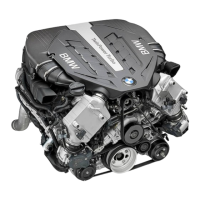
N55 Engine
Valvetronic III
The main differences between Valvetronic III and Valvetronic II are in the arrangement of
the Valvetronic servomotor and the Valvetronic sensor. As in Valvetronic II, the turbulence
level is increased at the end of the compression cycle for the purpose of optimizing the
mixture formation with the use of phasing and masking measures. This movement of the
cylinder charge improves the combustion during partial load operation and in catalytic
converter heating mode. The quench areas also contribute to mixture formation.
Phasing
Phasing results in a lift difference between both intake valves of up to 1.8 mm in the
lower partial load range. Consequently, the flow of fresh air is distributed asymmetrically.
Masking
Masking refers to the design of the valve seats. This machining ensures that the incoming
fresh air is aligned in such a way as to give rise to the required cylinder charge movement.
The advantage of this measure is that the combustion retardation is reduced by approxi-
mately 10° of crankshaft rotation. The combustion process takes place faster and a larger
valve overlap can be achieved, thus considerably reducing NOx emissions.


 To Next Page