Backpod
®
for straight or concave thoracic spines
The common problem with middle/upper thoracic
spines is excessive kyphosis from too much bent-
forward activity. This leads on to most neck problems
as the cervical spine is cranked into excessive
extension and joint loading to simply hold the head up,
and the upper trapezius muscles which do most of the
work strain, scar and shorten.
However, a minority of patients (perhaps 5%) have
straight or even concave sections of the thoracic spine
where the segments are locked in extension. This is
usually the result of a fall on the back or other impact,
or an excessively rigid upright posture. These type of
thoracic spines are readily identified simply by looking
at the patient from behind.
In my experience, the standard physiotherapy
mobilisation technique of oscillating downward
pressure on the spinous processes with the patient
lying prone (Maitland PAs) will tend to make this
sub-group worse, as it increases the extension glide of
facets already excessively extended (i.e., it increases
the concavity). On the same principle, repeated
manipulation similarly tends not to clear the problem.
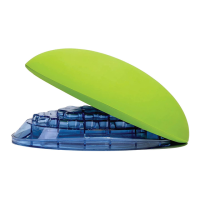
The Backpod
®
answer to this subgroup is simple
and logical. Lay the patient prone with the Backpod
®
longitudinally under their sternum – you may need
to cover it with a folded towel for extra padding. This
creates a flexion stretch at the extended thoracic
joints. Then glide the spinous processes longitudinally
apart using thumbs, fingers and/or hypothenar
eminences. This direction of mobilisation glides the
facets in a flexion direction, taking them out of their
locked end-range extension.
Oscillatory pressure is best initially to get the facets
moving, followed by sustained pressure to stretch the
shortened capsules and ligaments. It is a technique
that can generally be taught to the spouses, partners,
friends, etc. of patients for follow-up at home.
Note that these patients with straight or concave
thoracic spines can still have tight or frozen
costovertebral joints where the ribs hinge onto the
backbone. These patients can use the Backpod in the
normal way to stretch these posterior rib joints, with
the Backpod positioned slightly to either side of the
backbone but not over the spine itself. The positioning
is over the curve of the ribs, about 40-50mm (2
inches) out from the midline, i.e. between the midline
of the spine and the inside edge of the scapula.
17
Health Practitioner pages


 To Next Page