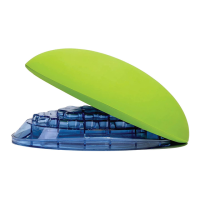
The Backpod
®
can also be used to mobilise a
hypomobile sacroiliac (SI) joint problem such as
can commonly occur after a fall onto the low back
or coccyx. The impact can often leave the sacrum
‘ridden up’ along the SI joints and jammed in flexion
(i.e., nutated). This leaves the tailbone more exposed
to impact/pressure when sitting down and creates a
chronic coccydynia from the repeated banging on the
tip of the coccyx. This type of tailbone pain doesn’t
respond to purely local treatment of the tailbone but
clears when the SI movement is restored to normal.
The extremely tough mix of capsule, ligaments and
fascia around hypomobile SI joints means that good
results from mobilisation and manipulation techniques
are often quite temporary, before the surrounding
shortened collagen tightens them up again.
The Backpod
®
is ideal for a sustained stretch of
this very tough surrounding collagen and a shearing
mobilsation of the joint surfaces. The most basic
manual physiotherapy mobilisation technique for the
SI joints is a Maitland PA, a vertical oscillation of the
sacrum by the therapist while the patient lies prone.
The Backpod
®
essentially produces a sustained
version of this, using the patient’s own lower body
weight to provide the force. The patient lies on their
back on the floor, thighs vertical, shins horizontal,
ankles crossed and heel supported on the edge of a
table or chair. The Backpod
®
is positioned under the
sacrum longitudinally and the patient relaxes onto it
for at least several minutes, once or twice daily. It can
still take weeks before the SI joint movement is free
enough to stay free.
The Backpod
®
leverage on hypomobile SI joints can
be enough to free them up on its own, but frequently
they are tight enough to need the greater force of
a manipulation or specific therapist mobilisation
techniques. The Backpod
®
is then the ideal follow-up,
to stretch things further and retain the benefits of the
treatments.
Clinical Caution: The Backpod
®
should be used to
mobilise only restricted hypomobile sacroiliac joints.
Stretching already excessively moving hypermobile
SI joint problems will make them worse. The best
way to clinically distinguish between the two is Andry
Vleeming’s test for SI hypermobility. Briefly, the patient
lies on their back and actively lifts one straight leg
as high as they can. This is then repeated with the
therapist manually pushing both sides of the patient’s
pelvis together (i.e., artificially compressing and
stabilising the SI joints). If the leg raise is then clearly
higher and without pain, it indicates an unstable,
hypermobile sacroiliac joint. This should not be
Backpod
®
for sacroiliac joint mobilisations, and coccydynia (tailbone pain)
25
Health Practitioner pages


 To Next Page